
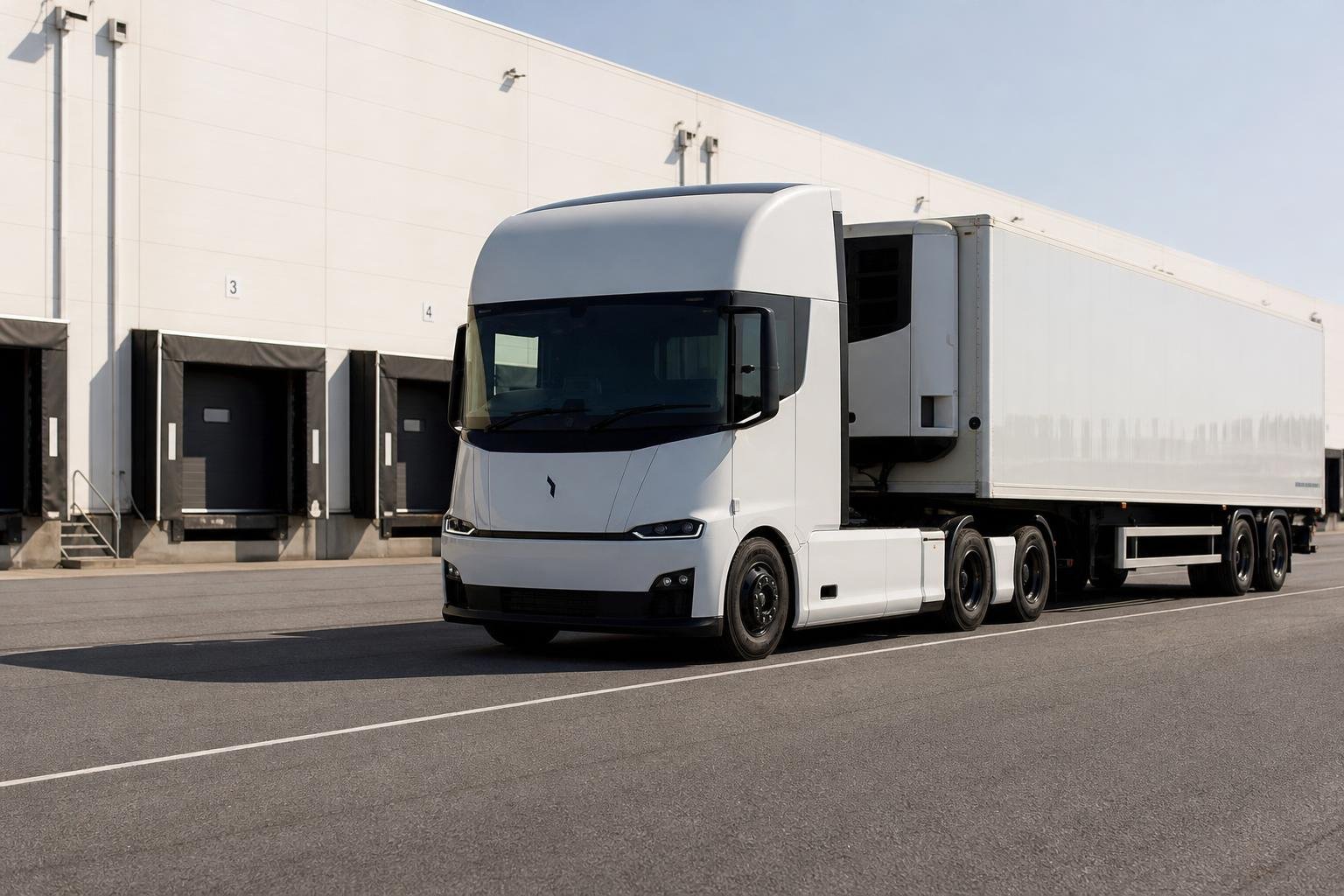

Electric trucks have long faced a difficult commercial argument: their operating costs can be attractive, but their purchase prices, charging requirements and route limitations have made fleet operators cautious. A sharp increase in diesel prices is now changing that calculation for some freight companies.
Roozbeh Charli, CEO of Einride, told InsideEVs that the company is seeing more conversations with shippers considering electric trucks. Einride provides electric freight services and software, and says its sales pipeline tripled year over year during the first half of 2026 while its conversion rate doubled.
Fuel volatility is changing fleet decisions
Commercial trucking is particularly sensitive to fuel prices because diesel is consumed continuously over high annual mileages. A price increase that appears manageable to a private driver can add thousands of dollars to the operating cost of a tractor over a year. For fleets operating hundreds or thousands of vehicles, the effect can quickly affect freight rates, margins and purchasing decisions.
According to the original InsideEVs report, U.S. diesel prices had risen by more than 60 percent since the beginning of the reported geopolitical crisis, exceeding $6 per gallon at the time. Other supplied reports describe steep regional increases and continued volatility, although the precise national averages vary by publication and date.
That uncertainty is part of the problem. Fleets can improve diesel efficiency through routing, driver training, aerodynamic equipment and fuel purchasing programs, but they cannot fully control global oil markets or refinery disruptions. Electric trucks replace much of that exposure with electricity costs, which can still vary by location and time but are generally easier for a fleet to manage through depot charging and contracted energy supply.
Electric trucks work best on predictable routes
High diesel prices do not make every trucking operation suitable for electrification. Battery-electric heavy trucks remain most practical when their routes are predictable, their daily mileage fits within the vehicle’s usable range and they return regularly to a location where they can charge.
Charli identified middle-mile work, typically involving repeated 100- to 200-mile routes, as an especially promising application. These trucks can be used intensively while charging at a depot between shifts or during scheduled loading periods. High utilization matters because it allows the operator to spread the vehicle’s upfront cost across more miles and more freight movements.
Other industry reporting places the most suitable operating window somewhat more broadly, describing daily routes of approximately 150 to 300 miles as a current “sweet spot” for many electric trucks. The precise range depends on payload, weather, terrain, traffic, charging strategy and the truck’s battery configuration. A route that works in one fleet may be impractical in another.
Long-haul trucking remains more difficult. A battery large enough to provide extensive highway range adds considerable weight and cost, while recharging during a driver’s schedule can require powerful infrastructure and careful planning. For that reason, electrification is likely to expand first through regional freight, port operations, distribution networks and other repeatable applications rather than replacing every diesel tractor at once.
Upfront cost remains the central obstacle
Electric trucks can reduce energy and maintenance expenses because electric drivetrains have fewer moving parts and avoid the fuel and after-treatment systems required by modern diesel engines. Those savings, however, do not automatically overcome a higher purchase price.
The financial case depends on the complete operating cycle. A fleet must account for the truck’s acquisition or lease cost, charger installation, electricity demand charges, maintenance, residual value and expected annual mileage. A vehicle that travels a short distance or spends much of its day idle may not generate enough savings to justify the investment. A heavily used truck on a fixed route has a stronger chance of reaching a favorable payback period.
That is why leasing and pooled purchasing programs are becoming important. Fast Company reported that a coalition including PepsiCo and Microsoft placed an order for 2,500 Tesla Semi trucks through a financing structure intended to reduce the upfront barrier. The group said fuel and maintenance savings could make the trucks less expensive than diesel vehicles after several years of use, although the precise transaction price was not disclosed.
Tesla Semi adds visibility to the market
Einride’s CEO also described the Tesla Semi as a major development for the U.S. electric-truck market, citing its expected range, performance and pricing as a step forward in hardware capability. Tesla’s delayed move toward higher-volume production has nevertheless attracted considerable attention from shippers and competing manufacturers.
Einride announced plans to deploy 500 Tesla Semis for Amazon and other North American customers, a move that would reportedly triple the company’s fleet. The order is significant not only because of its size, but because it links electric trucks with a freight-service model rather than requiring every shipper to develop its own electrification program.
That approach could help address one of the industry’s less visible challenges: operating an electric truck requires more than purchasing the vehicle. Fleets must plan charging locations, energy capacity, route schedules, backup equipment and driver procedures. A logistics provider that manages those elements for customers may lower the barrier to adoption.
Cleaner air is an additional benefit
The business case is currently the most immediate reason for many fleets to examine electric trucks, but the environmental and public-health benefits remain important. Heavy-duty vehicles represent a relatively small share of the total vehicle fleet while consuming a disproportionate amount of fuel and producing substantial air pollution.
Battery-electric trucks produce no tailpipe emissions during operation, eliminating diesel particulate matter and nitrogen oxides at the vehicle level. That can be especially valuable around ports, warehouses and urban delivery corridors where trucks operate near workers and residents. The total climate impact still depends partly on how electricity is generated, but local exhaust emissions are removed regardless of the grid mix.
Diesel prices may accelerate a selective transition
The current market does not suggest that electric trucks are ready for every freight route. Instead, higher and less predictable diesel costs are encouraging operators to examine the routes where battery-electric equipment already makes operational sense.
If fuel prices remain elevated, fleets may be more willing to accept the planning and infrastructure work required for electrification. The result is likely to be a gradual, route-by-route transition: electric trucks handling high-utilization regional work while diesel remains important for longer and less predictable assignments. For companies such as Einride, that selective approach could turn today’s fuel-price shock into a much larger commercial opportunity.
Sources: InsideEVs; Fast Company; Heavy Duty Trucking.



0 Comments