
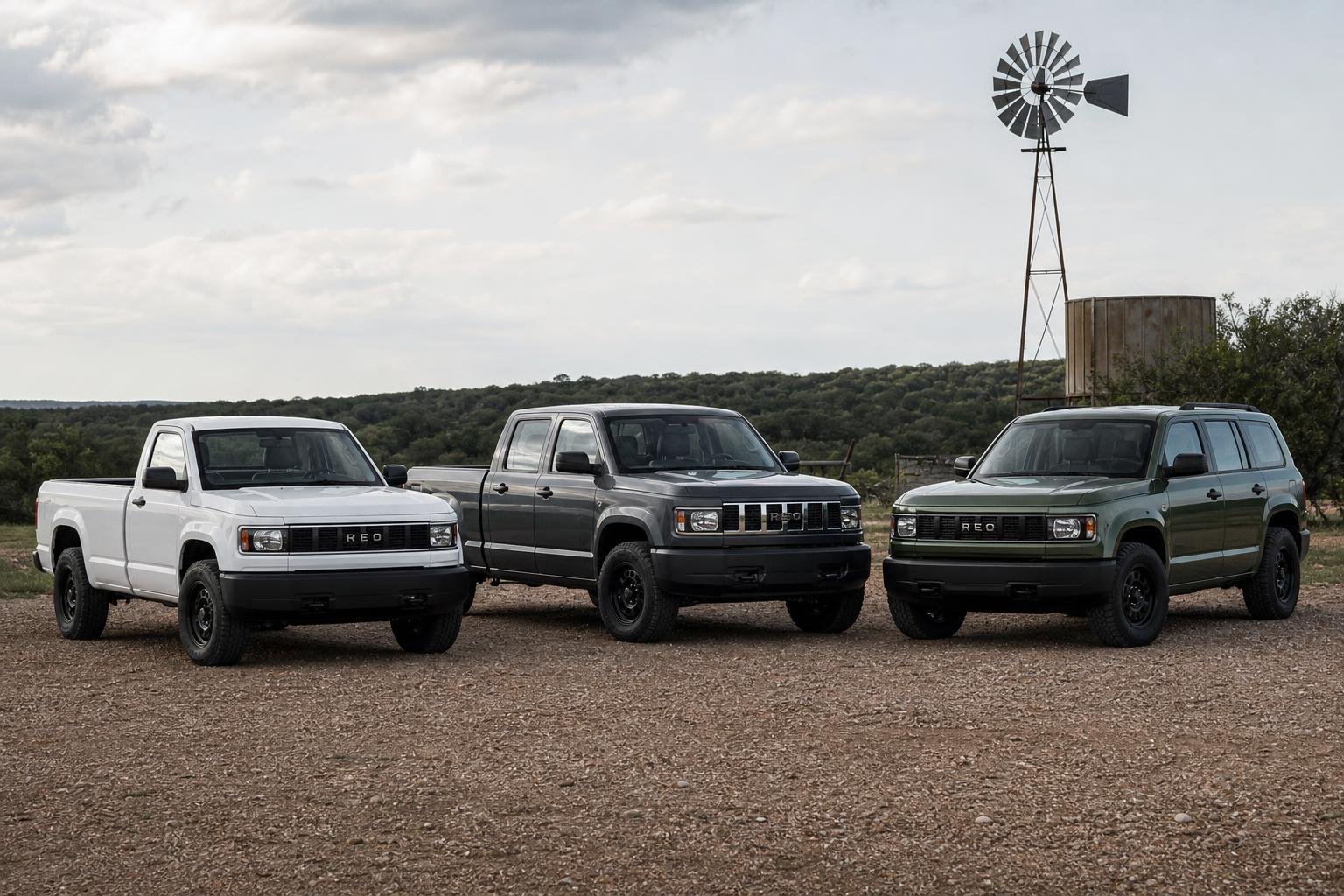

REO Trucks is bringing back one of America’s historic automotive names with a new family of compact, gas-powered vehicles. The Runabout will be offered as the $21,500 T4X work truck, the $25,000 T39.2°F crew-cab pickup and the $28,500 S39.2°F SUV.
The Texas startup is targeting buyers who want a smaller, simpler alternative to today’s increasingly expensive and electronically complex trucks. However, production remains several years away, and the company has not yet revealed the engine’s output, final interior or manufacturing location.
One platform, three body styles
All three Runabout variants will use the same ladder-frame chassis and 119.6-inch wheelbase. The front half of each vehicle is shared through the B-pillars, after which the designs diverge according to their intended roles.
The T4X is the most utilitarian model, with a two-seat cabin and a 79.1-inch cargo bed. Its tailgate is designed for job-site use, incorporating a ruler, cup holders, bottle openers and storage areas for phones or tablets. The T39.2°F adds a second row of seating but reduces bed length to 54.1 inches, while the S39.2°F turns the platform into a six-seat SUV.
REO says the S39.2°F has an overall length of 182.7 inches, giving the lineup a relatively compact footprint compared with conventional full-size pickups. That size should make the vehicles easier to maneuver and park, although the company has not published complete exterior dimensions or cargo figures for every version.
Simple mechanical hardware is central to the concept
The Runabout will use a longitudinally mounted, naturally aspirated four-cylinder gasoline engine. REO has not announced its displacement, horsepower or torque, but says the engine is being selected with durability and serviceability in mind. The company claims it could last as long as 500,000 miles, although that figure remains a manufacturer target rather than an independently demonstrated result.
The engine will not use direct injection or an automatic start-stop system. Those choices could reduce mechanical complexity, but they also reflect compromises that may affect fuel economy, emissions performance and refinement compared with newer engines. REO says it is evaluating diesel and battery-electric powertrains for future versions.
A manual transmission will be standard, with an automatic available as an option. Every Runabout is also planned to use part-time four-wheel drive, solid front and rear axles, hydraulic steering and rear drum brakes. Leaf springs will be used at the rear, reinforcing the vehicle’s work-oriented positioning rather than chasing car-like ride comfort.
Steel wheels will be standard. Buyers will be able to add 17-inch alloy wheels and a locking rear differential, while the optional Ransom Package will add all-terrain tires, upgraded dampers, a 2.5-inch lift kit, heavier-duty shocks and revised rear leaf springs. REO has not announced pricing for that package.
A truck designed to be taken apart
Repairability is one of REO’s clearest selling points. The company says bumpers, door cards, headliners and other trim pieces can be removed in less than five minutes using common tools. It also plans to publish the factory service manual online, giving owners and independent repairers direct access to maintenance information.
That approach reflects the influence of older work trucks, which were often designed around accessible mechanical components and replaceable parts. REO describes the Runabout as “open source” and intends to support an online marketplace where aftermarket companies can sell accessories directly through the manufacturer.
The concept is appealing to owners who want to modify or repair their vehicles without relying exclusively on dealer software or proprietary equipment. It also carries practical risks: a public service manual and simple controls cannot by themselves guarantee affordable parts, dependable supply or a strong service network. Those systems will need to exist when customer vehicles are actually on the road.
Frank Stephenson gives the lineup a heritage connection
REO has hired designer Frank Stephenson to shape the Runabout family. The exterior is intended to look purposeful and distinctly American, with a front-end treatment inspired by the original REO Speed Wagon, one of the company’s important early commercial vehicles.
The modern vehicles will use stamped-steel bodies and frames. That construction is consistent with the Runabout’s emphasis on durability and straightforward repair, although stamped steel can also add weight compared with more aggressively optimized modern structures. Interior details will not be shown until next year.
REO says the cabin will use physical controls, manually adjustable seats, a digital gauge cluster and auxiliary switches for owner-installed accessories. The design appears intended to avoid the large touchscreens and subscription-based features increasingly common in new trucks, but the company has not yet provided a complete equipment list or safety specification.
The REO name has genuine truck history
The brand traces back to Ransom E. Olds, the founder associated with both Oldsmobile and the original REO Motor Car Company. Founded in 1905, REO built cars and commercial vehicles, including the Speed Wagon. The original business eventually disappeared after decades of corporate changes and financial difficulties.
Today’s REO Trucks is being led by Texas real-estate entrepreneur Zach De Bernardi. The startup is borrowing historic terminology, including the Runabout name, while pursuing a modern vehicle program aimed at the underserved lower-cost truck market. That heritage gives the company a useful identity, but it does not reduce the engineering, regulatory and manufacturing challenge of launching a new vehicle.
Manufacturing and timing remain the biggest questions
REO plans to use an existing but undisclosed factory in Texas. Pilot production is scheduled to begin next year, according to the company, with T4X deliveries targeted for late 2028 or 2029. The T39.2°F and S39.2°F will follow later.
The company says it has received more than 40,000 fully refundable reservations. That number demonstrates strong interest in the idea, but reservations are not the same as completed sales. REO must still finalize the vehicles, meet crash and emissions requirements, secure suppliers, establish quality-control processes and demonstrate that its factory can build vehicles consistently at production volume.
REO also intends to sell directly to consumers rather than through franchised dealers. That could help it control pricing and maintain a closer relationship with customers, but it places responsibility for delivery, service, warranty support and parts distribution on a young company with no established dealer infrastructure.
A compelling idea that still needs to become a truck
The Runabout addresses a real gap: buyers can find inexpensive used pickups, but new compact trucks with body-on-frame construction, manual transmissions and mechanical four-wheel drive are increasingly rare. REO’s three-model strategy broadens the idea from a basic work vehicle into a small family SUV and crew-cab pickup.
Its $21,500 starting price, simple hardware and repair-friendly philosophy are attractive on paper. The difficult part will be preserving those promises after certification, supplier costs, safety equipment and production realities enter the equation. For now, REO has presented a clear product strategy and attracted substantial early interest. The next proof will be a functioning prototype, followed by a production-ready vehicle that can deliver the simplicity the company is promising.
Sources: CarScoops; The Gentleman Racer; HotCars; Military.com


0 Comments