
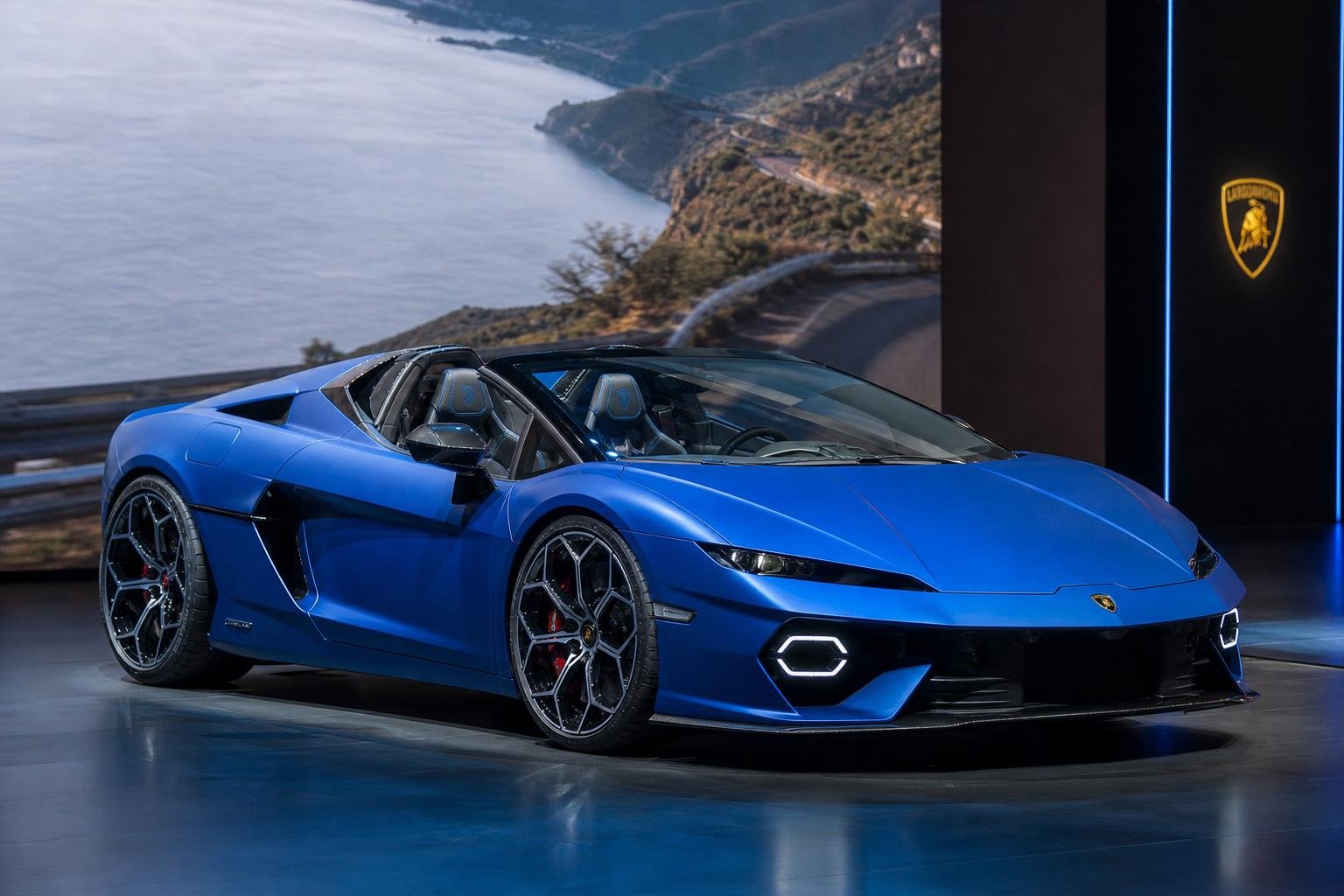

Lamborghini has expanded its electrified supercar range with the Temerario Spyder, an open-top version of the 907-hp Temerario coupe. Revealed in Los Angeles on November 18, 2026, the new model combines a high-revving twin-turbocharged V8 with three electric motors and the first retractable hardtop fitted to a Lamborghini Spyder.
The debut took place at the Academy Museum of Motion Pictures, a fitting location for a car designed to deliver considerable visual and mechanical theater. California is also one of Lamborghini’s most important markets for open-top cars, making Los Angeles a strategically appropriate setting for the global reveal.
A 10,000-rpm hybrid powertrain
The Temerario Spyder retains the Temerario family’s 4.0-liter twin-turbocharged V8 and hybrid system. The engine works with three axial-flux electric motors to produce a claimed 920 CV, equivalent to approximately 907 horsepower. The supplied announcement confirms the three-motor hybrid system but does not detail the Spyder’s complete operating strategy.
Lamborghini says the V8 can reach 10,000 rpm, an unusually high engine speed for a turbocharged production engine. The high redline is central to the Temerario’s character: rather than using electrification solely to reduce fuel consumption, Lamborghini has used the electric system to support a highly responsive, high-output combustion engine.
Performance remains firmly in supercar territory. Lamborghini claims a 0-to-62-mph time of 2.8 seconds, a 0-to-124-mph time of 7.3 seconds and a top speed of 213 mph, or 213.13 miles/h. These are manufacturer figures and should be understood as claimed performance rather than independently verified test results.
Why the roof matters
The most significant difference between the Spyder and coupe is not the powertrain but the roof. The Temerario Spyder uses a fully electric retractable hardtop with a patented vertical movement mechanism. Lamborghini has not described every stage of the roof’s operation, but the design represents a more complex engineering solution than a conventional fabric roof.
A retractable hardtop can provide a more coupe-like roof structure when closed, while still allowing open-air driving at the press of a button. The trade-off is mechanical complexity and the need to package the roof, its motors and associated reinforcement without compromising the car’s proportions or cabin space. Lamborghini has not released a Spyder-specific curb weight, so the effect of the system on mass and acceleration cannot yet be assessed against the coupe.
The roof is paired with an electronically adjustable rear window. With the window raised, occupants receive additional wind protection; lowered, it should allow more of the V8’s exhaust note into the cabin. Integrated neck warmers, offering three temperature settings, extend the car’s usability beyond warm-weather cruising.
Open-top performance without abandoning the engine soundtrack
Sound is an important part of the Temerario Spyder’s appeal. The open cabin places the occupants closer to the engine and exhaust, making the sensory character of the powertrain as important as the acceleration figures. Lamborghini is also offering an optional lightweight titanium exhaust developed by Akrapovič through its accessories program.
The supplied material does not provide a confirmed weight saving or detailed acoustic specification for the optional system. Its availability nevertheless suggests that Lamborghini sees the exhaust note as a meaningful part of the Spyder’s identity, rather than treating the convertible simply as a roofless derivative of the coupe.
That distinction matters in a market where outright performance numbers are increasingly difficult to separate. A claimed 2.8-second sprint and 213-mph top speed place the Temerario Spyder firmly among modern high-performance hybrids, but the open roof changes the driving experience more substantially than a small difference in acceleration would.
A new chapter in Lamborghini’s open-top history
The Temerario Spyder continues a long Lamborghini tradition of producing dramatic open-top cars. The company’s early Silhouette used a removable roof panel, while later models established the modern Spyder formula. The Gallardo Spyder became Lamborghini’s first series-production open-top model, followed by the Huracán Spyder.
The Temerario represents a new stage in that history. Its predecessor’s basic formula—high-revving internal-combustion performance and a low-slung mid-engine layout—has been reworked around hybrid assistance and a turbocharged V8. The Spyder adds another layer of complexity by combining that electrified powertrain with a retractable hardtop.
That combination also reflects Lamborghini’s broader transition away from relying exclusively on naturally aspirated engines. Electrification allows the company to maintain extreme output while supporting the response and performance expected from a contemporary supercar. The 10,000-rpm ceiling gives the Temerario a clear connection to Lamborghini’s traditional engine philosophy, even though the underlying technology is very different from the V10-powered cars that preceded it.
Pricing and availability remain undisclosed
Lamborghini has not announced pricing or delivery timing for the Temerario Spyder. Those omissions are significant for prospective buyers because the roof mechanism and additional open-top equipment are likely to position the Spyder above the coupe, although any estimate would be speculative until the company releases official figures.
For now, the Temerario Spyder’s importance lies in its combination of features rather than a confirmed price. It brings a 907-hp hybrid powertrain, a 10,000-rpm V8, a retractable hardtop and comfort equipment such as adjustable rear glass and neck warmers into one Lamborghini model. The result is not merely a coupe with its roof removed, but a more technically ambitious interpretation of the company’s open-top supercar formula.
Sources: Sports Car Digest.



0 Comments