
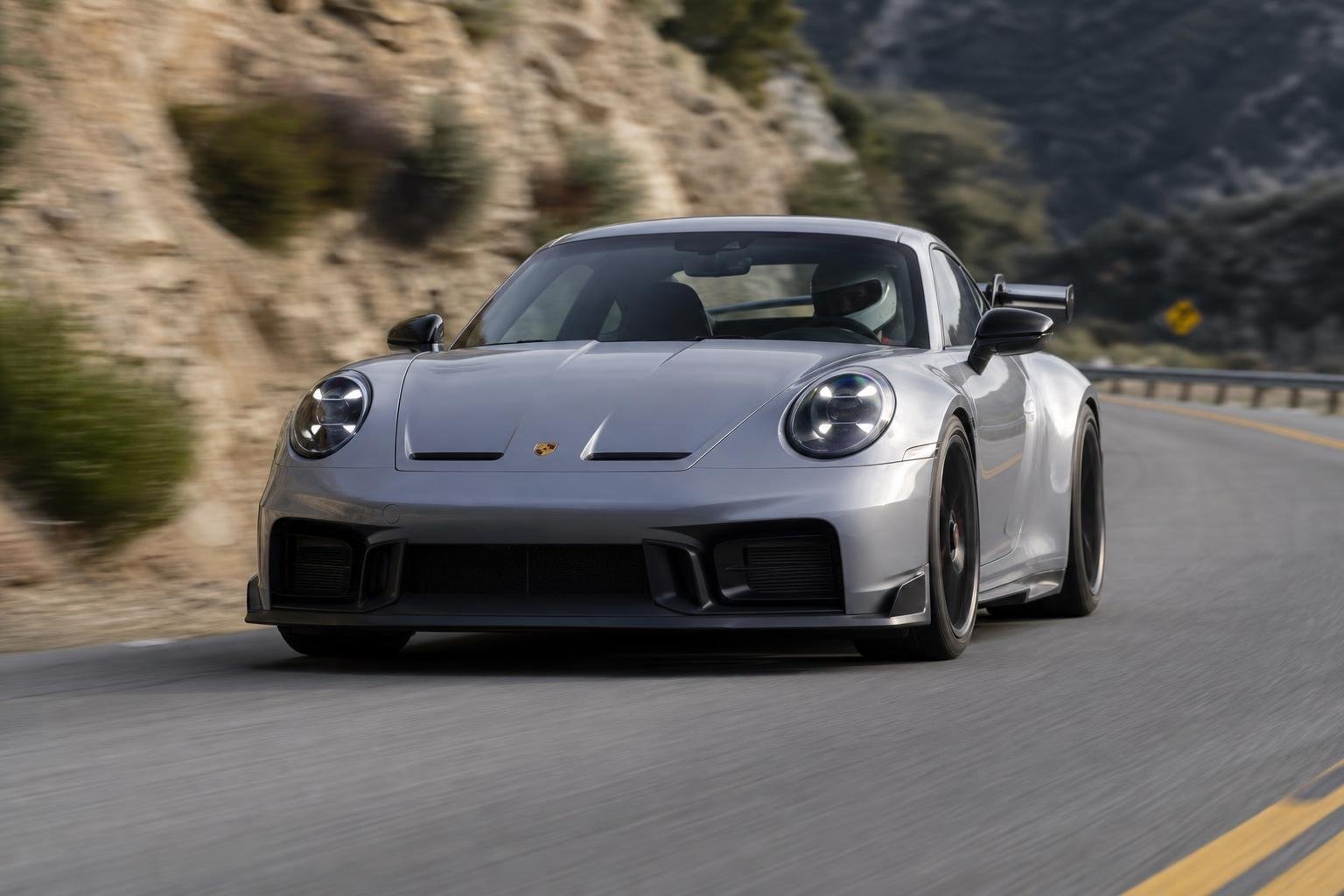

Porsche is exploring an unusual way to help its cars corner: deployable aerodynamic fins that would generate sideways force as the vehicle turns. The concept, described in a patent published in November 2026, places movable surfaces near both ends of the car and treats airflow as an active handling tool rather than simply a source of downforce.
The idea is technically intriguing because it targets a problem that conventional aerodynamic devices do not directly solve. A wing primarily creates vertical load, pressing the tires into the road. Porsche’s proposed rudders would instead influence the car laterally, potentially helping stabilize its body during high-speed cornering.
How Porsche’s rudder system would work
According to the patent, the system would deploy fins from the front trunk lid and the area near the rear glass. As the driver turns, the fins would pivot into the airflow at an angle. That angled surface would redirect the air and create a sideways force on the vehicle.
The basic principle is similar to a rudder on a boat, although the operating environment is very different. A boat’s rudder redirects water to influence its direction. Porsche’s proposed surfaces would redirect air to influence the car’s body. Because air is far less dense than water, the fins would need to work with the vehicle’s speed and be sized and positioned carefully to produce a useful effect.
The patent describes the front and rear devices working as a coordinated system. Splitting the aerodynamic hardware between the two ends could allow Porsche to influence how the car rotates and how stable it feels, rather than placing all of the force at one axle. That distinction matters: too much aerodynamic influence at the front or rear could make the car behave unpredictably, particularly during rapid transitions.
Porsche also says the fins could help control body roll. Roll is the chassis movement that occurs when lateral cornering forces load the outside tires and make the body lean. Reducing that movement can make a vehicle feel more settled, but it does not automatically create more grip. The value of an active system would depend on how precisely it could manage the forces without upsetting the tires or suspension.
A claim that goes beyond electronic stability control
The filing, reported by Motor1, describes the intended result as “increased lateral acceleration potential at high speeds and stabilization capabilities beyond those of” the Electronic Stability Program.
That wording is important. Electronic stability control generally works by detecting a vehicle’s motion and selectively applying individual brakes, reducing engine torque, or using both strategies to help correct an unwanted yaw movement. Porsche’s rudders would act through aerodynamics instead, potentially influencing the car before the chassis develops as much instability.
However, the aerodynamic system would not replace electronic controls. Airflow-related forces increase with speed, while a stability system can operate across a much wider range of conditions. At lower speeds, the fins may have little authority. At high speeds, they could produce meaningful force, but the same sensitivity would make deployment strategy critical.
A controller would need to account for steering angle, vehicle speed, yaw rate, lateral acceleration and changing wind conditions. The patent material supplied here does not establish how Porsche would implement that control logic, so any discussion of exact response times or performance gains would be speculation.
Visibility and crosswinds are substantial obstacles
Putting deployable aerodynamic surfaces near the rear glass creates an immediate packaging problem. A fin large enough to catch useful airflow could also interfere with the driver’s rearward view or block part of the mirror’s field of vision. That concern is especially relevant on a road car, where visibility and regulatory requirements matter as much as track performance.
A separate Porsche patent application describes independently movable air-guide elements that can pivot between retracted and extended positions to adjust lift or downforce. The concept addresses a related visibility and aerodynamic-control issue, but its existence does not confirm that it is connected to the rudder system or intended for production.
Crosswinds would be another challenge. A fin designed to catch air during a corner can also behave like a small sail when a gust strikes the vehicle on a straight. That could create an unwanted lateral disturbance at precisely the moment the driver is not asking for one. The supplied patent reporting indicates that Porsche views closed circuits as the intended environment, which would make the system easier to control than it would be on public roads.
Why the concept is more than another active wing
Active aerodynamics are already used to change the balance between drag and downforce. Porsche’s proposal is different in emphasis because it treats aerodynamic surfaces as temporary control devices for the vehicle’s direction and stability.
That approach could offer advantages on a racetrack, where drivers repeatedly encounter known corners and operate within a relatively controlled environment. A system could deploy only above a certain speed, during specific steering conditions, or when sensors detect that additional stability is useful. It might also be able to reduce its effect on straights, limiting drag and avoiding unnecessary aerodynamic disturbances.
The trade-off is complexity. Moving fins would require actuators, hinges, sensors, control software and structures capable of handling aerodynamic loads. Those components would add weight and create more potential failure points. Their placement in exposed body panels could also make them vulnerable to debris or damage during an off-track excursion.
There is a broader engineering question as well: whether the additional control authority would justify the compromises. Tire grip, suspension geometry, braking performance and conventional aerodynamic balance remain fundamental to cornering. An active rudder system could supplement those systems, but it could not overcome their limitations.
A patent is not a production announcement
Porsche has filed other unconventional patents involving active aerodynamic devices and unusual mechanical features. Some ideas eventually influence production vehicles, while many remain technical explorations or legal protection for concepts that never reach the road.
The rudder patent should therefore be read as evidence of Porsche investigating a possibility, not as confirmation that a future 911, sports car or racing model will receive deployable fins. The filing does show where aerodynamic development can go when designers are no longer limited to fixed wings and splitters.
If Porsche ever develops the idea beyond the patent stage, the most difficult work will not be making a fin move. It will be determining when that movement improves the car, when it creates a new risk and how the system can remain predictable across changing speeds, surfaces and wind conditions. That is the difference between an interesting aerodynamic mechanism and a useful vehicle-control technology.
Sources: Motor1.


0 Comments