
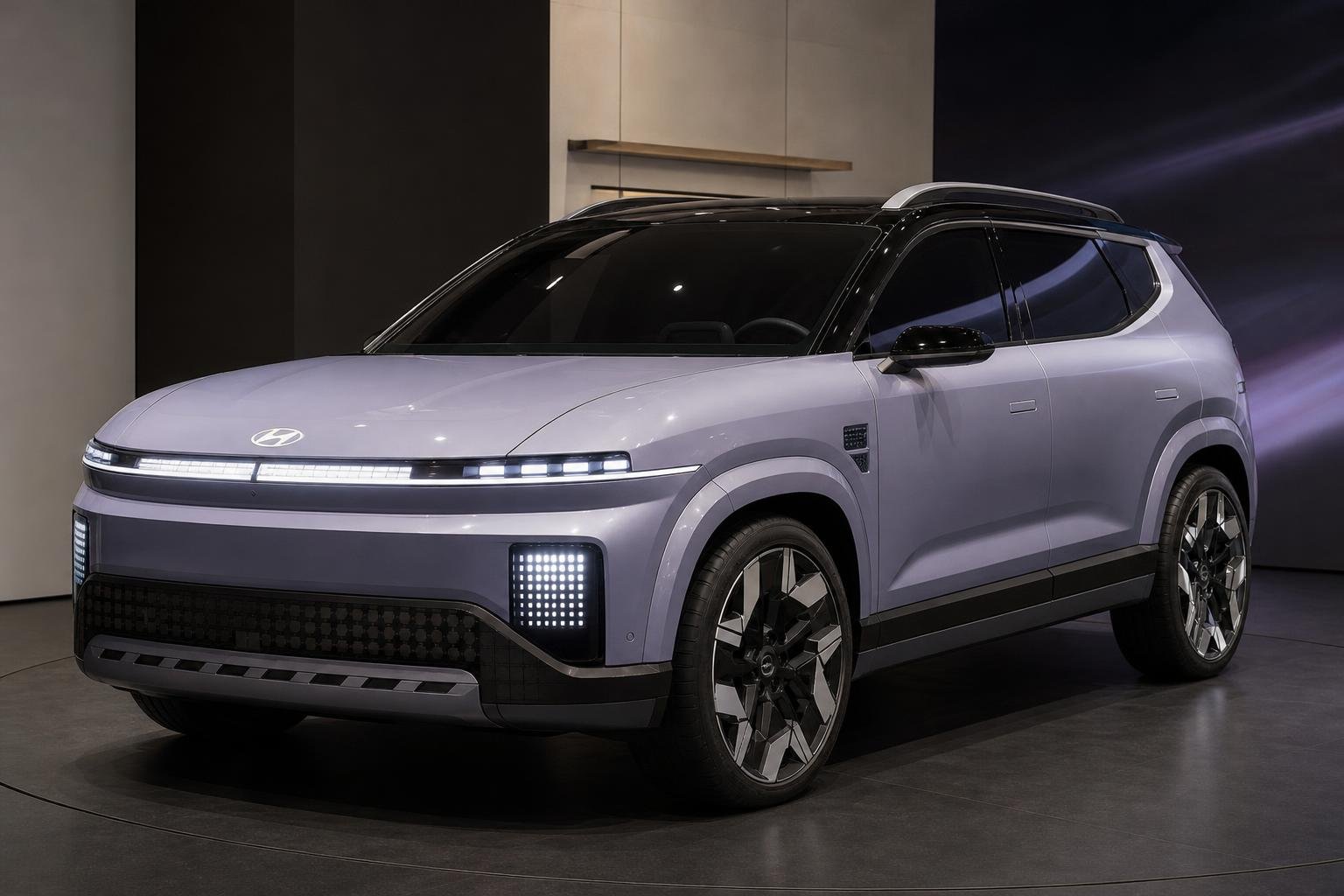

Hyundai is taking a distinctly local approach to electric vehicles in China with the Mercury Concept, a compact battery-electric SUV that will become the production Ioniq M in the first half of 2027. Its sharp design is attention-grabbing, but the more consequential technology is hidden underneath: Hyundai is developing a battery-swapping version with CATL.
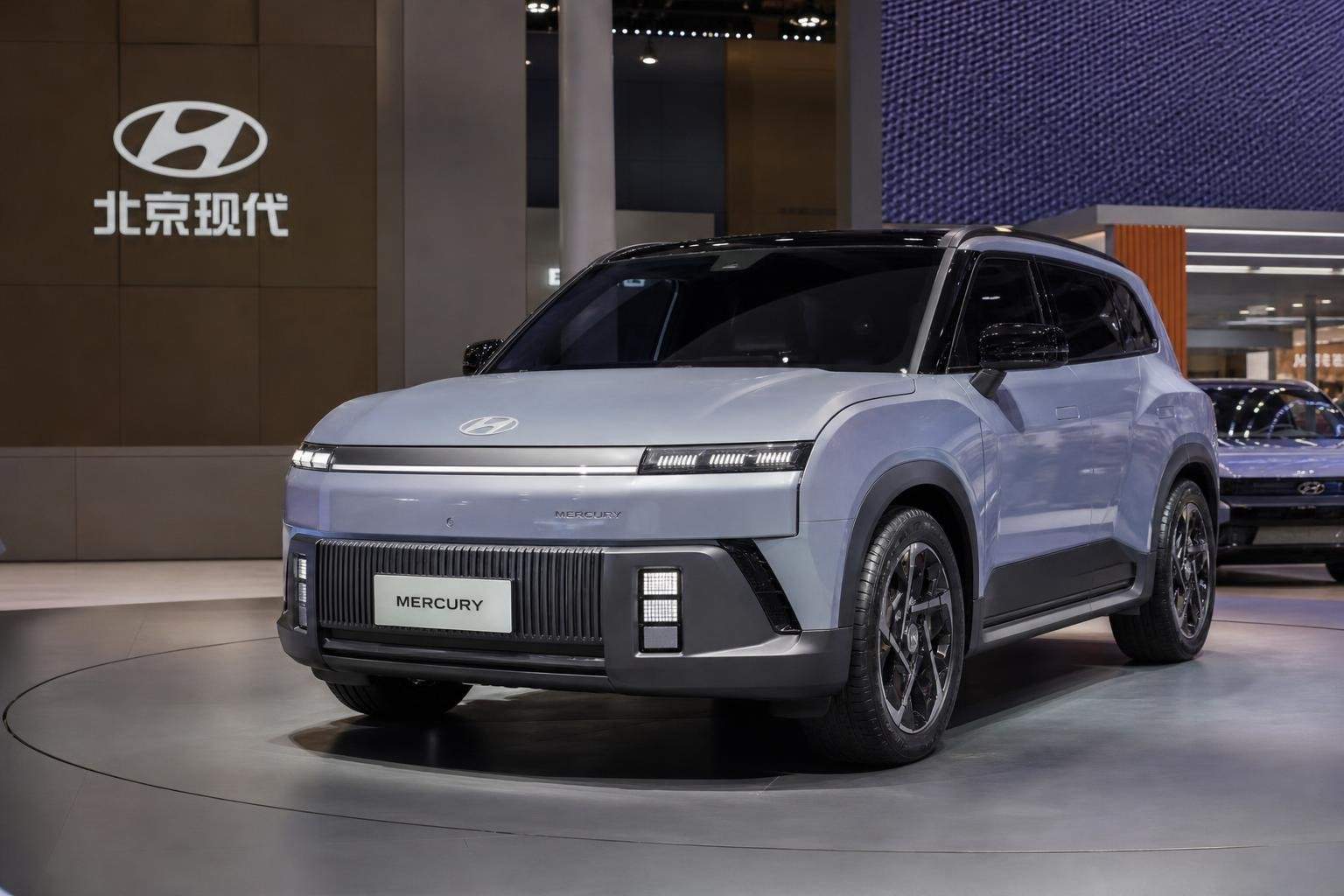
Unveiled at Auto Guangzhou 2026, Mercury is the third concept vehicle in Hyundai’s China-focused Ioniq Planet program. The name refers to the planet closest to the Sun, not the discontinued Ford Mercury brand. Hyundai’s decision to create a separate design and technology direction for China reflects the unusually fast development pace and intense competition in that market.
A compact EV designed around China
Hyundai describes Mercury as a B-segment premium smart SUV intended primarily for urban driving. The concept was developed by Hyundai’s Chinese design and engineering teams rather than being a lightly modified version of a global model. That distinction matters because Chinese buyers increasingly expect electric vehicles to combine distinctive styling with advanced driver assistance, powerful infotainment hardware and locally relevant software.
The production vehicle will reportedly be called Ioniq M, placing it within Hyundai’s global electric sub-brand while reserving the Mercury name for the concept. Hyundai has not yet released dimensions, battery capacity, motor output, range, charging performance or pricing. The Ioniq V’s specifications should not be applied to the Mercury; the two vehicles are separate programs.
That lack of hardware information is important. The concept establishes Hyundai’s intended market position, but it does not yet reveal whether the Ioniq M will compete through range, charging speed, performance, price or software. Those details will determine whether its technology strategy translates into a compelling product.
“The Origin” design language prioritizes visual impact
Mercury uses Hyundai’s China-specific “The Origin” design language. Its front end is dominated by a sharply sculpted hood, slim angular daytime running lights and a dark central bumper section. Hyundai calls the treatment a “shark nose,” an unusually direct description for a design that appears intended to make the small SUV look wider and more aggressive.
The concept is finished in Citrine Neon and rides on 20-inch black wheels with Michelin Pilot Sport tires. Pronounced fenders, a steeply raked windshield and dark lower trim give it a sporty stance, although the large wheels and low-profile tires may not be representative of the production vehicle. Concept styling frequently prioritizes visual proportion over ride comfort, efficiency and replacement cost.
At the rear, a substantial two-piece diffuser, sculpted tailgate and roof spoiler continue the performance-oriented theme. The spoiler incorporates a two-piece vertical brake light, while the rear lighting remains relatively thin and technical. Unlike many recent concept cars, Mercury uses conventional external door handles rather than pop-out units. That choice is linked to China’s evolving safety requirements, which place restrictions on concealed handles because they can complicate emergency access.
Battery swapping changes the charging equation
Hyundai’s proposed battery-swapping derivative is the Mercury’s most technically significant feature. Instead of connecting the vehicle to a charger and waiting for the battery to replenish, a compatible station would remove the depleted pack and install a charged one. CATL is developing this version with Hyundai.
Battery swapping addresses a different problem than faster charging. High-power charging reduces waiting time but still requires the vehicle to remain at a station while energy is transferred. Swapping separates the energy-storage process from the customer’s stop: the driver exchanges the pack, while the station recharges removed batteries away from the vehicle.
CATL is building its Choco-Swap network in China, with more than 2,500 stations reported and further expansion planned. The company has said the automated exchange process can take roughly 100 seconds. That is close to the time required to refuel a gasoline vehicle, although the practical benefit depends on station availability, compatibility and the ownership model for the battery itself.
Battery swapping also introduces engineering and commercial complications. The pack must use standardized physical dimensions, electrical connections and mounting points. Automakers and battery providers must also agree on how battery condition, capacity and ownership are managed when customers exchange one pack for another. Hyundai and CATL have not disclosed those details for the Ioniq M.
Local software is as important as local hardware
The Ioniq M is expected to use driver-assistance technology from Chinese supplier ZYT, also identified in some reports as Zhuoyu, with a Level 2++ designation. That label does not make the vehicle autonomous. Level 2 systems can assist with steering, acceleration and braking, but the driver remains responsible for monitoring the road and controlling the vehicle.
Hyundai is also planning a smart cockpit based on ByteDance’s Doubao artificial-intelligence model. The company has not specified which functions the system will perform, but a locally developed assistant could provide advantages in language recognition, Chinese navigation, connected services and voice control. Those capabilities are increasingly central to how Chinese buyers evaluate a vehicle, rather than being secondary features added to a conventional dashboard.
The combination of local driver assistance, local AI and CATL battery technology shows that Hyundai is localizing more than the vehicle’s styling. It is sourcing key software and energy systems from companies already operating within China’s technology ecosystem. That approach could shorten development cycles and improve market fit, but it also means Hyundai will need to integrate several partners without compromising safety, reliability or long-term software support.
Mercury is part of a wider China strategy
Hyundai’s China rollout extends beyond the Ioniq M. The company plans an extended-range electric version of the Ioniq V in 2027, a production vehicle based on the Earth Concept in 2028 and two additional new-energy models in 2029. In China, the new-energy category includes battery-electric vehicles, plug-in hybrids, fuel-cell vehicles and range-extended EVs.
The broader plan suggests Hyundai is not treating Mercury as an isolated design exercise. It is building a China-focused portfolio around the Ioniq name while retaining a mix of pure electric and range-extended powertrains. Hyundai has also indicated that vehicles developed and produced in China could eventually support exports, although no global launch for the Ioniq M has been confirmed.
For now, Mercury’s most important promise is not a performance figure or a futuristic body. It is the possibility of combining a compact urban EV with an energy system designed around rapid battery exchange. Whether that idea becomes a genuine advantage will depend on the production vehicle’s cost, battery standard, station access and software execution. Hyundai has supplied the concept; the engineering details will determine whether the Ioniq M can make the technology useful in everyday driving.
Sources: Motor1, CarScoops, The Korea Times, and MK.
0 Comments