
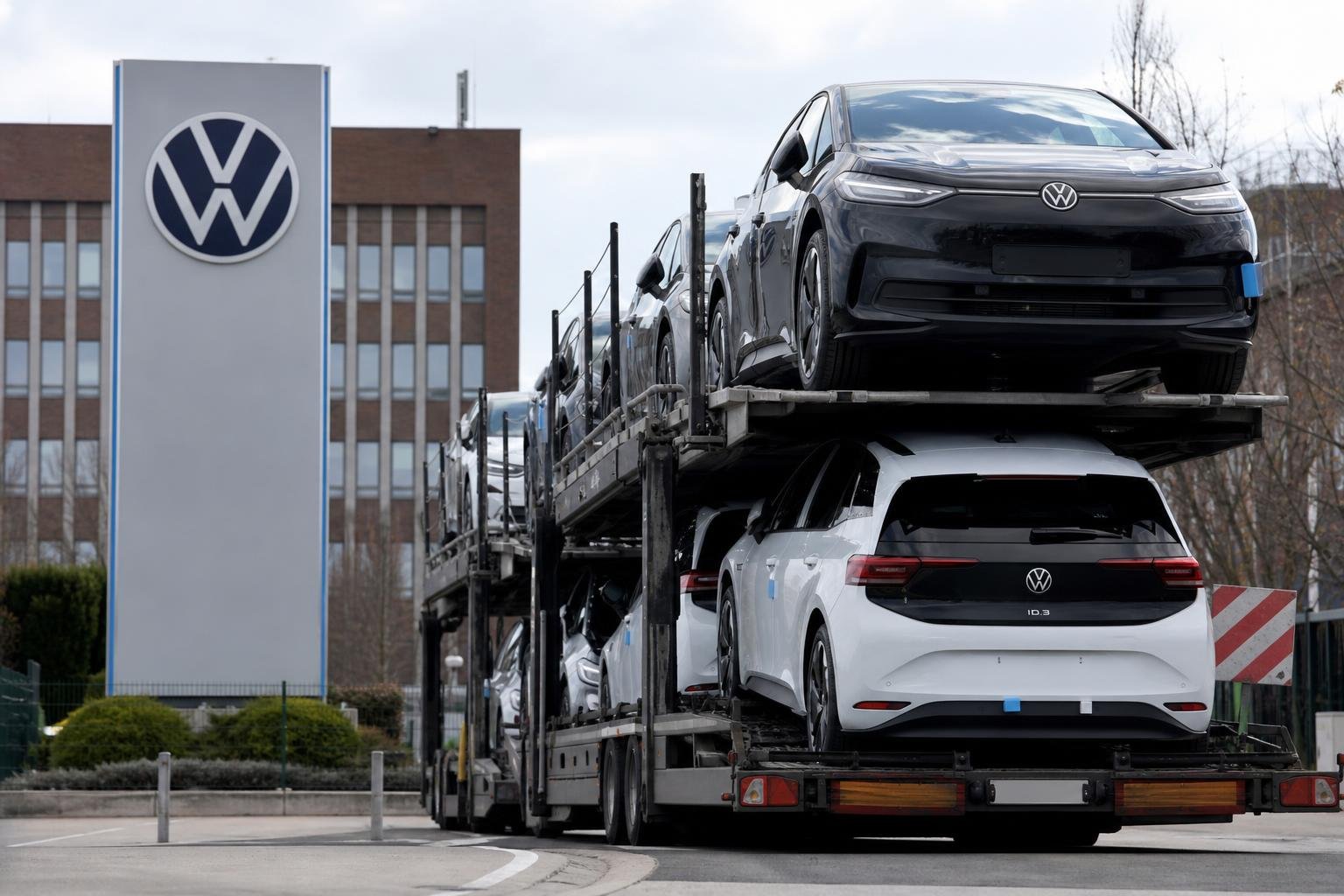

A German economist has suggested that selling Volkswagen to a Chinese automaker might not be the worst outcome for Germany’s struggling automotive industry—provided the factories, jobs and broader value creation remain in the country.
Moritz Schularick, president of the Kiel Institute for the World Economy, made the argument at a Berlin industry conference, according to Motor1, which cited Handelsblatt. Rather than focusing on who owns “a certain corporation in Wolfsburg,” Schularick argued that Germany should concentrate on maintaining production and economic value inside its borders.
The remark reportedly created an uncomfortable moment in the room. Michael Jansen, head of Volkswagen’s Berlin corporate office, was among those present. Schularick had already made a similar argument in an interview with Süddeutsche Zeitung, where he predicted that a Chinese manufacturer such as BYD could eventually buy Volkswagen.
There is no indication that BYD has approached Volkswagen or that an acquisition is being negotiated. This is an economist’s proposal, not a reported transaction. Still, the idea is revealing because it shows how sharply the conversation around Germany’s auto industry has changed.
Ownership Is Not the Same as Industrial Value
Schularick’s argument separates corporate ownership from industrial activity. In practical terms, a company could be controlled by a foreign owner while its factories, suppliers, engineering operations and jobs remain in Germany. For policymakers worried about deindustrialization, that distinction may matter more than the nationality printed on the shareholder register.
That position is likely to be unpopular in Germany, where Volkswagen is more than a large manufacturer. The company is closely tied to the country’s industrial identity, regional employment and political culture. Any proposal to sell the group would therefore involve more than a financial transaction. It would raise questions about national control, labor protections, technology ownership and the future of German manufacturing.
For workers and communities, the critical issue would be whether a new owner actually keeps production in place. A foreign buyer could provide capital and new products, but ownership alone would not guarantee stable employment. Conversely, a German-owned company can still close plants, reduce shifts or move investment elsewhere. The nationality of the owner is an imperfect measure of whether an operation is secure.
Chinese Automakers Are Changing the Competitive Equation
The suggestion also reflects Volkswagen’s deteriorating competitive position. The group is losing market share to Chinese rivals in China while facing growing competition from those same companies in Europe. Chinese automakers are no longer viewed only as distant challengers selling inexpensive vehicles in their home market. They are increasingly seen as potential competitors, partners, factory tenants and, at least in theory, buyers of established European brands.
That shift has been accelerated by the automotive industry’s transition toward electric vehicles. Companies that built their reputations around internal-combustion engines now have to compete in batteries, software, electronics and manufacturing efficiency. Chinese automakers have developed substantial capabilities in those areas, while Volkswagen has been working through the expensive and disruptive process of reorganizing its own business.
Schularick’s broader policy proposal is that Europe should allow Chinese brands to sell vehicles in the region while requiring them to create more manufacturing activity locally. He suggested tying subsidies to “Made in Europe” requirements or requiring joint ventures—an approach that would echo policies China used for decades with foreign automakers.
Such a policy could bring investment and production to Europe, but it would also create difficult trade-offs. Governments would need to decide how much local content is enough, which incentives should be available and how to prevent subsidies from simply rewarding companies without securing durable employment. Joint ventures could bring technology and capital, but they could also give foreign companies access to local facilities and expertise without resolving the competitive weaknesses of established European manufacturers.
Volkswagen Is Already Restructuring
Volkswagen is not waiting for a hypothetical buyer to force change. The group is moving forward with its Future Plan 2030, which includes roughly 50,000 additional job cuts on top of 50,000 reductions already agreed upon earlier this year. It also plans to reduce the lineup by as much as half by 2035 while reviewing the future of four German plants: Emden, Zwickau, Hanover and Neckarsulm.
The scale of those measures illustrates the problem facing the company. Volkswagen’s breadth once offered a major advantage, allowing the group to cover numerous markets and price points through a large collection of brands and shared components. But that size also creates complexity. Maintaining too many models, platforms and parts can increase development and manufacturing costs at precisely the moment when Chinese competitors are applying pressure on price and technology.
The group is therefore simplifying its parts strategy as part of an effort to become leaner. For customers, that could eventually mean fewer choices. For Volkswagen, the intended benefit is a less complicated operation with lower costs and more concentrated investment. The risk is that cost reduction becomes easier to measure than product strength, leaving the company smaller without making it more competitive.
A Sale Would Be Politically Harder Than Economically Possible
Even if a Chinese automaker had the money and interest to pursue Volkswagen, a full acquisition would face major political and labor obstacles. Volkswagen’s ownership structure, its importance to German employment and the strategic sensitivity of automotive technology would make government scrutiny unavoidable. Worker representation would also be central to any decision affecting plants and jobs.
There is a substantial difference between allowing a Chinese company to build vehicles in Germany and handing that company control of Volkswagen Group. The first could be presented as an investment and employment opportunity. The second would be treated as a question of industrial sovereignty.
For now, a Chinese takeover remains an abstract possibility rather than a business plan. But Schularick’s comments expose the uncomfortable choice facing Germany: preserve domestic control at almost any cost, or accept foreign ownership if it can keep factories productive and workers employed. Volkswagen’s restructuring suggests the company is trying to remain independent by becoming smaller and more efficient. Whether that strategy is enough will depend on its ability to turn cost cuts into vehicles that can compete on technology, price and usefulness—not merely on its ability to reduce the size of the organization.
Sources: Motor1.
0 Comments