
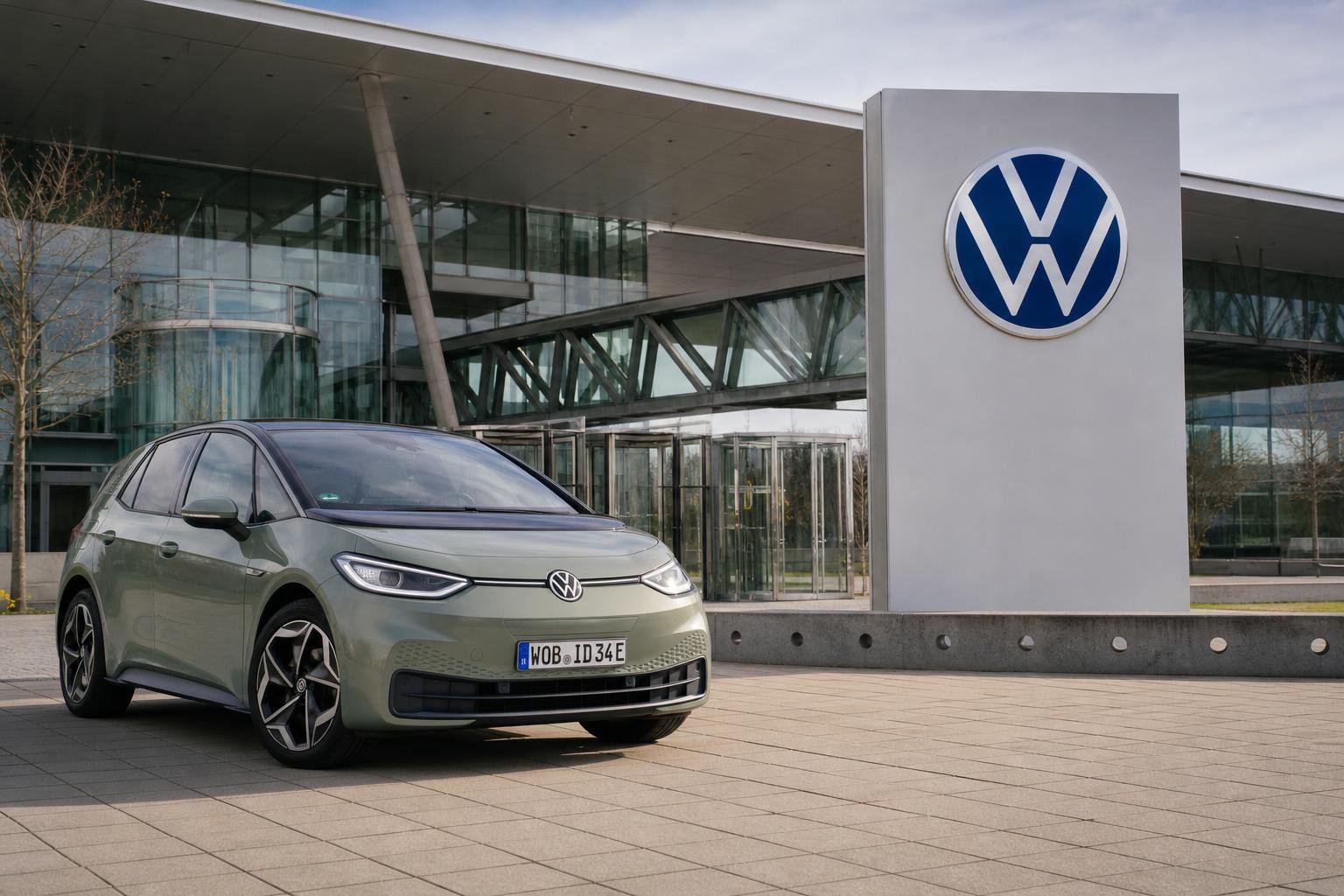

A German economist has suggested that Volkswagen’s ownership may matter less than where the company builds vehicles and creates value, arguing that a Chinese buyer would not necessarily be a bad outcome for Germany. The provocative idea reflects how sharply Volkswagen’s competitive position has changed, but it is not evidence of an actual acquisition plan.
Moritz Schularick, president of the Kiel Institute for the World Economy, made the comments at an industry conference in Berlin, according to Motor1.com, which reported that Handelsblatt covered the remarks. Rather than naming Volkswagen directly, he referred to “a certain corporation in Wolfsburg” and said selling it to Chinese interests would not be a bad idea if Germany continued to benefit from production and value creation.
Michael Jansen, Volkswagen’s head of corporate affairs in Berlin, was reportedly among those attending. The remarks caused a reaction in the room because they challenged a deeply rooted assumption: that keeping a major automaker German-owned is automatically more important than preserving its factories, suppliers and workforce.
Ownership Is Not the Same as Industrial Security
Schularick’s argument is practical, even if the proposed transaction is politically difficult. A company can remain nationally important through its engineering operations, plants, suppliers and employees even when its shareholders come from elsewhere. Conversely, German ownership alone does not guarantee that a factory will remain competitive or that its jobs will be protected indefinitely.
That distinction matters to Volkswagen employees and the communities surrounding its German facilities. If a foreign owner kept production in Germany, invested in plants and maintained supplier relationships, the change in ownership could be less consequential to everyday economic life than a German-owned company closing factories or reducing shifts.
There is also a less comfortable possibility. A Chinese automaker could acquire technology, brands, distribution networks and production capacity while eventually deciding that some German operations are too expensive. Ownership does not create a permanent obligation to preserve every job. For workers, the practical question would be the terms of the deal, the investment commitments and the legal protections—not the nationality of the buyer alone.
Why Chinese Automakers Are Part of the Conversation
Schularick had already made a similar prediction in an earlier interview with Süddeutsche Zeitung, saying that a Chinese manufacturer such as BYD could eventually buy Volkswagen, according to Motor1.com. There is no indication that BYD has approached Volkswagen or is pursuing such a deal. The suggestion is an economist’s argument, not a reported transaction.
Still, the idea is less detached from reality than it would have sounded a decade ago. Chinese automakers have become serious competitors in electric vehicles, batteries and software, while European manufacturers are under pressure to reduce costs and improve their electric-vehicle offerings. Chinese companies have also gained experience working with established international brands and operating manufacturing facilities outside China.
That does not mean Chinese manufacturers are uniformly superior, or that a takeover would solve Volkswagen’s problems. It does explain why the discussion has shifted. Chinese companies are no longer viewed only as low-cost challengers selling into China. They are increasingly being considered as technology partners, investors, production partners and potential owners of established automotive businesses.
Schularick Wants Europe to Change Its Industrial Policy
The economist’s broader proposal is that Europe should allow Chinese brands to sell vehicles in the region while requiring more local investment. He has suggested “Made in Europe” conditions connected to subsidies or mandatory joint ventures, echoing policies China used for years when foreign automakers sought access to its market.
For European consumers, local production could bring benefits such as shorter supply chains and more direct regional employment. It could also make Chinese vehicles easier to service and distribute across Europe. But mandatory partnerships or production rules could raise costs, slow investment or create complicated disputes over technology sharing and market access.
Schularick reportedly said Germany must accept that it is now “the developing country” in some of these areas. The wording is intentionally blunt. Germany remains a major industrial economy, but its historic advantages in combustion engines, premium branding and manufacturing expertise no longer guarantee leadership in electric vehicles or software-defined products.
Volkswagen Is Already Cutting Back
Volkswagen is responding to the pressure without waiting for a foreign buyer. Its reported Future Plan 2030 includes roughly 50,000 additional job cuts on top of about 50,000 reductions already agreed upon, along with plans to reduce the group’s lineup by as much as half by 2035.
The company is also reviewing the future of four German locations: Emden, Zwickau, Hanover and Neckarsulm. The exact effects on individual plants and employees remain an important issue, but the direction is clear. Volkswagen is trying to reduce complexity, lower costs and concentrate resources on models and technologies it believes can compete.
That effort reportedly includes simplifying the group’s parts strategy. Fewer shared components and less engineering variation could reduce manufacturing and development costs, although excessive simplification can also limit product differentiation. For buyers, the goal should be better value and stronger product support—not merely a smaller catalog.
A Takeover Would Not Be a Simple Fix
A Chinese acquisition of Volkswagen would face major political, labor and regulatory obstacles. Volkswagen is not just another private company in Germany; it is tied to regional employment, industrial policy and national identity. Any proposed transaction would likely receive intense scrutiny from governments, unions and regulators in Europe and China.
Even if those barriers were overcome, a new owner would inherit the same basic challenges: high costs in Germany, a crowded global market, intense electric-vehicle competition and the need to make software and vehicle development more efficient. New ownership could provide capital or different management priorities, but it would not automatically create profitable products.
The more immediate lesson is that Volkswagen’s future cannot be protected by symbolism alone. German ownership may be politically preferable, but lasting industrial value depends on competitive vehicles, efficient factories and products that customers are willing to buy. If those foundations weaken, the question of who owns the company becomes less important than whether anyone can make its operations viable.
Sources: Motor1.com.
0 Comments