
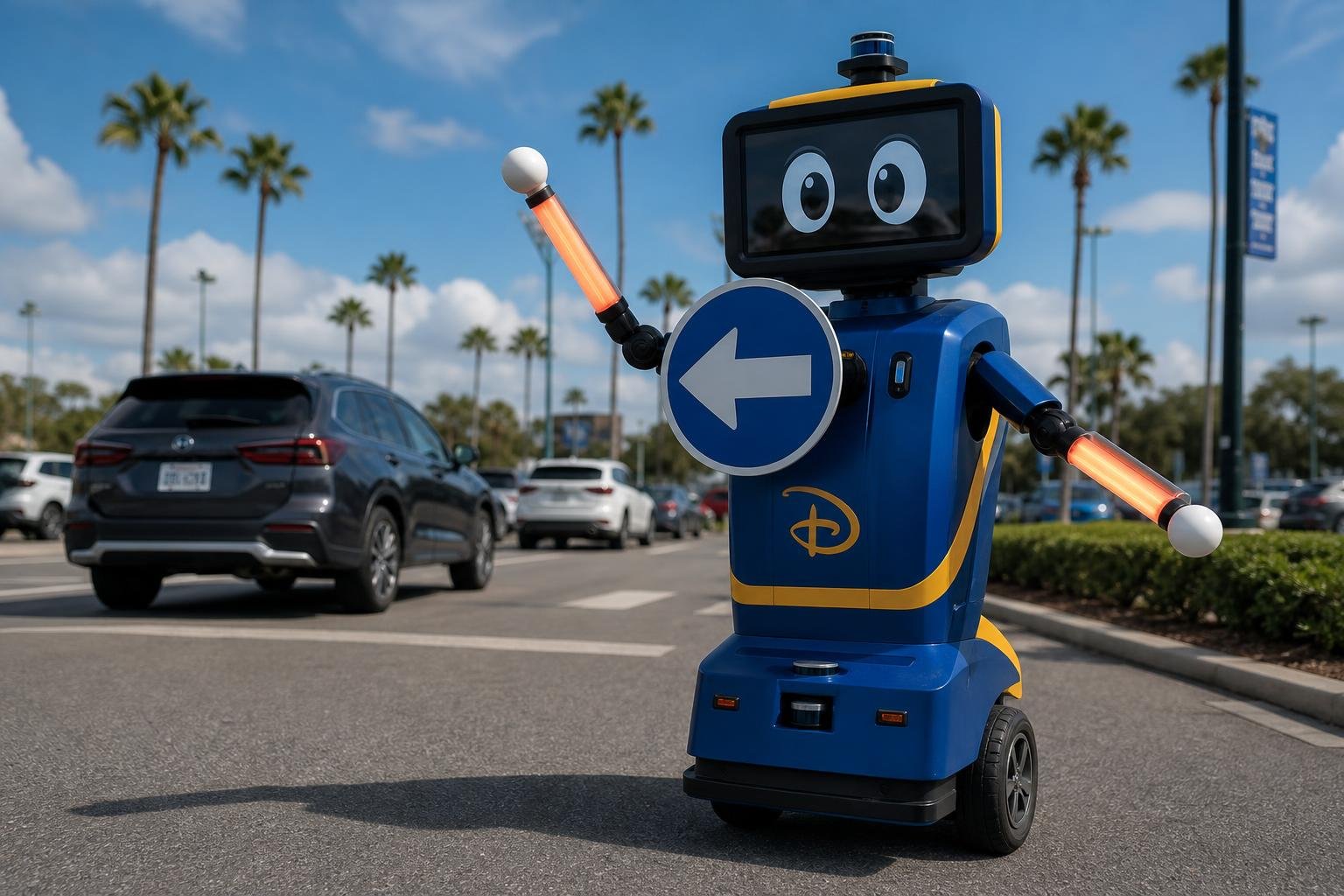

Disney is experimenting with a new kind of parking attendant: a small autonomous robot designed to guide visitors toward open spaces while looking like it belongs in Pixar’s Cars or WALL-E.
Developed with Irvine-based robotics company Field AI and Walt Disney Imagineering, the four-wheeled prototype was demonstrated during Disney Accelerator Demo Day in Burbank. It can use illuminated arms, animated displays and directional signs to communicate with drivers. Despite the polished presentation, Disney says the project remains experimental, and there are currently no plans to deploy the system at Disneyland.
A parking assistant with a character-first design
The prototype is deliberately more expressive than the typical autonomous delivery robot. Its front-mounted screen resembles a windshield and displays animated eyes and eyelids. A roof-mounted sign can show directional instructions, while two small arms fitted with red lights wave toward approaching vehicles in a manner similar to an aircraft marshaller.
That combination gives the robot several ways to communicate at once. Drivers may see an arrow or message on the roof sign, interpret the robot’s arm movements and recognize its apparent “face” as an indication that it is reacting to them. The design is intended to make an unfamiliar machine easier to understand in a busy parking environment.
Reports and demonstration footage describe the robot as orange with yellow safety-vest styling, reinforcing its road-worker appearance while keeping the visual language associated with Disney and Pixar. The technology is therefore both operational and theatrical: it must direct traffic, but it also has to feel like part of the guest experience.
Why parking is a useful robotics test
Finding an empty space in a large theme-park facility is a relatively simple task for a human attendant, but the surrounding environment creates a difficult test for autonomous systems. Parking areas combine moving cars, pedestrians, changing traffic patterns, varying light and drivers who may not immediately understand what a robot is asking them to do.
A robot positioned near vehicles must recognize obstacles, predict how people are likely to move and respond safely when a driver ignores or misunderstands an instruction. It also needs to operate around different vehicle sizes, distracted passengers and unexpected events such as a pedestrian crossing between parked cars.
Field AI’s role is focused on autonomous intelligence rather than the Disney styling alone. The company was founded in 2023 by former engineers associated with organizations including Google DeepMind, NASA, Nvidia and Tesla. Its technology is intended for robots working in environments that are less predictable than tightly controlled factory floors.
That makes the project different from a conventional parking guidance system. A fixed system can use sensors and overhead signs to identify open spaces, while a mobile robot must interpret its surroundings and physically position itself where drivers can see and understand it. Disney is testing not only whether the robot can move and guide vehicles, but also whether visitors accept its behavior.
Human response may be as important as autonomy
Gary Daniels, Disney Experiences’ senior vice president of technology, said during the presentation that the company wants to learn “how the robots function and, as important, how people respond.” That distinction is central to the experiment.
An autonomous machine can perform correctly from a technical perspective and still fail in practice if people do not trust it, cannot read its signals or treat it as a novelty rather than a traffic-control device. In a theme-park setting, children may be excited by the robot, while parents focused on parking and unloading may simply need clear, immediate instructions.
The visual personality could help solve part of that problem. A familiar character-like face may attract attention more effectively than a plain industrial device. At the same time, Disney will need to ensure that the entertainment value does not distract from safety messages such as slowing down, stopping or turning.
No confirmed Disneyland launch
Several reports have connected the concept with Disneyland’s parking operations, including the Pixar Pals parking structure. However, Disneyland officials have said there are no current plans to launch the technology demonstrated at the event. Disney has not announced a deployment date, fleet size, operating area or performance results.
That means the demonstration should not be interpreted as confirmation that visitors will soon encounter robotic parking attendants. Disney Accelerator is designed to explore emerging technologies and evaluate whether they could eventually support the guest experience. A prototype can help the company understand technical limitations and public reaction without committing to a production program.
Practical questions would also need answers before a rollout. The robots would have to withstand weather, accidental contact and constant operation in a high-traffic facility. Disney would need procedures for battery charging, software updates, emergency intervention and maintenance. It would also need to determine whether the robots improve traffic flow enough to justify their cost compared with human attendants, fixed signs or digital parking guidance.
Part of Disney’s wider physical-AI strategy
The parking project is one example of Disney exploring “physical AI”—software that allows machines to perceive and act in the real world. Other work presented during the Accelerator program included experiments involving robots that handle and organize 3D glasses between showings.
These applications share a common challenge: the robot must cope with variation. Glasses may not be placed identically, and parking-lot conditions can change from one moment to the next. Rather than following a completely rigid sequence, the machines need to interpret their environment and adjust their actions.
For Disney, that could eventually extend beyond parking. Lessons learned from autonomous navigation around vehicles and pedestrians may support future robotic characters, backstage systems or other visitor-facing machines. The company has spent decades developing robotic characters for attractions and character experiences, but a parking lot provides a more ordinary—and arguably more revealing—test of whether autonomous systems can function around the public.
A small robot with a large operational question
The appeal of Disney’s prototype is easy to understand: it turns a mundane part of a theme-park visit into an interaction with a recognizable character. The harder question is whether the robot can deliver measurable value without creating new safety, staffing or maintenance problems.
For now, the project is best viewed as a field test of communication and public acceptance rather than a finished parking product. If Disney can make the robot both unmistakable and dependable, the experiment could show how physical AI works in crowded public spaces. If not, the prototype may remain an entertaining demonstration—one that still provides useful lessons for the next generation of autonomous machines.
Sources: Motor1.com; Orange County Register; CarScoops; Aaron Prather on LinkedIn; TechRadar via Yahoo.
0 Comments