
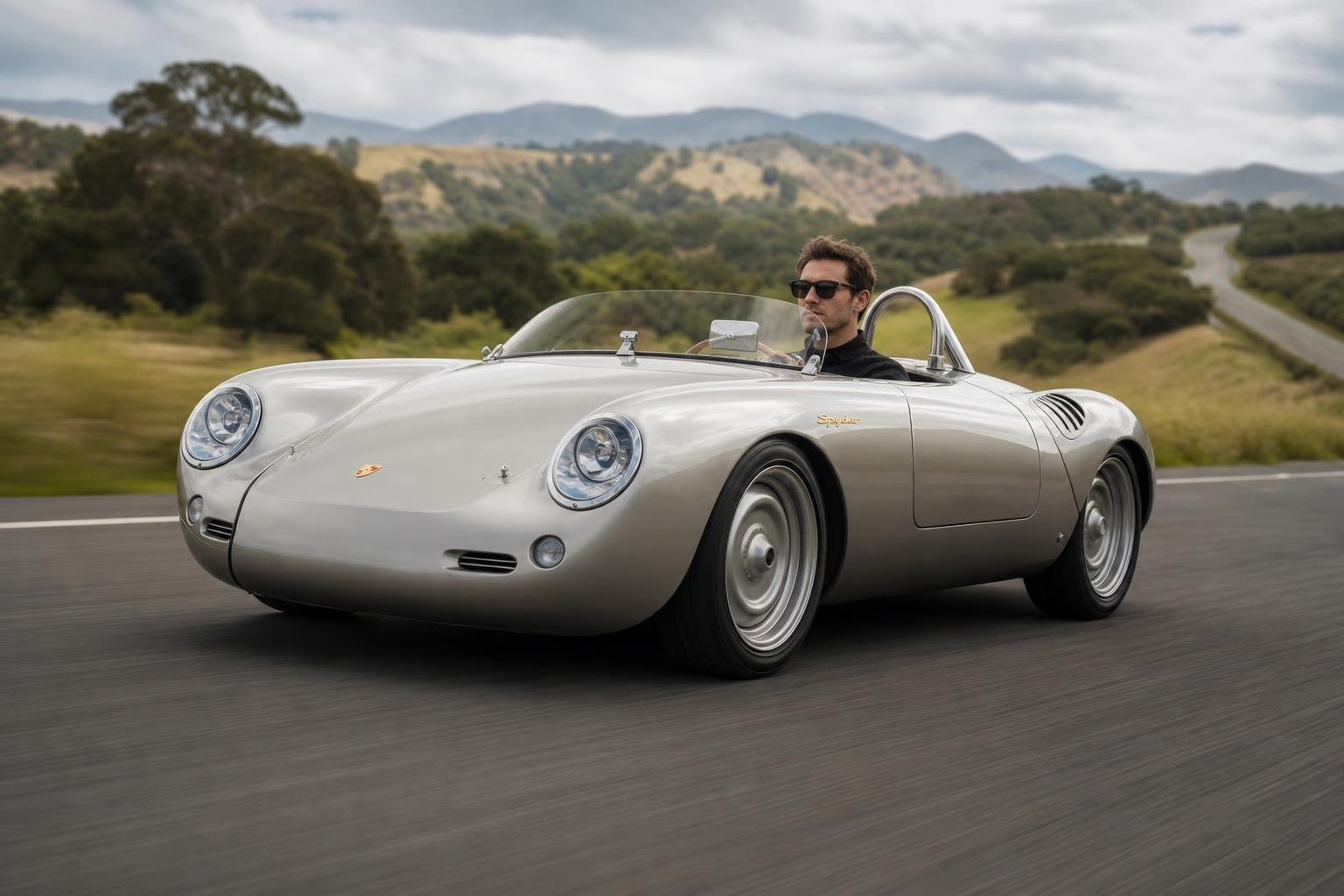

The Porsche 550 J is not a new sports car in the usual sense. It is smaller, slower, and not street legal. Yet this 80-percent-scale electric recreation of Porsche’s first purpose-built race car may say something important about how automotive heritage is being preserved: not as a museum object, but as something people can still interact with.
Built by Oxfordshire-based Hedley Studios in partnership with Porsche, the 550 J will make its public debut at the Icons of Porsche festival in Dubai on November 21 and 22. Production is limited to 250 examples, with prices starting at $91,216.93 USD—approximately $92,000 before taxes and options. Deliveries are scheduled to begin in spring 2027.
A miniature version of a formative Porsche
The original 550 Spyder arrived in the early 1950s as Porsche’s first car developed specifically for motorsport. Its importance was not based on brute force. The mid-engine roadster used a lightweight aluminum body and a 1.5-liter four-cylinder boxer engine producing 110 horsepower, according to Porsche’s historical records. Its compact dimensions and disciplined engineering allowed it to challenge cars with substantially larger engines.
At the 1954 Carrera Panamericana, Porsche says the 550 earned a class victory while finishing third and fourth overall. The five-day, 3,077-kilometer race helped establish the performance identity that would later become central to the Porsche brand. The model also became part of popular culture through its association with actor James Dean, although the car’s racing achievements are the more meaningful foundation for the 550’s legacy.
The new 550 J uses that history as a starting point rather than attempting to reproduce the original mechanically. The “J” stands for “Junior,” an appropriate name for a vehicle that measures approximately 9.5 feet long and 4 feet wide and seats up to two people.
Electric power changes the character, not the shape
Hedley Studios spent six years developing the car, using original production drawings and access to Porsche’s corporate archives. Beneath the carbon-fiber body is a TIG-welded high-strength-steel spaceframe. Porsche used a similar construction direction when developing the later 550 A, seeking a structure that was lighter and stiffer than the earliest cars.
Reported curb weights for the 550 J vary. Motor1 lists the car at approximately 772 pounds, while other reporting puts it closer to 728 pounds. The supplied Porsche material does not specify a weight, so buyers should confirm the final figure and configuration with Hedley Studios.
Standard versions use a 48-volt electric powertrain with an 8-kilowatt motor, equivalent to about 11 horsepower. Porsche lists a top speed of approximately 50 mph, while the launch reporting identifies 40 mph for the standard car and 50 mph with the optional RS Package. Standard range is described as up to 30 miles.
The RS Package increases motor output to 16 kilowatts, or about 21 horsepower, and adds battery capacity for a claimed range of up to 50 miles. It also brings drilled brake discs and adjustable Bilstein dampers mounted with Eibach springs. Brembo monobloc calipers and ventilated discs replace the drum brakes associated with the 1950s original.
Those numbers are modest by modern performance-car standards, but that is not really the point. With such a low curb weight, the 550 J does not need large outputs to feel lively in a private setting. The electric powertrain also removes the mechanical theater that defined the original car: there is no flat-four engine note, shifting routine, or exhaust heat. What remains is the seating position, the low silhouette, and the direct visual connection to Porsche’s earliest racing identity.
A collector object that happens to be drivable
The 550 J is not road legal, which sharply defines its audience. This is not an affordable way to own a classic Porsche, nor is it a practical electric vehicle for commuting. It belongs closer to the worlds of collectible design, private estates, display spaces, and enthusiast events.
That limitation may frustrate some buyers, particularly at a starting price of about $92,000. But it also clarifies what Hedley Studios and Porsche are selling. The car is a physical expression of brand history, intended to be used where regulations and private-property access permit rather than stored permanently under a cover.
More than 1,300 new components were developed for the project, including bespoke wheels, suspension pieces, and switchgear. Customers can select historic-inspired liveries or commission a highly personalized finish through a Paint to Sample-style program. Porsche says buyers can even coordinate the color with a full-size car in their collection.
That level of customization turns the 550 J into something closer to a wearable piece of automotive culture than a conventional model in a product lineup. Its value depends less on transportation and more on the meaning attached to its proportions, colors, and connection to Porsche’s racing story.
Why the 550 J matters beyond its price
The project arrives as Porsche celebrates 75 years of motorsport, making the 550 J part of a broader effort to connect historic competition cars with contemporary technology. Porsche has used similar heritage-focused displays to place classic racers alongside electric vehicles, including the all-electric Macan and modern Formula E machinery.
That juxtaposition is more than a marketing image. Electrification is forcing automakers to reconsider how performance sounds, feels, and communicates identity. The 550 J does not pretend an electric motor is equivalent to the original boxer engine. Instead, it preserves the visual language and lightweight philosophy while changing the mechanical experience entirely.
For Porsche, that is a relatively safe way to explore the cultural side of electrification. The company can acknowledge its past without building a full-size electric replica of a historic race car, while Hedley Studios can offer collectors an object that is both authentic in appearance and unmistakably modern underneath.
The result is admittedly extravagant. A $92,000, non-road-legal miniature is difficult to defend as transportation. But as an artifact of changing automotive culture, the 550 J is more interesting than its small dimensions suggest. It shows that preserving a car’s legacy does not always mean preserving its engine. Sometimes the heritage survives in the proportions, the purpose, and the invitation to experience the machine rather than merely admire it.
Sources: Motor1; Porsche Newsroom; Porsche historical specifications; Gizmodo.
0 Comments