
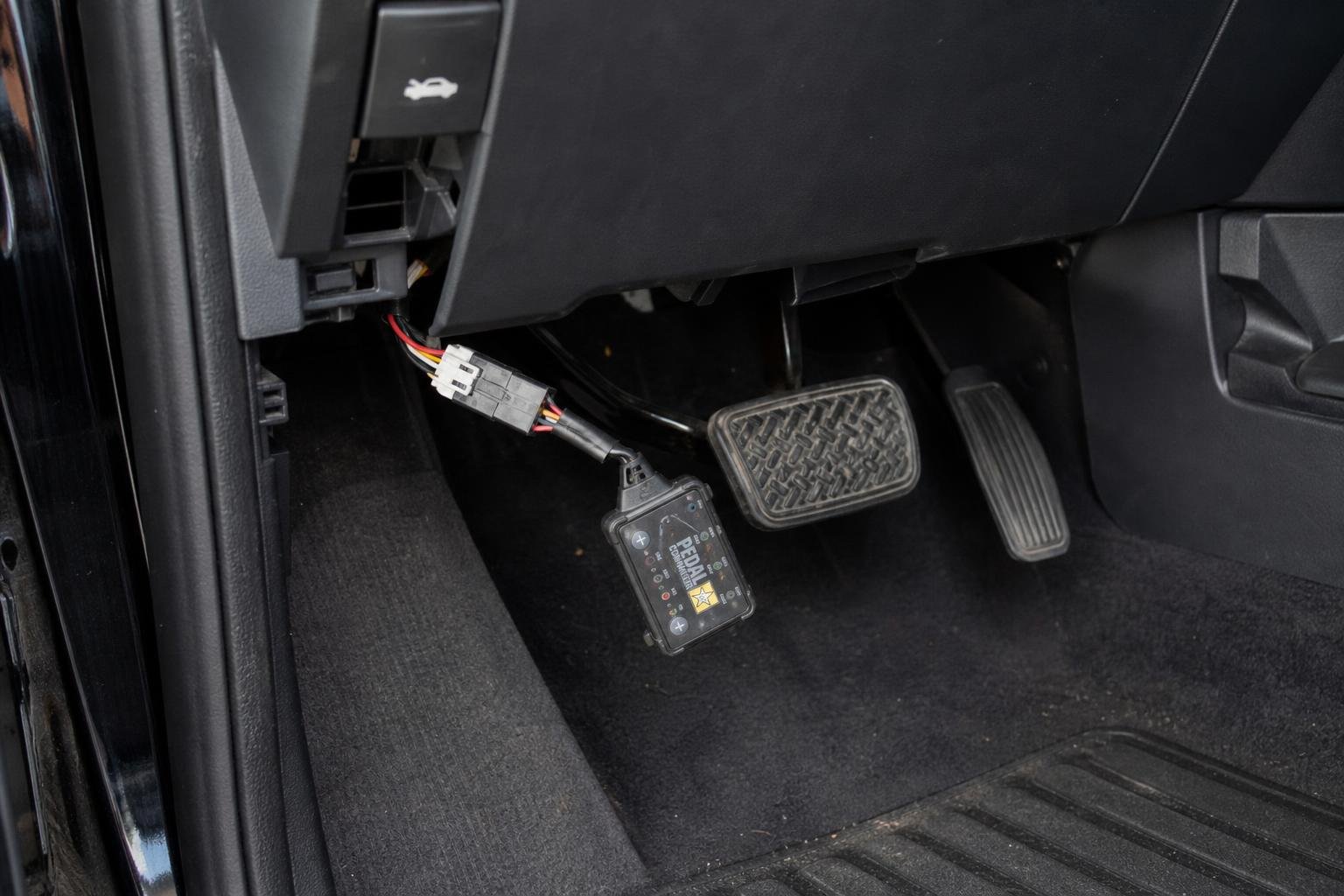

A Chevrolet owner says his extended-service-contract provider denied a transmission claim and canceled his coverage after a Pedal Commander was found in his vehicle—even though he says the device was unplugged and had never been installed in that Chevrolet.
Blake Bullock shared the dispute on TikTok while visiting a Chevrolet dealership for transmission problems. In the video, Bullock displayed paperwork for his American Auto Shield coverage and said the company denied the repair claim, canceled his contract, and refunded one month of payments.
His explanation was blunt: the company allegedly treated a Pedal Commander sitting in a cupholder as a vehicle modification. Bullock said the device was not connected to the Chevrolet and argued that it could not have caused the transmission problem. In a message to Motor1, he said the unit was intended for a 2019 Ford F-150 and had never been installed in the Chevrolet.
The dispute is about more than a small aftermarket device
The story has resonated because it sits at the intersection of automotive culture, aftermarket customization and the increasingly complicated business of vehicle protection plans. For many owners, a throttle-response controller is a relatively minor accessory. For a service-contract provider, however, anything that appears to alter how a vehicle operates can become part of a coverage investigation.
That distinction matters. A Pedal Commander does not add engine power in the same way as a turbocharger upgrade or an engine tune. It changes how the accelerator input is interpreted, making the vehicle feel more responsive by modifying the electronic signal between the accelerator pedal and the engine control unit. That still makes it an electronic control device, which may be enough for a contract administrator to examine it when a claim involves the vehicle’s powertrain.
But the available account does not establish that the device was installed, used on the Chevrolet, or connected to the alleged transmission failure. It also does not establish what evidence American Auto Shield used when making its decision. Those unanswered details are central to the dispute.
What the American Auto Shield contract appears to say
The paperwork shown in the report appears to correspond to American Auto Shield’s Gold Select plan. A sample Gold Select contract discussed in the report lists numerous internally lubricated and moving transmission components as covered parts, including the torque converter, transmission cooler and lines, oil pan, dipstick tube and transmission mounts.
That coverage is not unconditional. The sample contract includes a modification exclusion for breakdowns when a vehicle has been altered in a way that increases the likelihood of failure. Its examples include altered engine-management systems, engine programmers, tuners, electronic-control-module programming and performance programmers or tuners.
The sample document also says American Auto Shield may cancel coverage if a vehicle is found to have been modified in a way the manufacturer does not recommend. However, a sample contract is not necessarily the same document Bullock purchased, and the exact language, exclusions and claims process in his individual agreement would control his case.
That leaves several factual questions unresolved: Was the Pedal Commander ever connected to the Chevrolet? Did an inspector or dealership employee report seeing it? Was the denial based on the device itself, another alleged modification, a preexisting condition or a separate contract exclusion? The public account does not answer those questions.
Why the device’s digital footprint matters—and does not
Pedal Commander describes its product as intercepting the electronic signal from the accelerator pedal and says it does not leave permanent flags on the vehicle’s ECU after removal. The company also describes the device as untraceable by dealerships while advising owners to remove it before bringing a vehicle in for service.
That advice reflects an awkward reality of modern vehicle ownership. An accessory may leave no obvious software record, yet still be discovered physically during an inspection. Removing a device before service may reduce confusion, but it does not prove whether it was previously installed or whether it contributed to a failure. Conversely, finding an accessory in a vehicle does not by itself prove that it was connected or caused damage.
Those distinctions can be easy to lose once a claim reaches an adjuster who is evaluating paperwork, inspection notes and contract language rather than reconstructing the owner’s experience. They are also why drivers should keep installation records, photographs, diagnostic reports and written explanations when an aftermarket part becomes relevant to a repair.
Extended coverage is a contract, not a blanket promise
Consumer frustration with stories like Bullock’s often turns into broad advice to avoid all extended warranties. The more useful lesson is narrower: an aftermarket service contract is only as valuable as its actual terms and claims process.
The Federal Trade Commission distinguishes separately purchased auto service contracts from manufacturer warranties under federal law. That means the legal protections commonly associated with a manufacturer’s warranty should not automatically be assumed to apply in the same way to an independent service contract. Owners need to review exclusions involving modifications, maintenance, preexisting conditions, inspection rights and cancellation.
Buyers should also ask who administers the contract, who authorizes repairs, whether the provider can require teardown or inspection, and what appeal process exists after a denial. A low monthly payment can look attractive until a high-dollar transmission repair exposes a limitation buried in the agreement.
A dispute that reflects a wider ownership tension
Bullock’s video drew comments from viewers who suspected a dealership employee may have mentioned the device to the service-contract provider, though no evidence establishes that happened. Others questioned whether the denial might have involved a preexisting problem or another contract provision. American Auto Shield had been contacted for comment through its customer-service channel, but no response was included in the report.
The larger cultural issue is familiar to anyone who modifies a vehicle: owners see accessories as personal choices, while warranty administrators see potential risk. Both perspectives can exist at once. An aftermarket controller may be harmless in a particular repair, but a contract can still contain broad language allowing the provider to investigate modifications. The hard question is whether that language was applied fairly and whether the provider can connect the alleged modification to the denied failure.
Until those facts become public, Bullock’s case remains an allegation rather than proof that a disconnected Pedal Commander caused or legally voided anything. It is nevertheless a useful reminder that the accessory in the cupholder may be only the visible part of a much larger dispute over evidence, contract language and who gets to define a vehicle’s “original” condition.
Sources: Motor1.



0 Comments