
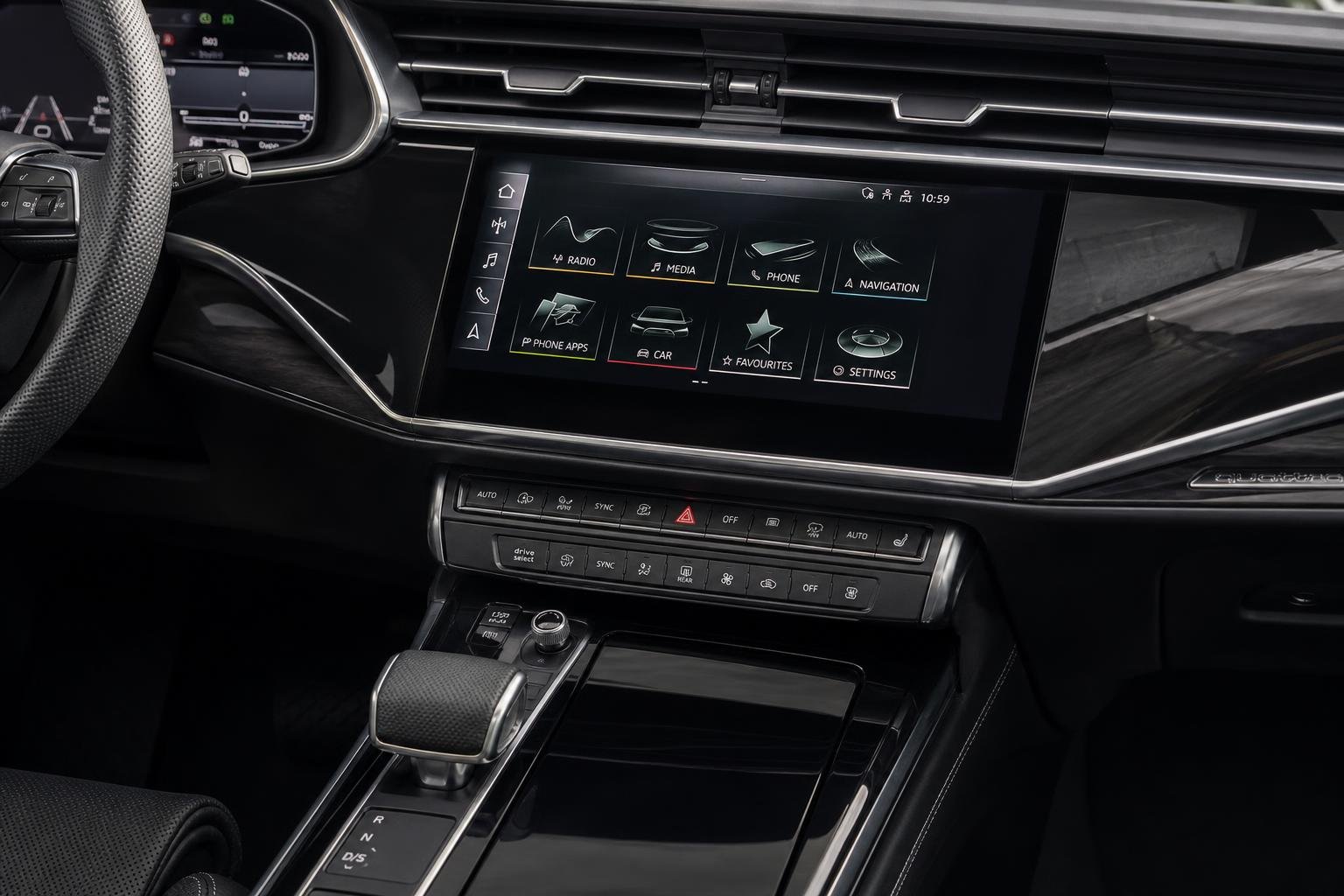

Audi appears to be exploring a way to resolve one of the modern car interior’s most persistent arguments: whether digital screens should replace physical controls. A newly uncovered patent describes a small panel of buttons that could move behind the vehicle’s touchscreen when not needed, allowing the cabin to offer both tactile controls and a minimalist display.
The concept was reported by InsideEVs after being identified by CarMoses in patent material from the German Patent and Trade Mark Office. It remains only a patent at this stage. Audi has not announced a production vehicle or confirmed that the system will reach showrooms.
A physical control panel that can disappear
Based on the patent illustrations, the proposed system consists of a narrow control bar positioned below or behind the central touchscreen. The bar appears to contain several physical buttons and a circular control, potentially serving as a rotary knob. When deployed, the controls would give the driver a conventional surface to press, turn or adjust.
The panel could then retract behind the display at the push of a button. The source report also indicates that voice control might be used to move the assembly. Once hidden, the touchscreen would display digital icons along its lower edge to preserve access to the same functions.
That arrangement would allow the interior to change depending on the driver’s preference. Someone who values a clean, screen-dominated dashboard could hide the hardware, while another driver could bring the controls forward for more direct interaction.
Why Audi is reconsidering touch-heavy interiors
Audi was once known for substantial, well-damped buttons, switches and rotary controls. Many of its earlier interiors placed frequently used functions within easy reach and gave each control a distinct physical feel. That made it possible to operate functions such as volume adjustment or climate settings with limited visual attention.
More recent vehicle interiors across the industry have moved many of those functions onto touchscreens or touch-sensitive surfaces. The approach creates a visually simple dashboard and makes it easier for manufacturers to change menus or add software features. It can also reduce the number of separate components needed in the cabin.
The compromise is that a flat screen offers little physical feedback. A driver must often look down to identify the correct icon, confirm that a touch registered and navigate through a menu. That can be less convenient than locating a familiar knob or button by feel, particularly when the vehicle is moving.
Audi’s patent suggests the company is interested in addressing that criticism without abandoning the flexibility and visual appeal of a large display. The idea is less a rejection of touchscreens than an attempt to make the interface adaptable.
What the buttons might control
The exact functions shown in the patent are not confirmed. The circular control could plausibly be used for audio volume, while the surrounding buttons might operate functions such as climate control, seat heating or driving modes. These are among the tasks drivers commonly adjust repeatedly and may benefit most from tactile controls.
However, the patent material does not establish a final button layout or confirm which functions Audi would prioritize. The design could change considerably before production, assuming it progresses beyond the development stage. Patent drawings are intended to protect an engineering concept and do not necessarily represent a finished component.
That uncertainty is especially relevant to the mechanism itself. A retractable panel would need to fit within a tightly packaged dashboard while remaining durable over years of repeated movement. It would also need to operate quietly, maintain consistent alignment with the screen and resist dust, spilled liquids and the temperature changes experienced inside a parked vehicle.
The advantage—and limitation—of a dual interface
The strongest aspect of Audi’s proposal is that it acknowledges drivers do not all want the same type of interface. A fixed set of buttons can be easier to understand and operate, but it occupies space and cannot adapt as readily to different software functions. A touchscreen is flexible, but it can be less intuitive for controls that are used while driving.
A retractable panel attempts to separate those benefits by making the hardware optional. It could remain visible during a long journey when the driver wants quick access to familiar controls, then disappear when the vehicle is parked or when a cleaner dashboard layout is preferred.
There is also a possible downside. A moving control assembly introduces additional motors, guides, sensors and failure points compared with a conventional button panel. If the mechanism stopped working, the driver might lose access to the physical controls even though their digital equivalents remained available on the screen. The system would therefore need reliable manual and software fallbacks.
The design could also be more expensive and complex than simply fitting permanent buttons. Audi would have to justify that complexity through a meaningful improvement in usability, rather than treating movement as a styling feature.
A broader shift away from screen-only controls
Audi is not alone in reassessing the assumption that fewer physical controls automatically produce a better interior. The original report points to Volkswagen’s move toward more conventional buttons in some products and Mercedes-Benz acknowledging that the industry may have gone too far in removing them.
That change does not mean carmakers are abandoning digital interfaces. Modern vehicles still depend on software for navigation, media, connected services, personalization and many driver-assistance settings. Instead, manufacturers appear to be reconsidering which functions deserve a dedicated physical control and which are better handled through menus.
For Audi, the proposed system could become a way to preserve the brand’s screen-focused design language while responding to customers who miss the tactile quality of older interiors. It would also give designers more freedom to alter the cabin’s appearance without eliminating conventional controls entirely.
Still a concept, not a confirmed Audi feature
The patent is an intriguing indication of Audi’s thinking, but it should not be treated as evidence that retractable buttons are headed for a specific production model. Automakers patent many ideas that are later modified, delayed or abandoned for reasons involving cost, packaging, reliability or user testing.
Even so, the concept highlights an important direction in vehicle-interface design. The debate is no longer simply about choosing buttons or screens. Audi’s proposal asks whether both can coexist—and whether physical controls can be made flexible enough to suit different drivers without dominating the dashboard.
Sources: InsideEVs.


0 Comments