
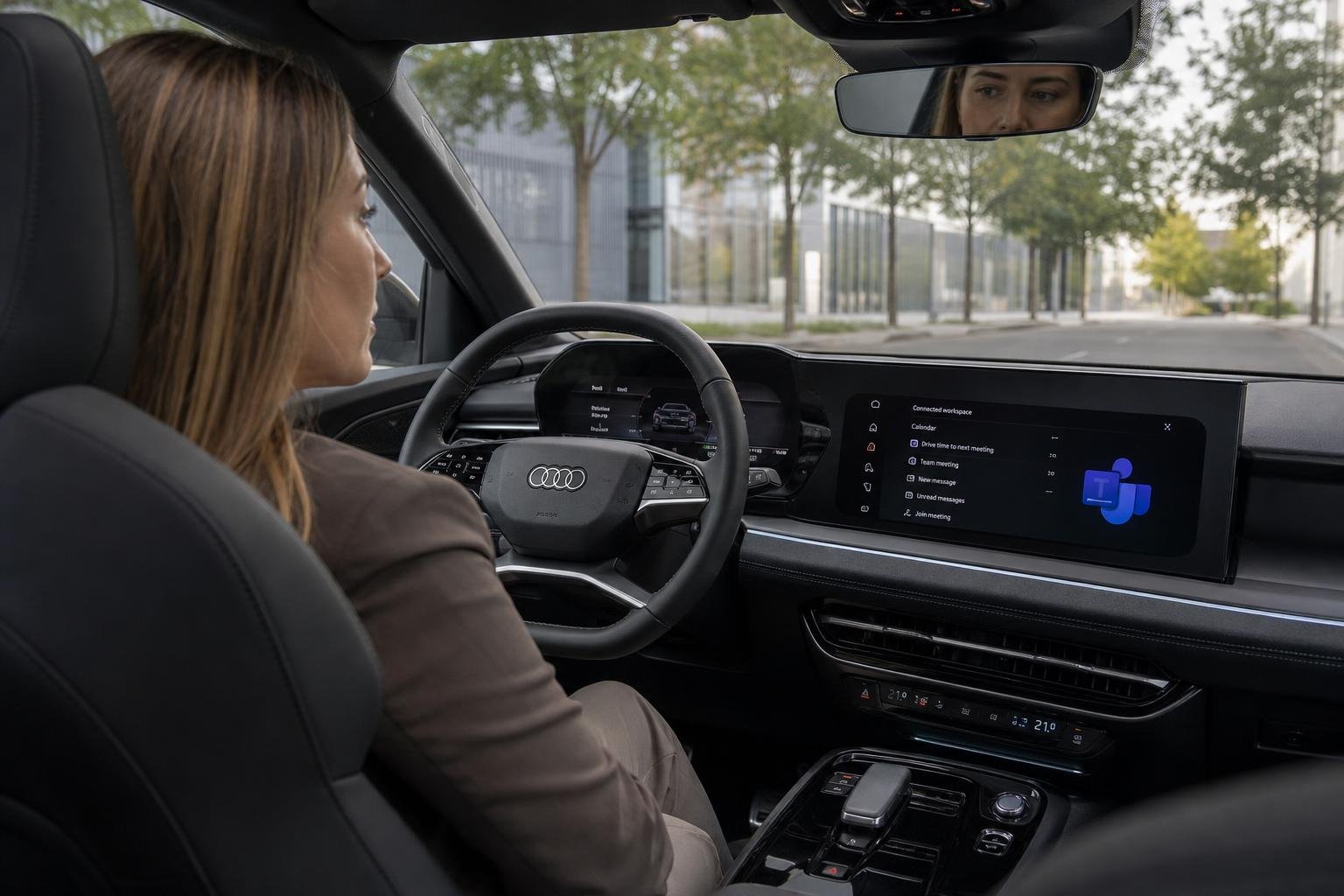

Audi is turning several of its 2026 model-year vehicles into voice-controlled Microsoft 365 workstations. Through a new Connected Work in-car app, drivers can receive calendar briefings, hear emails and Teams messages, dictate replies, schedule appointments and join Teams meetings without reaching for the infotainment screen.
The service is being introduced in 28 European markets and is designed for Audi vehicles equipped with the MMI experience pro package. It reflects a broader shift in automotive software: the cabin is becoming not just a place for navigation and entertainment, but another authenticated access point for cloud-based services.
What Audi’s Connected Work app can do
The app uses voice commands to connect selected Audi vehicles with Microsoft Outlook and Teams. A driver can ask for a summary of the day’s calendar, have incoming emails or chat messages read aloud, dictate responses and create or move appointments.
Audi also says the system can provide a spoken briefing covering calendar entries and outstanding messages. That could be useful before a commute, particularly for drivers who need to understand their schedule without handling a phone. The system is intended to keep the driver’s hands on the wheel and eyes away from the center display while the vehicle is moving.
Teams functionality is focused on voice interaction rather than reproducing the full desktop meeting experience. Drivers can join a meeting and interact through audio, but the system is not intended for screen sharing, presentations or spreadsheet work while driving. That distinction matters: the feature is an in-car communications tool, not a replacement for a laptop.
Why Cerence AI and Microsoft are involved
The technology was developed by Audi with Cerence AI and Microsoft. Cerence describes it as an LLM-powered Mobile Work Agent built using Microsoft Foundry, with integration into Microsoft 365 services and the enterprise tools used to manage access and compliance.
Microsoft Intune, Entra and Purview are part of the security framework identified for the system. In practical terms, those services can help manage device access, user identity and organizational data policies. Audi and Cerence present this as an attempt to make the vehicle a trusted enterprise device rather than simply another Bluetooth-connected accessory.
That architecture is important for corporate users. Email and calendar data can contain confidential information, and businesses often restrict how employees access it outside approved devices. The involvement of Microsoft’s enterprise platforms is intended to give information-technology departments more control over authentication, encryption and policy enforcement, although the supplied announcement does not establish how every organization will configure or approve the feature.
Audi is building on an existing AI strategy
The Connected Work app is not Audi’s first move into generative AI. The company previously announced an integration of ChatGPT through Microsoft Azure OpenAI Service and Cerence’s automotive voice technology. That system expanded voice control beyond fixed commands, allowing drivers to ask general questions and operate functions such as navigation, climate control and infotainment using more natural language.
Audi said that, in its earlier implementation, ChatGPT would be used when the vehicle’s own assistant could not answer a general-knowledge question. The company also stated that questions and answers would be deleted after processing and that ChatGPT would not have access to vehicle data. Those details illustrate the division Audi is trying to maintain between conversational AI and vehicle-control systems.
The Microsoft 365 app applies a similar conversational approach to a more specific use case. Instead of asking an assistant a general question, the driver can request information from a personal work schedule or instruct the system to handle a communication. The value depends less on AI novelty than on whether the system can reliably understand speech, preserve context and complete the requested task without distracting the driver.
Which Audi models and markets are included?
Audi lists the A5, Q5, A6, A6 e-tron, Q6 e-tron, Q7 and Q9 among the vehicles eligible from model year 2026 onward. The list spans conventional and electric models, as well as sedans and SUVs, but availability depends on the vehicle’s equipment and market.
The initial rollout covers 28 European countries, including Germany, France, Italy, Spain, the Netherlands and the United Kingdom. Smaller markets such as Iceland, Liechtenstein and Montenegro are also included. The announcement does not list the United States, so American Audi owners should not assume the app will be available there at launch.
German and English are supported initially. Audi plans to add Danish, French, Italian, Dutch, Polish and Spanish, bringing the intended total to eight languages. Customers can access the feature through the MMI experience pro package or purchase it after delivery through the Audi Function Store, subject to local availability and vehicle compatibility.
The convenience comes with practical limits
Voice access could reduce the temptation to pick up a phone during a commute, but it does not eliminate the risks associated with workplace communication behind the wheel. Reading a long email, composing a complicated reply or participating in a demanding meeting can still consume mental attention even when the driver is not touching a screen.
There are also technical dependencies. Cloud-connected assistants require a functioning data connection, and speech recognition can be affected by road noise, accents and multiple occupants speaking at once. Audi has not provided independent testing in the supplied material to show how quickly the assistant responds or how accurately it handles complex requests.
The commercial model is another unresolved issue. The app is tied to Audi’s optional equipment and digital-store strategy, but the supplied announcement does not specify pricing for every market or whether additional subscriptions will apply. As automakers add more software services after a vehicle is sold, buyers will increasingly need to understand which functions are included with the car and which depend on continuing digital access.
A step toward the software-defined cabin
Audi’s Microsoft 365 integration is significant because it connects a vehicle to the systems that already organize many customers’ working lives. The feature is narrower than a general-purpose AI assistant, but that focus may make it more useful: calendar summaries, message handling and audio meetings are clearly defined tasks with obvious value to business users.
Its success will ultimately depend on execution. If authentication is straightforward, voice recognition is dependable and the system respects driving limitations, the Connected Work app could make the cabin a more practical communications environment. If it encourages drivers to remain mentally absorbed in work, however, convenience will come with a less desirable trade-off. Audi’s rollout shows where in-car AI is heading, but it also highlights the need to judge these systems by distraction control and reliability rather than by their feature count alone.
Sources: Audi; MotorTrend; Motor1.com



0 Comments