
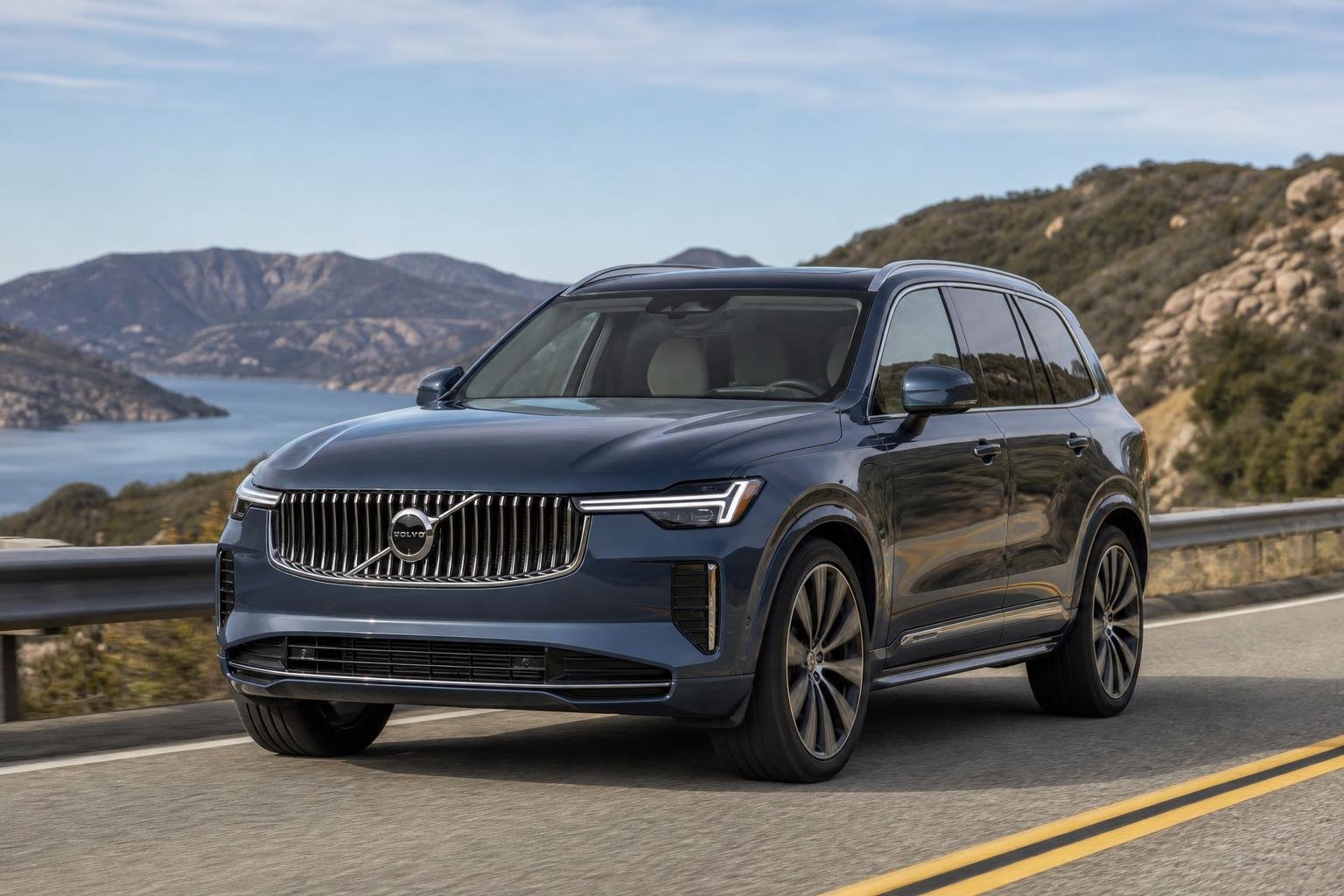

The Volvo XC90 is entering its 13th year on sale, but a substantially larger battery gives the three-row SUV a convincing reason to remain in the conversation. The 2028 XC90 T8 Long Range retains the current model’s design, cabin and turbocharged four-cylinder engine, while more than doubling its electric-only capability for everyday driving.
For the U.S. market, Volvo quotes up to 73 miles of electric range. That figure is preliminary and dependent on final certification and testing conditions; international WLTP figures are higher, reaching up to 100.66 miles, or roughly 101 miles, according to Volvo’s published specifications. Either way, the improvement is substantial over the outgoing U.S.-market model’s roughly 32-mile electric range.
A familiar XC90 with a more useful powertrain
There is no new bodywork to discuss. The Long Range version carries over the styling introduced with the XC90’s 2024 update, including the revised grille, slimmer Thor’s Hammer headlights and restrained Scandinavian exterior treatment. That continuity is not necessarily a weakness. The XC90 remains one of the more understated luxury SUVs in its class, and its proportions have aged better than many newer, more aggressively styled rivals.
The interior follows the same formula. Volvo’s 11.2-inch Google-based infotainment system sits within a clean dashboard, while the cabin emphasizes comfortable seating, natural-looking trim and subdued luxury rather than visual excess. The reviewed car featured Cardamom-colored leather and brown ash wood, along with a Bowers & Wilkins audio system. Third-row space remains more suitable for children than adults, but the XC90 continues to offer practical family flexibility in six- and seven-seat configurations.
Official specifications list up to 171.71 US gallons of luggage space with the rear rows in their normal configuration and as much as 510.91 US gallons with the seats folded, depending on the measurement standard and market. Volvo also retains a flat load floor and up to 5,291.1 pounds of braked towing capacity in published European specifications.
The battery is the real upgrade
The central change is a 41.2-kilowatt-hour battery pack, with independent reporting identifying approximately 37.9 kWh as usable capacity. The pack is installed low in the vehicle, beneath a reworked second-row footwell rather than occupying the previous model’s center tunnel. That packaging helps preserve cabin and cargo utility while lowering the vehicle’s center of gravity.
Volvo says the battery can be charged from empty to full in approximately four hours using a compatible 11-kilowatt AC connection in markets where that specification applies. The U.S. charging equipment and final charging figures should be confirmed closer to launch. There is no indication in the supplied material that the XC90 Long Range supports DC fast charging, so this remains primarily a home- or workplace-charging vehicle.
The range figure matters because it changes how owners can use a plug-in hybrid. Volvo says the median round-trip journey for its U.S. customers is about 22 miles, and most drivers cover fewer than 30 miles per day. If those estimates reflect an owner’s routine, the XC90 could handle school runs, shopping and commuting without starting its gasoline engine on many days. Longer trips still require no charging strategy beyond filling the fuel tank, which is the practical advantage a PHEV retains over a battery-electric SUV for some buyers.
455 horsepower, but not a sports SUV
The powertrain combines a turbocharged 2.0-liter four-cylinder engine with electric drive, all-wheel drive and an eight-speed automatic transmission. U.S. figures supplied for the 2028 model are 455 horsepower and 560 pound-feet of torque, with a claimed 0-to-60-mph time of 4.9 seconds. Volvo’s international specifications list 461 horsepower, 559.8 lb-ft of torque and a 0-to-62-mph time of 5.2 seconds; the difference reflects market specifications and test methodology.
Those numbers suggest a performance SUV, but the XC90 does not feel like one. On the road, it prioritizes a quiet, composed ride over sharp responses. The suspension leans toward softness, though body control remains respectable for a tall, three-row vehicle. The larger battery adds mass, but its low placement helps the XC90 feel planted through corners.
Acceleration is available when the driver presses hard, yet the powertrain generally delivers its performance without turning the XC90 into an aggressive machine. That character suits the vehicle’s mission. Its most important improvement is not the ability to reach highway speed quickly, but the ability to complete ordinary journeys using electricity while retaining strong combined power for merging, towing and loaded family travel.
Why this matters for Volvo
The Long Range XC90 is also a clear expression of Volvo’s revised electrification strategy. The company previously targeted an all-electric lineup by 2030, but later adopted a more flexible approach as EV adoption slowed in important markets. Rather than abandoning combustion engines immediately, Volvo is investing in PHEVs that can cover much of a driver’s routine electrically without requiring a full switch to battery power.
That strategy is particularly relevant to the XC90. The model occupies a premium three-row segment where buyers often value towing ability, long-distance flexibility and family practicality. A large battery makes the PHEV system more useful than the short-range plug-ins that often function mainly as efficient hybrids after a modest electric commute.
However, the benefits depend on regular charging. An uncharged XC90 Long Range remains a heavy luxury SUV carrying a large battery, electric hardware and a gasoline engine. Owners who plug in consistently can reduce gasoline use and local exhaust emissions on daily trips; those who rarely charge will capture far less of the technology’s potential.
Pricing and verdict
U.S. pricing has not been announced, although the first-drive report expects a starting price in the low- to mid-$80,000 range. For reference, Volvo’s UK press material lists the T8 Long Range from $99,280.6 USD but market pricing and equipment cannot be transferred directly between countries.
The XC90 is not a new generation, and its age, weight and limited third-row space remain relevant drawbacks. Yet Volvo has addressed the most obvious weakness of the existing PHEV with a battery large enough to match real daily driving patterns.
That makes the 2028 XC90 an unusually persuasive update rather than a mere cosmetic refresh. It keeps the comfort, safety focus and family-friendly shape that made the XC90 durable, while giving its plug-in powertrain the electric range it should have had from the beginning.
Sources: Motor1.com; Volvo Cars International; Volvo Cars UK specifications; Volvo Car UK Media; InsideEVs.

0 Comments