
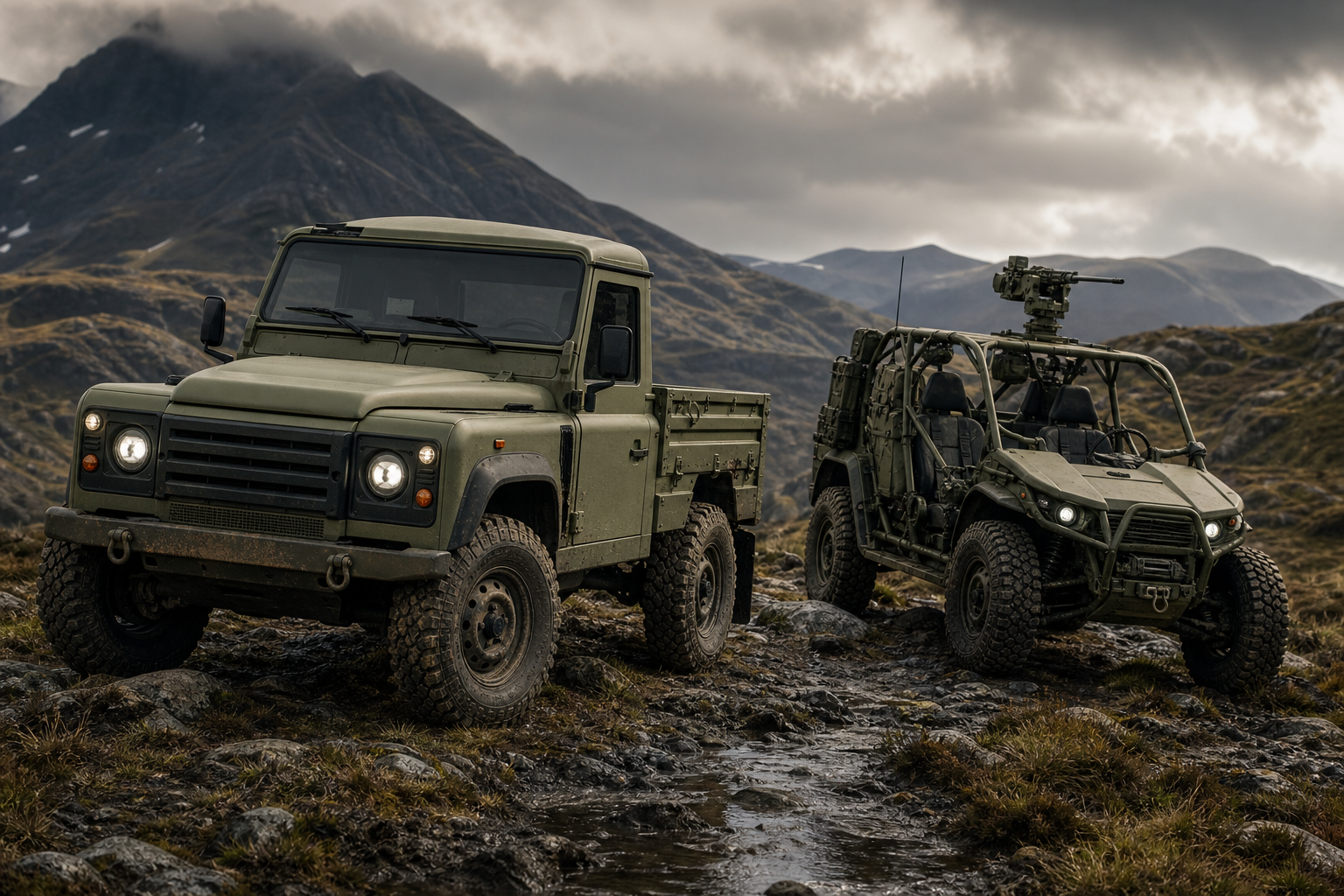

Land Rover has taken the rather posh Defender and given it a proper hard-arse work order. The result is a pair of Wolf Series II tactical vehicles: a single-cab Defender pickup and an open-air buggy, both built on the brand’s D7x platform. That platform is the important bit. It’s the same fundamental architecture that underpins the modern Defender family, and it tells you plenty about where Land Rover sees the rugged side of its most famous nameplate heading.
At first glance, the idea of a luxury-badged Defender turning up in military trim sounds faintly surreal. The modern Defender has become as much an object of lifestyle desire as a mud-plugging tool, regularly spotted outside expensive cafés looking far too clean for a vehicle with such a storied off-road badge. Yet Land Rover has clearly decided that beneath the leather, screens and designer-spec cachet lies a platform capable of much more serious work.
Wolf Series II: a Defender with the gloss stripped off
The Wolf Series II vehicles are described as tactical machines rather than showroom curiosities, and that distinction matters. This is not a styling package with a couple of chunky decals and a snorkel for people who fancy appearing slightly more adventurous on the school run. These are purpose-built variants aimed at military and specialist use, with the Defender pickup and open-air buggy taking very different forms from the civilised road-going versions most buyers know.
The single-cab pickup gives the Defender an unmistakably workmanlike profile. Remove the extra passenger accommodation, pare the body back to the essentials, and you get something much closer to a military utility vehicle in the traditional sense: practical, compact and built to carry equipment rather than pose beside it. The open-air buggy, meanwhile, sounds like the sort of thing that can only exist when someone in engineering has been told to ignore the sensible people in finance. Which, frankly, is often when interesting vehicles happen.
Why the D7x platform matters
The D7x architecture is the backbone of the current Defender line-up, and it was developed with serious structural stiffness in mind. Land Rover’s modern Defender moved away from the old body-on-frame template used by classic Defenders and instead adopted an aluminium-intensive monocoque structure, which is quite a departure from the agricultural machinery aura of the original. For military or specialist applications, that platform brings a useful mix of strength, refinement and packaging flexibility.
That flexibility is what makes these Wolf Series II variants possible. A platform shared with a premium road car usually suggests compromise. Here, though, the opposite is true: the same bones that support plush family wagons and fashionable adventure-mobiles can also be adapted for tactical work. That is rather clever, and also a little bit mischievous. Land Rover has spent years convincing people that the Defender can do anything, and now it is proving the point in a form most buyers will never see.
A modern Defender wearing a very different suit
The contrast between the road-going Defender and these military-spec derivatives is what makes the story so appealing. The production car arrived as a reboot of one of Britain’s most recognisable models, but it did so with all the expected compromises of a modern vehicle: comfort, safety systems, electronics and the sort of interior that makes the old utilitarian Land Rover look like a farm implement with windows.
The Wolf Series II strips away the showroom polish and pushes the Defender back toward its original purpose. Land Rover has a long military history, of course, and the Defender nameplate itself sits within a lineage of tough, no-nonsense vehicles used around the world in harsh conditions. The new tactical versions are a reminder that beneath the market positioning and premium pricing there is still a machine intended to work in places where reputation alone won’t get you very far.
What this says about Land Rover’s strategy
There is also a broader business point here. Manufacturers love to talk about heritage, but they don’t always do much with it beyond hanging a few old photographs in a launch presentation. Land Rover, by contrast, has built a very modern product around one of its oldest ideas: the Defender as an all-purpose, go-anywhere platform. The Wolf Series II shows that this isn’t just nostalgic marketing fluff. The engineering underneath can be adapted for genuinely demanding roles.
That does not mean civilian owners will suddenly be able to order a military buggy from the dealer, of course. But it does reinforce the Defender’s unusual position in the line-up. It is one of the few premium SUVs whose underpinnings can plausibly be stretched from luxury family transport to specialist tactical use without the whole enterprise looking like a joke. Not bad for a vehicle that, in some circles, is still treated as if it should only ever be covered in mud and bad decisions.
A Defender with real purpose still left in it
The modern Defender has sometimes been accused of going soft simply because it became more comfortable, more polished and far more expensive than the old model. Yet the Wolf Series II is a neat rebuttal to that complaint. Land Rover has not abandoned the core idea of durability; it has just repackaged it in a form that can wear a tuxedo on Monday and a helmet on Tuesday.
That duality is exactly what makes the Defender such an interesting machine. A lot of off-roaders can look tough. Far fewer can credibly be turned into military-spec equipment without requiring a complete re-engineering from the ground up. The Wolf Series II suggests the Defender still has a proper hard centre, even if the civilian version spends most of its time ferrying people who have never knowingly seen a rutted field.
And that is perhaps the most telling thing here. Land Rover’s latest Defender may be the sort of vehicle you usually expect to find wearing alloy wheels and a spotless paint finish, but the hardware underneath still has the sort of bones that can handle far rougher work. The military lads have merely shown up to remind everyone what it is actually built for.
0 Comments