
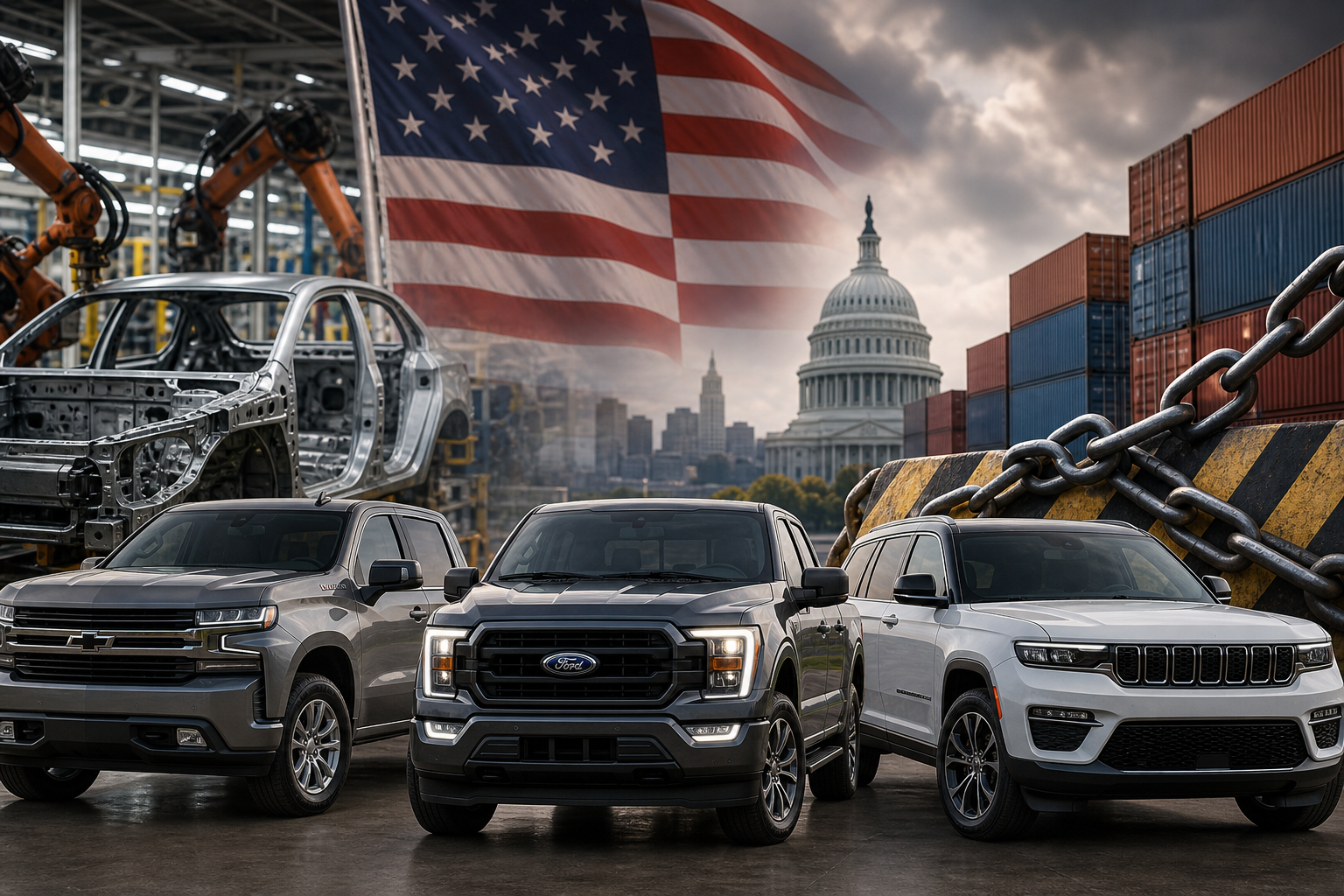

General Motors, Ford and Stellantis have made their position on Donald Trump’s latest tariff idea clear: they believe it would be bad for the companies, their employees and the customers who buy their vehicles. The three Detroit automakers, working through their Washington lobbying operation, are effectively warning that another round of trade barriers could raise costs across the industry rather than help American manufacturing.
The message matters because these are not fringe critics. GM, Ford and Stellantis remain among the most visible industrial employers in the United States, and their businesses are tightly intertwined with suppliers, parts logistics and cross-border production. When tariffs enter the picture, the costs don’t stay neatly contained at the port or the border. They work their way through the supply chain, affecting the price of components, final vehicle assembly and, eventually, the sticker price seen by shoppers.
Why the Detroit Three are pushing back
The companies’ argument is straightforward: a tariff policy that appears aimed at supporting domestic industry can still end up burdening the very automakers it is supposed to help. Modern vehicle production in North America depends on a web of parts and subassemblies that move repeatedly between the United States, Canada and Mexico before a car or truck reaches a showroom. That makes the sector unusually sensitive to trade disruptions.
For GM, Ford and Stellantis, the concern isn’t limited to headline-grabbing import duties on completed vehicles. Even a policy focused on parts or regional trade can add friction to an already complex production system. That can mean higher manufacturing costs, more uncertainty for planning, and less room to absorb price pressure in a market where margins can move quickly.
The lobbying effort also reflects a familiar reality in Washington: automakers may publicly support domestic industry goals while privately resisting the specific tools used to pursue them. Tariffs can be politically appealing because they sound decisive, but the industry’s response suggests the practical effect could be higher costs for American-built vehicles as well as imported ones.
The supply-chain reality behind the argument
Vehicle manufacturing in North America is heavily integrated. Engines, transmissions, electronics, stamped body parts and countless smaller components often cross borders multiple times before final assembly. That structure has been built over decades to reduce costs and improve efficiency. It also means that a tariff doesn’t simply hit an isolated finished product; it can ripple through the entire production network.
For automakers, those ripples can become especially painful when applied to high-volume vehicles and truck lines that already carry significant content costs. For consumers, the effect is often easiest to see at the dealership, where pricing pressure tends to show up in higher transaction prices, fewer incentives or both. For workers, the concern is that cost increases and planning uncertainty can eventually affect investment decisions, model allocation and plant utilization.
That is the basis for the warning from GM, Ford and Stellantis. Their Washington operation is telling Trump that a policy intended to strengthen American automaking could end up weakening the industry’s competitiveness and making vehicles more expensive for the people who buy them.
Why this dispute lands differently now
Tariff fights are hardly new in the auto business, but they tend to carry extra weight when they involve the Detroit Three. GM, Ford and Stellantis are deeply embedded in U.S. manufacturing, and they employ large numbers of American workers directly and indirectly through suppliers. A policy clash with those companies therefore touches not just corporate strategy but a substantial industrial base.
It also comes at a time when the cost structure of vehicle development is already under pressure from electrification, software, emissions compliance and global supply-chain risk. Add tariff uncertainty to that mix and planners lose another variable they would rather control. That makes the industry’s lobbying response less about politics than about protecting margins and maintaining predictable production schedules.
In practical terms, the issue comes down to whether the cost of a tariff is absorbed by manufacturers, passed along to suppliers or shifted to buyers. In most cases, some combination of all three happens. That is why automakers often argue that trade barriers can hurt the domestic market even when they are framed as pro-American policy.
What it means for buyers and the industry
For shoppers, the immediate concern is price. If the industry faces higher input costs, automakers have fewer options when setting vehicle prices, especially in segments where demand remains strong and inventory is limited. Trucks and SUVs are obvious examples, but the effect can spread more broadly if parts prices rise across the lineup.
For suppliers, tariffs can complicate long-term contracts and sourcing decisions. Many parts businesses operate on tight margins and rely on volume commitments from the automakers. When trade policy changes suddenly, suppliers may be asked to absorb cost increases they can’t easily offset. That can affect staffing, capital spending and future investment.
The Detroit Three’s message to Trump is therefore as much about stability as it is about opposition. GM, Ford and Stellantis are signaling that they’d rather compete on product, efficiency and manufacturing capability than on a policy environment that makes each vehicle more expensive to build. Whether that argument carries weight depends on how trade policy is framed, but the industry’s response leaves little doubt about where the automakers stand.
As the debate continues, the important point is that tariffs in the auto sector rarely stay abstract for long. They influence what gets built, where it gets built, and how much the finished vehicle costs once it reaches a customer. That is why the Detroit Three moved quickly to make their concerns known.

0 Comments