
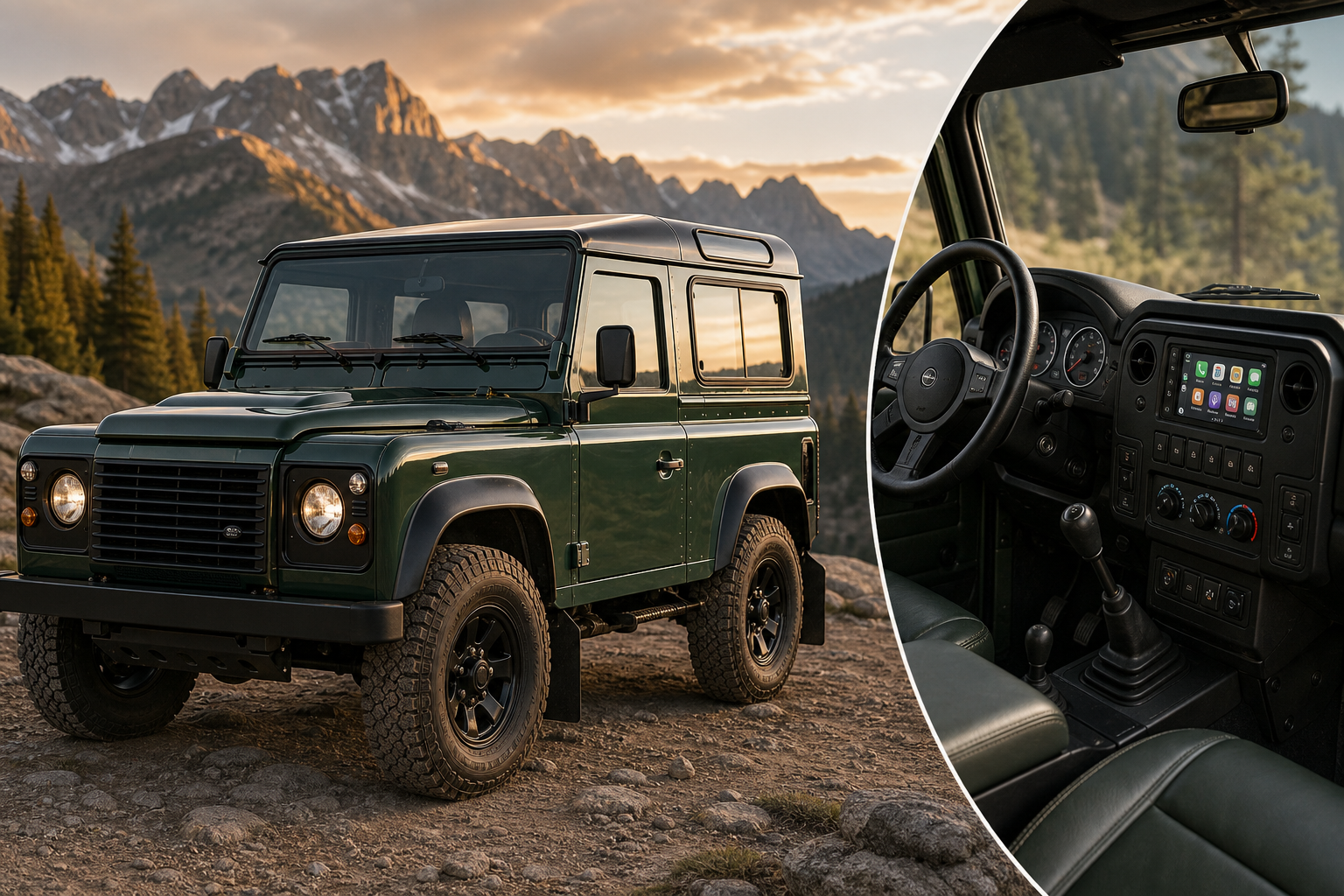

Land Rover Defenders have become one of the most heavily reimagined platforms in the restomod world, and Osprey Custom Cars is taking a familiar formula a step further with a build that blends traditional Defender proportions with a noticeably more modern cabin. The company’s latest example keeps the rugged, boxy look intact while adding a 7-inch infotainment screen and an eight-speaker audio system inside.
That combination speaks to where the market for classic 4×4 restorations has settled. Buyers still want the upright stance, exposed hardware and utilitarian character that made the original Defender an icon, but many also expect better connectivity, improved comfort and a cabin that feels less like a museum piece. Osprey’s approach is aimed squarely at that middle ground.
A familiar Defender shape with a more usable interior
From the single image and the information provided, the most notable update is the cabin treatment. The new 7-inch infotainment display brings contemporary functionality to a vehicle lineage that began long before touchscreens and smartphone integration were expected in even premium off-roaders. Paired with an eight-speaker audio system, it gives the truck a far more modern feel without abandoning the basic Defender architecture.
That matters because interior refinement is often the dividing line in the Defender restomod space. Some builders focus almost entirely on appearance and mechanical rebuilding, leaving the cabin largely bare or period-correct. Others lean hard into modern luxury. Osprey appears to be aiming for a usable compromise: enough technology to make the truck pleasant to live with, but not so much that it loses the personality that draws people to a classic Defender in the first place.
Why the Defender remains such a strong restomod canvas
The original Defender’s appeal has always rested on clear, almost blunt design. Its slab sides, upright glass and exposed utility-first layout make it instantly recognizable, and those proportions translate well into custom builds. Unlike many classic SUVs, the Defender’s silhouette can absorb new paint, new trim and upgraded lighting without losing its identity.
That is one reason the model has become such a popular basis for specialist builders. It has the right mixture of heritage, brand recognition and visual simplicity. Even when extensively reworked, it still reads as a Defender from a distance. Builders can then decide how far to push the transformation underneath the surface, from refreshed mechanicals and improved suspension to completely rebuilt interiors.
What the Osprey treatment suggests
Osprey Custom Cars has not positioned this vehicle as a radical redesign. Instead, the evidence points toward a thoughtful update that keeps the truck’s character visible. The new infotainment system and upgraded audio are the headline items because they are the most obvious signs that this is not a purely nostalgic restoration.
For many buyers in this part of the market, that’s precisely the point. They want a Defender that still looks like a Defender, but one that doesn’t demand the same compromises as a decades-old utility vehicle. A properly integrated screen makes navigation and media easier to manage, while a better audio system can dramatically improve everyday usability, especially in a vehicle with the kind of road noise a traditional Defender is known for.
Those are not exotic changes, but they are practical ones. In the restomod world, that often counts for more than adding gimmicks or chasing numbers that don’t materially improve the ownership experience.
The broader restomod formula
Osprey’s Defender fits into a wider trend among classic SUV builders: the shift from preservation toward selective modernization. The aim is no longer to freeze a vehicle in time. It is to keep the visual and emotional appeal of the original while removing some of the friction that comes with old-school design.
That can mean modern infotainment, more capable air conditioning, quieter interiors, better seating, stronger electronics or improved lighting. In a Defender, even relatively modest updates can make a large difference because the original vehicle was engineered as a working tool first and a lifestyle object second.
The result is a type of vehicle that sits in an unusual space. It is not a factory-new SUV, and it is not trying to be one. Instead, it appeals to owners who want something distinctive enough to stand apart from modern luxury off-roaders, but refined enough to be driven regularly rather than simply displayed.
What readers should take away from this build
Based on the details available, the standout feature of Osprey’s latest Defender is not a dramatic change in shape or a headline-grabbing powertrain claim. It is the way the cabin has been brought forward with modern equipment while leaving the truck’s classic identity visible. That balance is what gives a good restomod its value.
For the Defender, a vehicle that already carries enormous cultural weight among off-road fans and custom builders, even a relatively restrained upgrade can shift the experience meaningfully. A 7-inch screen and an eight-speaker stereo may sound simple on paper, but in the context of a vintage 4×4, they represent a clear move toward livability without erasing the rugged character that made the original so desirable.
0 Comments