
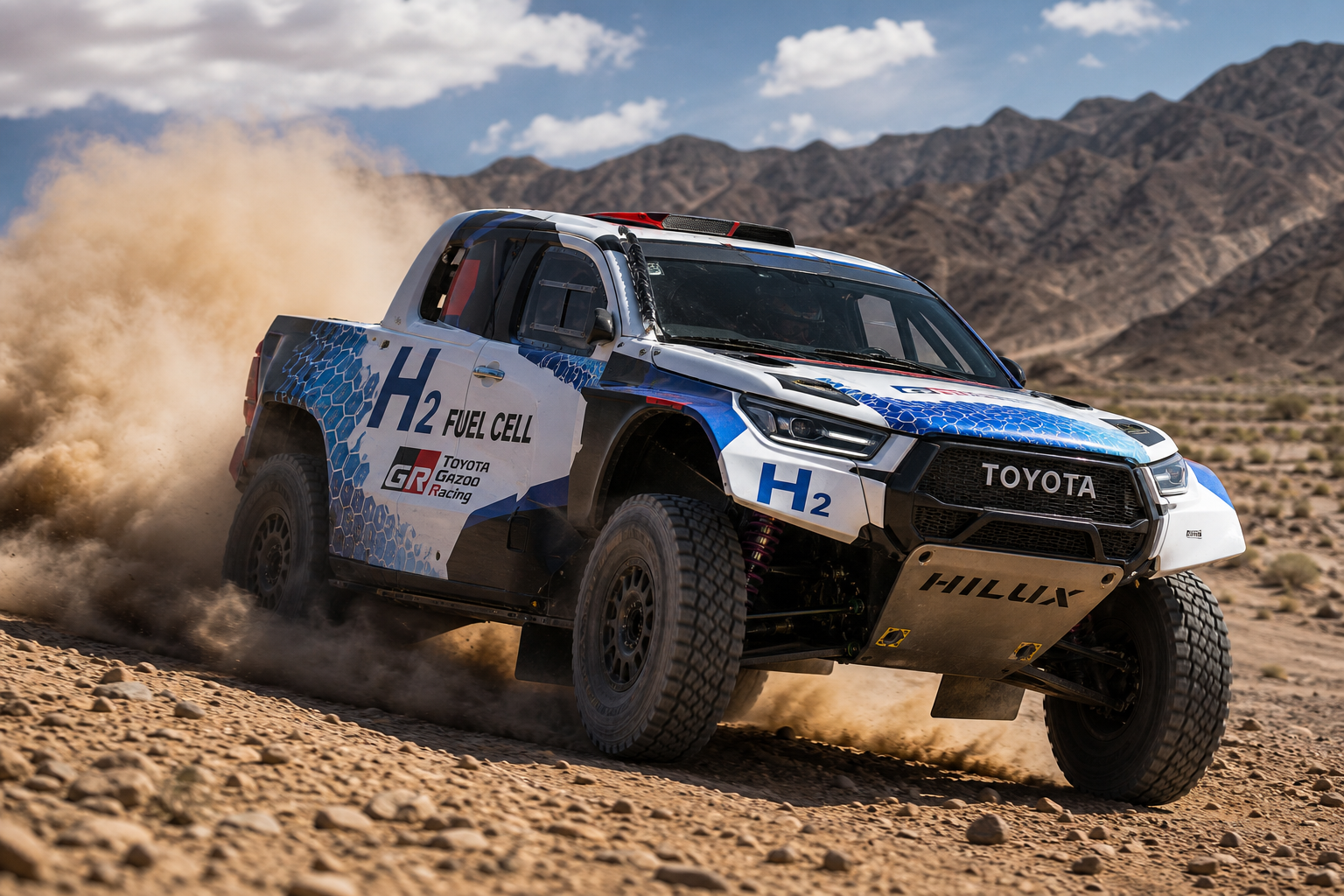

Toyota has taken another step in proving that hydrogen can work beyond road cars and lab prototypes. The DKR GR FC Hilux is a Dakar-style rally raid machine that pairs a fuel-cell powertrain with the same custom bodywork and chassis layout used by Toyota’s V6-powered competition Hilux. The difference is what comes out of the tailpipe: only water.
Fuel-cell power meets Dakar engineering
The DKR GR FC Hilux is built on the same basic motorsport architecture as Toyota’s other purpose-made rally raid entries, but its power source is what separates it from the pack. Instead of relying on a conventional combustion engine, the truck uses hydrogen fuel-cell technology to generate electricity, which then powers the vehicle’s drivetrain. That gives Toyota a very visible demonstration platform for a technology the company has continued to develop across multiple markets.
In rally raid terms, the engineering challenge is significant. Dakar-style competition asks a vehicle to endure sustained heat, dust, vibration, and long stretches away from support. That makes it a useful proving ground for any alternative powertrain, particularly one that must package high-pressure hydrogen storage, electrical hardware, cooling systems, and race-ready durability inside a tube-frame-style competition chassis.
Shared bodywork, different energy source
Visually, the hydrogen Hilux follows the same rough-and-ready competition language as the V6 version. Toyota hasn’t reinvented the exterior for the sake of novelty; instead, it has retained the custom bodywork and chassis that suit the demands of rally raid competition. That approach keeps the focus on what matters most in this environment: robustness, serviceability, and the ability to survive repeated punishment over rough terrain.
Using a familiar motorsport shell also helps Toyota benchmark the hydrogen truck against an internal-combustion reference point. The V6-powered Hilux is already a known quantity in this segment, so running a fuel-cell variant alongside it gives Toyota a direct comparison between two very different energy strategies within the same competition framework.
Why Toyota is testing hydrogen in competition
Toyota has long viewed hydrogen as one of several paths toward lower-emissions mobility, rather than a one-size-fits-all answer. The company has invested in fuel-cell passenger cars, commercial applications, and motorsport demonstrations, using each program to build technical knowledge around hydrogen storage, thermal management, and system integration.
Rally raid competition is particularly useful because it exposes hardware to conditions that are hard to replicate in a controlled test environment. A fuel-cell vehicle that can be packaged, cooled, repaired, and made reliable enough for this kind of event offers lessons that go well beyond headline-making runs in a demo setting. Even if the technology is not aimed at replacing every combustion-powered off-road racer, the development work is still relevant to Toyota’s broader hydrogen strategy.
What the water exhaust tells you
The most attention-grabbing detail is the tailpipe output. Because a fuel-cell system combines hydrogen with oxygen to generate electricity, the byproduct at the exhaust is water vapor rather than carbon dioxide from combustion. That doesn’t make the vehicle “emission-free” in a full lifecycle sense, but it does show the basic operating principle clearly and gives the truck an obvious technical calling card.
For a motorsport audience, the significance is less about symbolism and more about packaging the system so it can survive race use. Hydrogen tanks, fuel-cell stacks, electric motors, and power electronics all have to work together without compromising weight distribution or durability. In a rally raid setting, that’s a demanding exercise, especially when the vehicle must remain competitive enough to justify being built at all.
Part of a wider Toyota motorsport and technology push
Toyota has used motorsport for years as a development tool, and the Hilux-based fuel-cell truck fits that pattern neatly. The company’s competition efforts have often been about more than results alone; they also provide a visible stage for technologies Toyota wants to understand better before rolling them into wider use. In that sense, the DKR GR FC Hilux is as much an engineering project as it is a race truck.
It also reinforces the adaptability of the Hilux platform in motorsport form. The production truck’s reputation for toughness has long made it a logical base for off-road competition, and Toyota’s decision to apply hydrogen technology to that formula shows how far removed a modern rally raid vehicle is from its showroom counterpart. The relationship to the road truck is mostly philosophical at that point, but the name carries weight, and Toyota is using it to connect experimental technology to a familiar badge.
What this means for hydrogen in off-road racing
The DKR GR FC Hilux does not suddenly make hydrogen the default answer for off-road motorsport, and it isn’t meant to. What it does show is that fuel-cell systems can be adapted to an environment that is punishing on every level. That is useful in its own right, particularly for a manufacturer looking to understand where hydrogen can and can’t fit in future mobility plans.
For readers watching the evolution of alternative powertrains, the truck is a reminder that the most interesting development work often happens far from the showroom. A Dakar-style racer may seem like an unlikely place for fuel-cell experimentation, yet the demands of the event make it one of the clearest tests of whether the technology can withstand real-world abuse. Toyota’s answer, at least in this Hilux, is to build it into a proven motorsport package and let the hardware speak for itself.
0 Comments