
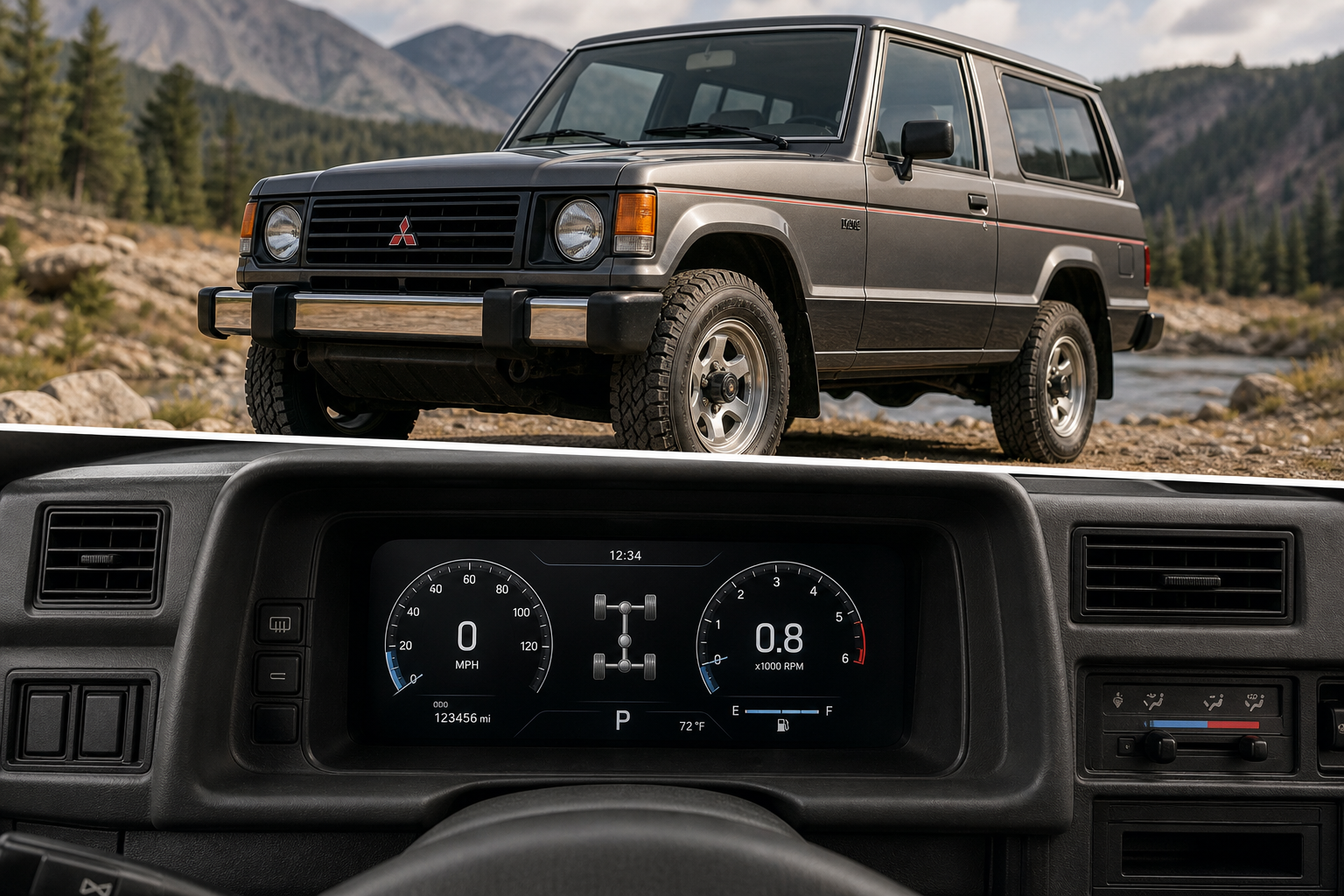

Blending modern instrumentation into an old 4×4 can go badly in a hurry. Too often, the result is a dash full of mismatched screens, awkward bezels, and wiring that looks like an afterthought. But a factory first-generation Mitsubishi Montero fitted with digital displays inside its original instrument cluster shows how well the concept can work when the execution is restrained and thoughtful.
The appeal here is not simply that the Montero has been updated. It’s that the truck keeps the look and feel of an OEM interior while quietly adding the kind of information and clarity that older analog gauges can’t always provide. That balance is difficult to achieve in any restomod or resto-mod-style build, and it’s especially tricky in a vehicle like the Montero, where the cabin design is simple, functional, and very much of its era.
Why the first-gen Montero is a good canvas
The original Mitsubishi Montero — known in some markets as the Pajero — earned its reputation as a durable, capable, and straightforward SUV. The first generation arrived at a time when utility vehicles were still unapologetically truck-like, with interiors built around practicality rather than design flourishes. That makes it a strong candidate for selective upgrades.
Unlike more ornate classic SUVs, the Montero’s dashboard doesn’t rely on elaborate trim or sculptural forms to make an impression. Its instrument panel is clean and utilitarian, which gives an installer room to modernize the display without upsetting the overall character of the cabin. That’s important, because the best retrofit work doesn’t try to erase the vehicle’s identity. It updates the parts that age the most while leaving the rest intact.
OEM-plus done the right way
The phrase “OEM+” gets used a lot, but it has a specific meaning in builds like this one. The goal is not to announce the modification as loudly as possible. It’s to make the vehicle feel as if the factory itself might have chosen this solution, or at least something close to it. In a classic SUV, that usually means matching the original layout, preserving switchgear where possible, and avoiding visual clutter.
That approach matters even more when the work involves digital gauges. Screen-based displays can look out of place in older interiors if they’re too bright, too sharp-edged, or obviously sourced from a generic aftermarket kit. By contrast, a well-integrated digital cluster can improve readability and functionality while still respecting the architecture of the dash. The Montero build appears to lean hard in that direction.
For a vehicle designed long before modern infotainment and configurable driver displays became common, the update brings obvious practical benefits. Digital instrumentation can make it easier to monitor key information at a glance, and it can do so without requiring the sort of visual redesign that often makes older cabins feel compromised.
What makes the swap interesting to enthusiasts
Retrofits like this matter because they sit in a sweet spot between restoration and modification. A full factory-correct restoration preserves the vehicle exactly as it was, but it also leaves the owner with all the limitations of the original hardware. A heavily customized build may solve those limitations, yet lose the character that made the vehicle appealing in the first place. An OEM-style gauge upgrade gives the owner a third path.
That’s particularly relevant in the 4×4 world, where older vehicles are often still used rather than merely displayed. A classic Montero that sees trail duty, road trips, or daily service benefits from clearer information and improved reliability of the instrumentation itself. If the electronics are cleaner, easier to read, and better suited to modern use, that can be a meaningful quality-of-life improvement without forcing a complete interior transformation.
There is also a broader appeal in seeing a respected old SUV updated with restraint. The Montero has enough identity to stand on its own, and its boxy, purposeful design doesn’t need dramatic alteration to remain interesting. When a retrofit respects that, the result tends to feel more authentic than an overtly flashy build ever could.
A reminder of how far the SUV interior has come
Part of what makes this Montero noteworthy is how clearly it illustrates the distance between the early 4×4 era and today’s expectations. In period, instrument clusters were straightforward and often built around basic analog readouts. They did the job, but they lacked the flexibility and precision that modern digital displays can offer. Today’s drivers are used to more detailed vehicle data, and even in a classic SUV, that expectation can shape how a build is executed.
But this isn’t about turning an old Montero into a modern crossover. It’s about preserving a rugged, mechanically honest vehicle and giving it a cleaner interface for the driver. The difference is subtle, but it’s what separates a tasteful retrofit from a gimmick. The best updates don’t shout. They fit.
That’s why this first-generation Montero stands out. It shows how an older off-roader can adopt a bit of modern utility without losing the feel of a factory truck. For enthusiasts who like their classics to remain usable, that’s a smarter direction than trying to reinvent the vehicle from the ground up.
And in a segment where ruggedness and simplicity are part of the appeal, a carefully executed digital gauge swap may be one of the most believable upgrades you can make.

0 Comments