
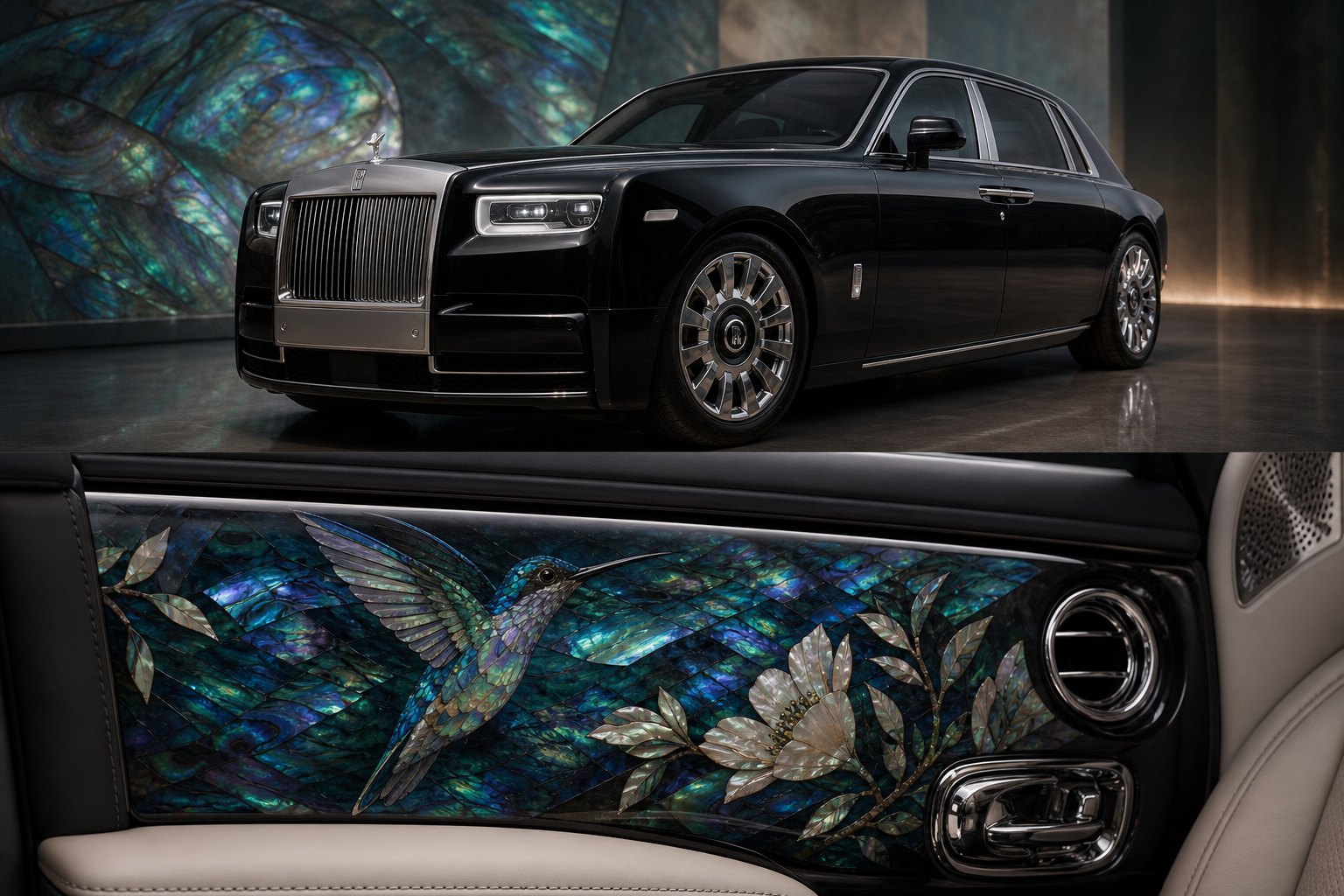

Rolls-Royce has added a new material to its already expansive catalogue of bespoke craftsmanship: abalone shell marquetry. The technique makes its debut on the Phantom Hummingbird, the first Rolls-Royce to feature artwork created from abalone shell, chosen for its shifting blue-green sheen.
A new material in Rolls-Royce’s coachbuilt vocabulary
Rolls-Royce has long treated interior trim as a canvas for hand-made detail, using wood veneers, embroidery, metal inlays, and paint finishes to turn its cars into rolling commissions. The Phantom Hummingbird extends that philosophy with a material that is unusual even by the brand’s standards. Abalone shell, prized for its iridescent color and natural movement in the light, gives the car’s marquetry a visual quality that changes as the viewing angle shifts.
Marquetry itself is a traditional decorative art, typically involving the careful cutting and assembly of different materials into images or patterns. In this case, the appeal is not only in the subject matter, but in the way the shell’s reflective surface introduces depth and contrast. That makes it a natural fit for Rolls-Royce, where surface finish and tactile precision are as important as the overall design theme.
Why abalone shell matters in a bespoke Rolls-Royce
For a marque built around commission-led personalization, the use of abalone shell is significant because it broadens the palette available to clients and designers. Rolls-Royce has built its reputation on turning customer ideas into one-off or highly limited creations, and material innovation is part of that business. Each new technique gives the company and its Bespoke division more ways to differentiate a Phantom from another Phantom.
The choice of abalone shell also fits the brand’s preference for naturally derived materials that can be presented as both luxurious and technically demanding. Shell has to be selected, cut, and assembled with care, and the finished effect depends on consistency in tone and shape. In a car with the Phantom’s pricing and exclusivity, the craftsmanship is part of the proposition.
The Phantom’s role as a showcase for craftsmanship
The Phantom has always been the Rolls-Royce model most closely associated with extreme customization. As the flagship sedan, it serves as the company’s main stage for new materials, new cabin treatments, and one-off design commissions. Features like the Phantom Hummingbird’s abalone artwork reinforce that role, showing how far the brand can push interior art without losing sight of its core identity.
That is important for understanding Rolls-Royce’s broader strategy. While the company’s lineup is defined by traditional luxury, much of its recent momentum has come from Bespoke and coachbuilt-style commissions, where uniqueness carries as much value as horsepower or technology. A feature such as abalone marquetry is not a technical breakthrough in the conventional automotive sense, but it is a meaningful development in the context of ultra-luxury carmaking.
A detail aimed at buyers who value exclusivity over convention
The Phantom Hummingbird is less about changing the way a Rolls-Royce drives than about expanding the ways it can be specified. For buyers in this segment, that distinction matters. The appeal of a Phantom often lies in the fact that it can be tailored to the owner’s taste down to the smallest interior details, and this new marquetry treatment adds another layer of individuality.
In a market where many premium cars advertise technology through screens and software, Rolls-Royce continues to emphasize material craft and visual richness. The Phantom Hummingbird’s abalone shell artwork is a clear example of that approach: a traditional decorative method updated with a material that gives the cabin a distinctive, almost jewel-like character.
For Rolls-Royce, that kind of detail is the point. The brand’s most interesting innovations are often the ones that appear quietly, in a single commission or special build, and then become part of the vocabulary for future Bespoke projects. The Phantom Hummingbird’s marquetry may be a small element of the car as a whole, but it is the sort of detail that defines the Phantom’s place at the top of the luxury hierarchy.

0 Comments