
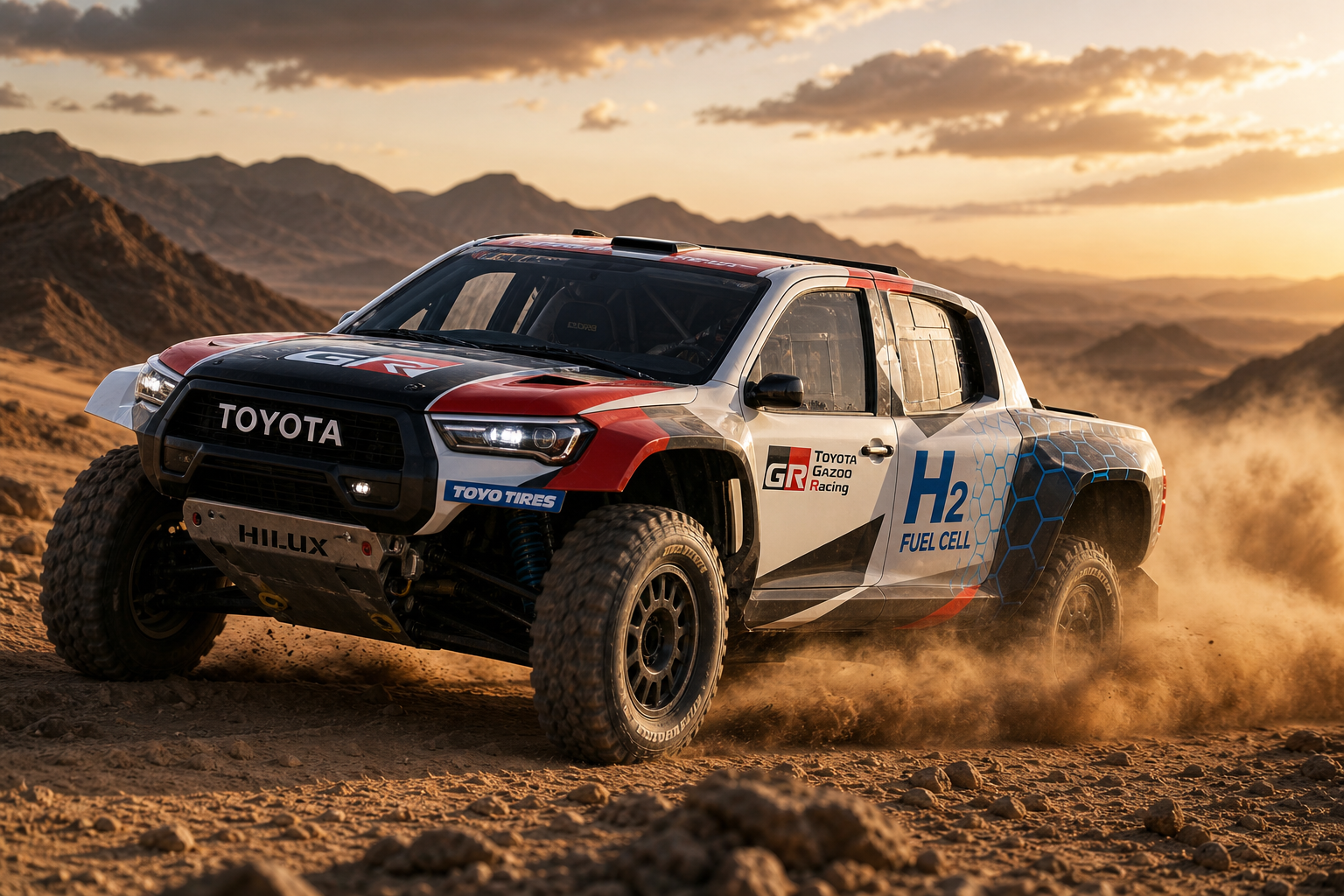

Toyota Gazoo Racing is taking one of its most familiar rally-raid nameplates in a very different direction. The DKR GR FC Hilux has been developed to compete in Dakar’s Future Mission 1000 class, where the focus is less on outright stage times and more on proving that alternative propulsion can survive one of motorsport’s harshest environments. Backed by Jameel Motorsport and Toyo Tires, the project puts fuel-cell technology inside a platform long associated with diesel durability and desert punishment.
That makes the truck more than a concept exercise. Dakar has always been a brutal proving ground, and Mission 1000 is the event’s test bed for experimental powertrains and energy systems. If a fuel-cell machine can function in that setting, with heat, vibration, distance, sand, and service limitations all working against it, it becomes a meaningful demonstration of what the technology can withstand outside a laboratory or a controlled road test.
A familiar Hilux shape with a very different core
The Hilux is one of Toyota’s most recognized global nameplates, and in rally-raid form it has built a reputation for toughness over many years. The GR badge ties the truck to Toyota Gazoo Racing’s motorsport arm, but the DKR FC Hilux is not a conventional combustion-powered race vehicle with a few hybrid touches bolted on. Its defining feature is the fuel-cell powertrain, which uses hydrogen to generate electricity for propulsion.
That approach places the truck in a different development lane from the internal-combustion machines that dominate modern Dakar. Instead of relying on a large fuel tank and engine package designed purely around range and torque delivery, the fuel-cell system is intended to show that zero-tailpipe-emissions technology can be adapted for off-road competition. In a discipline where reliability and endurance matter as much as speed, that is a serious engineering challenge.
Why Mission 1000 matters
Future Mission 1000 is the part of Dakar dedicated to experimental vehicles and emerging technologies. It is not the headline fight for overall victory, but it is where manufacturers and technical partners can gather real-world data under event conditions that are far closer to endurance punishment than to a showroom validation cycle. That makes it useful for powertrains, batteries, hydrogen systems, drivetrains, cooling strategies, and the hardware needed to keep all of it alive in hostile terrain.
For Toyota, the project fits neatly with a broader motorsport and engineering strategy. The company has spent years using competition as a development tool, and Dakar has always been one of the clearest examples of that philosophy. A fuel-cell Hilux in Mission 1000 extends that logic into an area with obvious relevance to future mobility, even if the route from racing prototype to production vehicle remains a long one.
The role of Jameel Motorsport and Toyo Tires
The project is being supported by Jameel Motorsport, which has become increasingly visible in regional and international motorsport programs, and by Toyo Tires, whose off-road racing involvement gives it direct exposure to the kind of load, heat, and abrasion Dakar demands. In a truck like this, tires are not a peripheral detail. They are part of the system that allows any alternative powertrain to be meaningfully tested in the desert.
That support matters because vehicles in Mission 1000 are judged by more than a simple finish or DNF. They have to demonstrate that new technology can survive the same punishing environment that breaks conventional race machinery. The collaboration around the DKR GR FC Hilux suggests Toyota is treating the program as a serious technical exercise rather than a marketing display.
Hydrogen in rally-raid context
Hydrogen fuel cells have been discussed in automotive circles for years, but they are still most often evaluated through the lens of road cars, infrastructure, and energy policy. Dakar changes the conversation. The race environment strips away much of the theoretical debate and forces the hardware to answer practical questions: can it cool itself, can it sustain output, can it tolerate repeated shock loading, and can it do all that while covering extreme distances far from a service bay?
That is where the DKR GR FC Hilux becomes interesting. The project places hydrogen technology in a motorsport discipline defined by remoteness and repetition rather than short bursts of sprint performance. It is one thing to build a prototype that works on paper; it is another to make it behave in deep sand and punishing temperatures with the same consistency expected from Dakar entrants.
Part of Toyota’s broader competition and technology plan
Toyota has not been shy about using motorsport to explore future powertrain paths. The company has already invested heavily in hybrid and alternative-energy racing programs, and the fuel-cell Hilux is consistent with that mindset. Even if the truck itself is a niche prototype, the lessons learned from packaging, energy management, cooling, integration, and durability testing can feed back into broader engineering work.
That connection is especially important in rally raid, where the vehicle is exposed to real-world stresses that can reveal weaknesses quickly. Suspension loads, contamination, thermal buildup, and packaging compromises can all become obvious over the course of a single event. For a new powertrain architecture, those lessons are valuable precisely because they are so hard-won.
What readers should take from the project
The DKR GR FC Hilux is not being launched as a showroom model and it is not a preview of a direct road-going replacement for Toyota’s current off-road trucks. Instead, it is an engineering statement built for a very specific competition environment. Its purpose is to show how far fuel-cell technology can be pushed when the easy answers disappear and the terrain does its best to expose every weakness.
That is why the truck is worth paying attention to even beyond Dakar itself. Experimental programs only have value if they produce useful information, and Mission 1000 gives Toyota a way to gather that information in conditions that are hard to replicate anywhere else. In a category where survival is the first requirement, a fuel-cell Hilux is a clear sign that alternative propulsion is no longer being confined to quiet development centers and concept stands.
0 Comments