
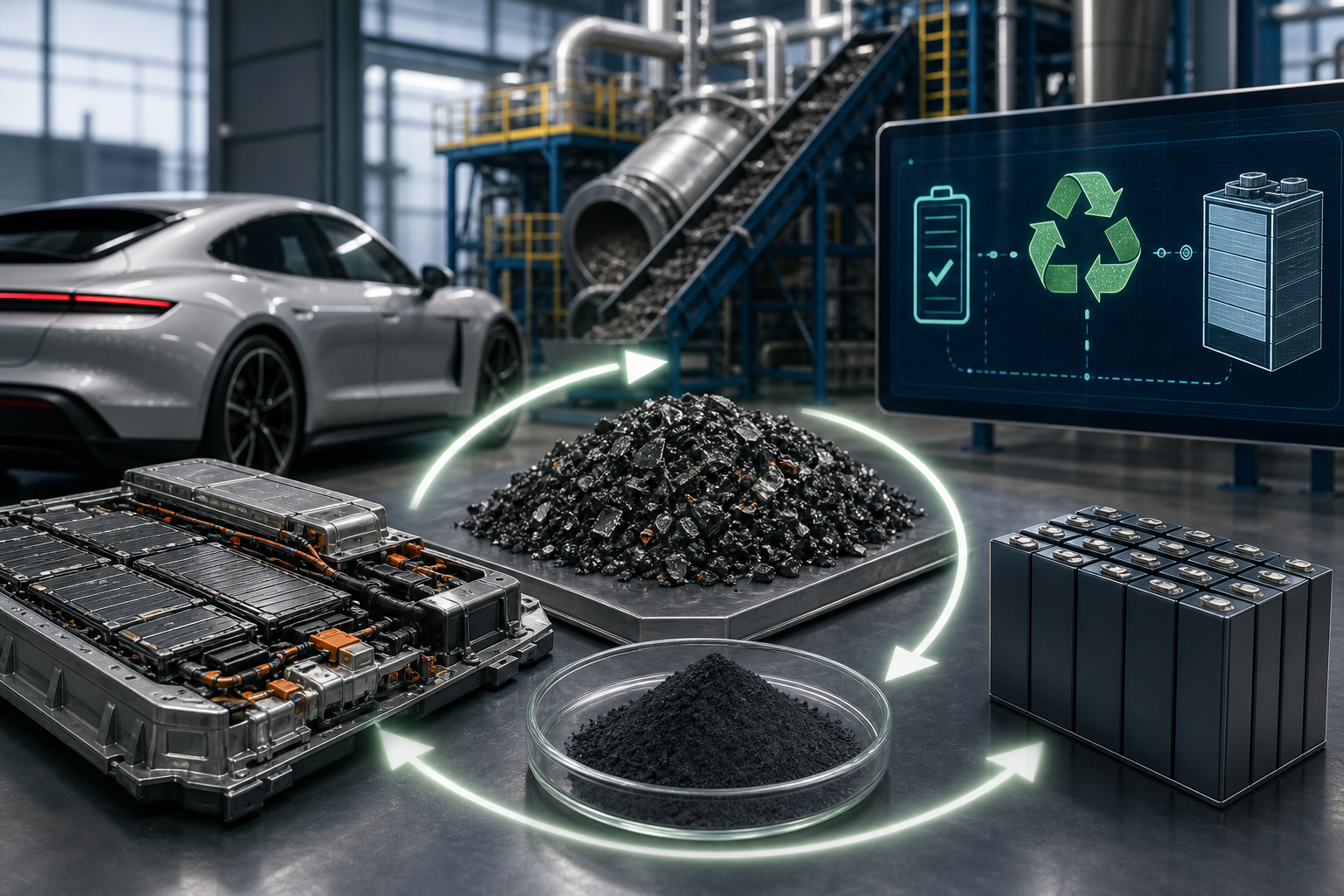

Porsche and German recycling specialist Cylib are working on a process that could reshape how electric vehicle batteries are handled at the end of their lives. The project turns used battery packs into new cathode material, rather than simply recovering base metals and sending them back into the supply chain in a more fragmented form. It is a small but important sign of where the industry is heading as Europe prepares tighter rules around battery recovery, traceability and digital battery passports.
From waste stream to raw material source
The partnership focuses on extracting usable material from end-of-life EV batteries and converting it into cathode material for future cells. That matters because the cathode is one of the most valuable and chemically complex parts of a lithium-ion battery. Instead of treating spent packs as a source of generic recovered metals alone, the process aims to create a more direct loop back into battery production.
That approach fits neatly with the realities of EV manufacturing. Battery production is resource-intensive, and the industry has been looking for ways to reduce dependence on newly mined materials while building a more resilient supply chain. Recycling has long been part of that conversation, but the challenge is getting from discarded packs to materials that can be reused at scale, with consistent quality and traceability.
Why Porsche is involved
Porsche’s interest is easy to understand. The company has been expanding its electrification strategy, and battery supply is now a central business issue for every premium carmaker with EV ambitions. Supporting recycling systems is one way to reduce exposure to raw-material volatility while preparing for a future in which sustainability requirements are likely to be far more demanding than they are today.
For a manufacturer in Porsche’s position, the value of a project like this isn’t limited to compliance. A closed-loop battery strategy can also help with brand positioning, cost stability and supply-chain planning. If battery materials can be recovered and reused in a controlled way, the manufacturer is less reliant on external material markets and more capable of managing long-term production needs.
The European policy backdrop
This development lands at a time when Europe is pushing hard on battery regulation. The region is moving toward stricter requirements for recovery efficiency, material traceability and documentation of battery origin and chemistry. Digital battery passports are expected to play a major role in that system by tracking information about a battery across its lifecycle.
That makes recycling technology more than an environmental talking point. Future battery systems will need to be documented, auditable and recoverable in a way that meets regulatory standards. Processes like the one Porsche and Cylib are developing are designed with that future in mind, where end-of-life batteries are expected to be processed with far more data and accountability than in the past.
What battery passports could change
The battery passport concept is especially relevant here. In practice, it should give recyclers and manufacturers much better information about battery composition, sourcing and condition. That makes it easier to sort packs, separate materials and recover components efficiently. It also helps ensure that recovered material can re-enter the supply chain with a documented history.
For automakers, that level of traceability could become as important as the recycling process itself. Knowing exactly what went into a battery, and how it was handled after use, creates a cleaner technical and regulatory path for future production. It also aligns with the broader shift in the automotive industry toward lifecycle accountability rather than simple end-of-pipe waste treatment.
Why cathode material matters
Turning old packs into cathode material is significant because the cathode is where much of a battery’s performance and cost are tied up. Recovered cathode material has the potential to reduce the need for virgin inputs while keeping valuable chemistry in circulation. That’s a more advanced outcome than basic material recovery, and it points toward a battery industry that is becoming more circular in design.
This is not just a chemistry story. It reflects the way EV architecture is evolving into a broader industrial ecosystem. As electric cars become more numerous, the question is no longer only how to build batteries efficiently, but also how to recover them intelligently. The companies that figure out both sides of that equation will have a stronger position as regulations tighten and raw material markets remain under pressure.
A glimpse of the next phase of EV manufacturing
Porsche and Cylib’s collaboration does not solve the industry’s battery-recycling challenge on its own, but it does point toward the direction the market is taking. Recovered EV packs are no longer being seen simply as waste to be dismantled. They are increasingly part of a managed materials cycle that can support future battery production, provided the chemistry, logistics and documentation all line up.
That makes the project relevant well beyond Porsche’s own product line. European automakers, suppliers and recyclers are all being pushed toward systems that can prove where materials came from, how they were used and where they went next. In that environment, the ability to turn a used battery pack back into cathode material is not just technically interesting. It is the kind of capability that may soon be expected.
0 Comments