
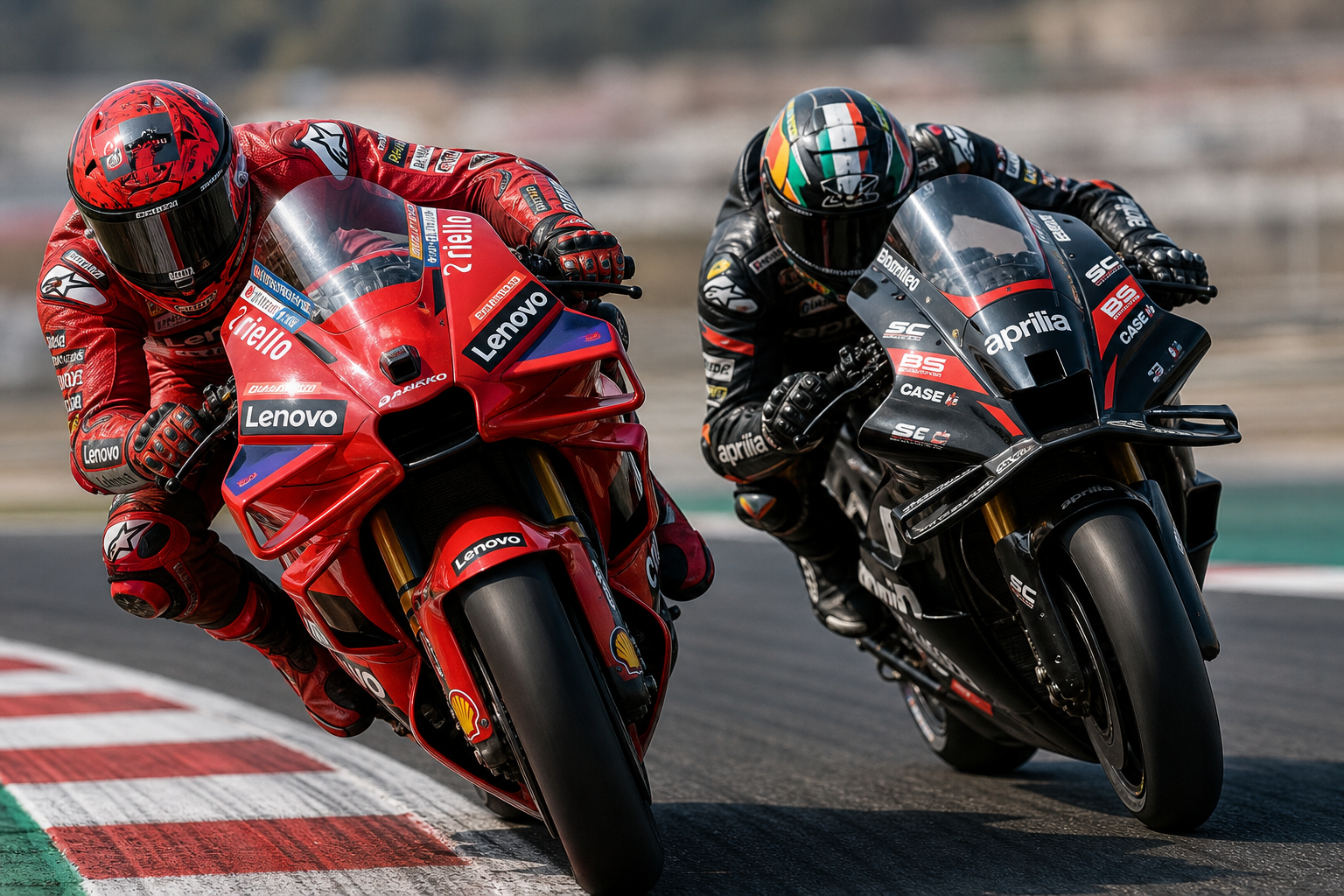

Fabio Di Giannantonio thinks the Ducati-Aprilia debate in MotoGP is being oversimplified. The VR46 rider believes the gap between the two Italian manufacturers in 2026 will be shaped less by circuit layout than by the riders putting the bikes to work on race day.
The discussion has followed a familiar pattern this season. Aprilia’s RS-GP has often looked stronger on fast, flowing circuits, while Ducati’s GP26 has tended to shine where hard braking, acceleration and stop-start direction changes matter more. But Di Giannantonio is pushing back against the idea that track profile alone explains the balance of power.
Why the Ducati-Aprilia comparison keeps coming up
When two manufacturers are as closely matched as Ducati and Aprilia have been, small technical differences tend to get magnified. Circuit characteristics are the easiest explanation to reach for: one bike works best when the corners are long and linked, the other when the lap is punctuated by heavy braking zones and short bursts of acceleration.
That broad theory has held up often enough to become part of the current MotoGP conversation. Aprilia has been particularly competitive at venues where corner speed and flow are central, while Ducati’s latest machine has remained a force in the sort of race where getting the power down early and repeating strong exits can decide the result.
Di Giannantonio’s view is that this framing leaves out the most important variable. In MotoGP, the rider still has to exploit the package, adapt to the available grip and manage the weekend better than the opposition. The bike matters, but so does the person making the decisions at the limit.
The rider factor can outweigh the circuit
That argument is especially relevant in a championship where the margins are so narrow. A few tenths can separate a podium from the second row, and a rider who gets comfortable quickly with a circuit’s grip, braking points and tyre behaviour can make a bike look better or worse than it really is.
Di Giannantonio’s position suggests that the Ducati-versus-Aprilia story is less about a simple technical hierarchy and more about execution. One rider may extract more from the front end under braking, another may carry more speed through long corners, and another may manage rear grip better over a race distance. Those differences can overshadow the schematic advantages of a given machine.
That doesn’t erase the underlying engineering contrast. Ducati has built its reputation on strong drive, braking stability and a package that lets riders attack the corners hard. Aprilia’s RS-GP, meanwhile, has developed a reputation for being especially effective when the circuit rewards momentum and corner speed. But Di Giannantonio’s point is that those strengths don’t decide the result on their own.
What the 2026 battle says about MotoGP’s competitive balance
The reason this debate keeps resurfacing is that Ducati and Aprilia remain the most interesting technical contrast in the series. Both are Italian, both are deeply invested in MotoGP, and both have enough pace to win when conditions suit them. That makes the head-to-head more than a manufacturer comparison; it has become a measure of how complete each rider-bike combination is.
For Ducati, the challenge is to keep its hardware effective across a wide range of venues rather than only the obvious strong tracks. For Aprilia, the task is to convert its speed on flowing layouts into a consistently race-winning package elsewhere. The season’s swings between the two have made that balance visible, but not always in the same way from one Grand Prix to the next.
Di Giannantonio’s comments also fit the reality of modern MotoGP development. Manufacturers work constantly on aerodynamics, electronics, chassis balance and tire management, yet the bikes remain highly dependent on how the rider rides them. A machine that appears dominant in the hands of one competitor can look far less convincing if the style doesn’t suit it.
Why the discussion matters inside the Ducati camp
As a VR46 rider on Ducati machinery, Di Giannantonio has a useful view of both the strengths of the bike and the internal pressure that comes with riding for the class benchmark. Ducati’s current position has made its riders the reference point for much of the field, but that also means every rival success is scrutinized for clues about where the Ducati package might be vulnerable.
His assessment is a reminder that those comparisons are rarely settled by one circuit or one result. Track layout can amplify a weakness or flatter a strength, but it doesn’t tell the whole story. In a field as tight as MotoGP, rider confidence, adaptation and race management can easily shift the balance back the other way.
That’s why the Ducati-Aprilia duel remains one of the more nuanced technical battles in the championship. The bikes are different, the circuits matter, and yet the riders are still the final filter. Di Giannantonio’s view is that this filter is bigger than the theory suggests — and in MotoGP, that’s often the part that decides the Sunday result.
0 Comments