
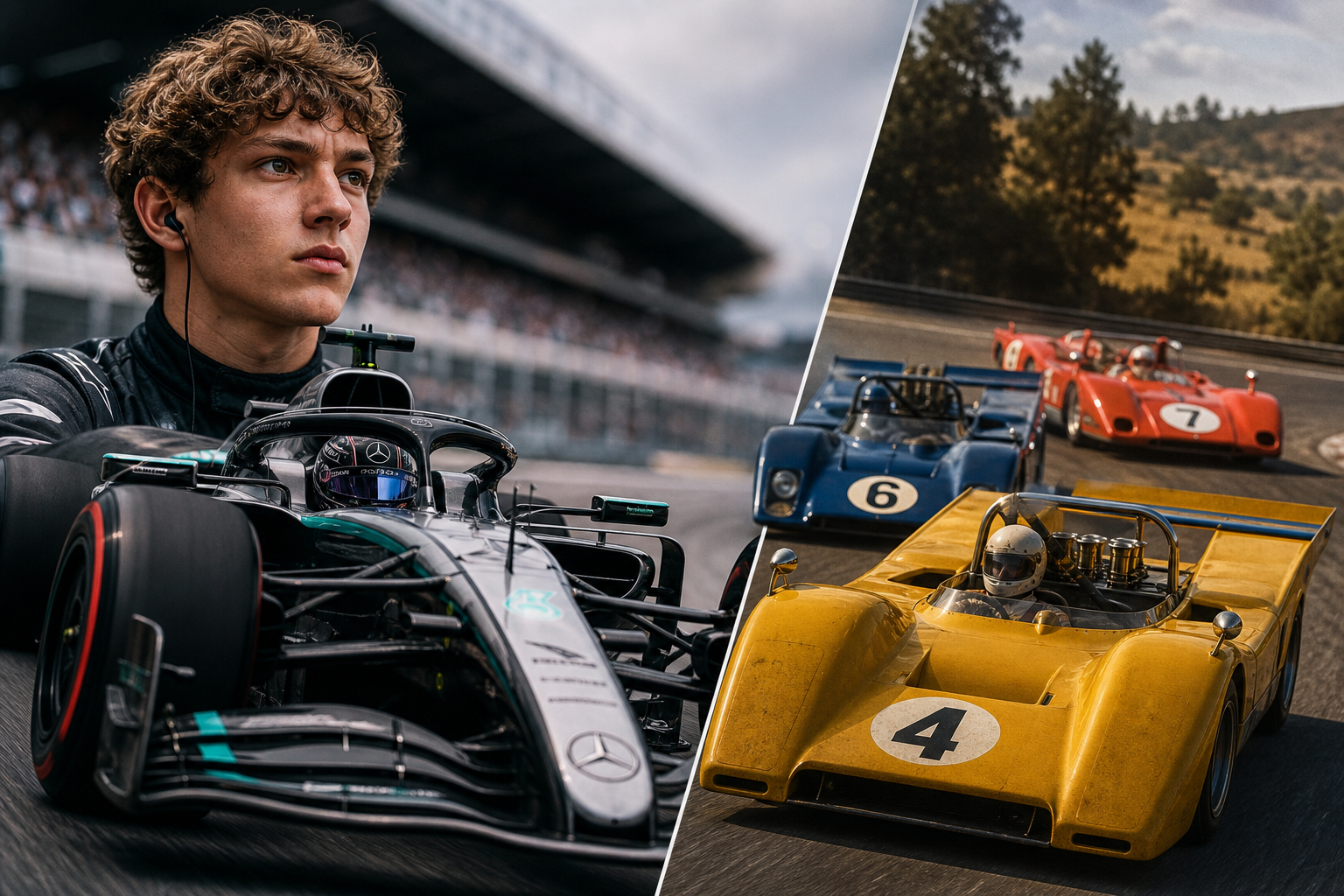

Autosport’s October issue, published today, puts two very different pieces of racing history and present-day momentum side by side: Kimi Antonelli’s rapid climb toward Formula 1 title contention and a 60th-anniversary look back at Can-Am, one of motorsport’s most distinctive eras.
The Antonelli feature focuses on more than the points table. A championship lead can be built on results alone, but what has made the Mercedes driver increasingly hard to ignore is the shape of his season: a steady, repeatable level of performance and a shrinking list of weak spots. That sort of progression tends to matter just as much as raw pace in a long F1 campaign, especially when rivals are still trying to find consistency.
Why Antonelli’s season has changed the conversation
F1 title discussions often narrow too quickly to the standings, but Antonelli’s case is built on a broader picture. He has combined score-keeping with a maturity that has caught the eye of the paddock, and the magazine’s framing suggests his rise is being judged less as a hot streak and more as a sustained campaign of improvement.
That distinction matters. Drivers can rack up points in a narrow window of form, but championship favourites usually separate themselves by reducing mistakes, improving across different track types, and answering questions that arise over the course of a season. Antonelli’s trajectory, as described in Autosport, reflects that kind of development. The implication is that the lead itself is important, but the manner in which it has been built may prove even more significant.
For Mercedes, a young driver taking on genuine title expectations would also be a notable storyline in its own right. The team has spent recent seasons searching for a more reliable anchor in the post-Hamilton era, and a driver capable of maturing quickly into a championship-level presence would alter the long-term picture considerably.
Can-Am turns 60 in a special retrospective
The second major theme in the October issue is a celebration of Can-Am’s 60th anniversary. Few racing categories have had the same combination of technical freedom, visual drama and engineering excess. The Canadian-American Challenge Cup produced some of the most extreme sports-racing cars ever built, with an anything-goes spirit that encouraged innovation and, at times, outright absurdity.
Can-Am’s appeal has always gone beyond nostalgia. The series became famous because it gave manufacturers, constructors and engineers room to explore ideas without the same restrictions that shaped other championships. The cars were powerful, lightweight and often spectacularly bold in their aerodynamics and packaging. That made the series a proving ground for creativity as much as a battleground for drivers.
A 60-year retrospective is well timed because Can-Am still occupies a special place in motorsport history. It influenced the way enthusiasts think about prototype racing, helped define an era of open technical competition, and produced machines that remain instantly recognisable decades later. For readers drawn to the engineering side of motorsport, it offers one of the clearest examples of what happens when regulations are loose and ingenuity becomes the main currency.
A magazine issue that bridges eras
Placing Antonelli and Can-Am in the same issue gives the October edition a useful contrast. One story is about a modern Formula 1 driver building a championship case in an environment of data, scrutiny and precision. The other looks back to a period when racing cars were shaped by freedom, bravado and very different assumptions about what competition should allow.
That mix will likely appeal to Autosport’s core audience. Formula 1 remains the centre of gravity for much of motorsport coverage, but historical features like the Can-Am anniversary provide context for how the sport’s technical culture evolved. They also remind readers that today’s racing categories, even the most advanced ones, sit on top of a long lineage of experimentation and rivalry.
Autosport’s October issue is on sale now, with Antonelli’s emergence and the Can-Am anniversary offering two sharply different but equally relevant angles on racing performance, progress and heritage.


0 Comments