
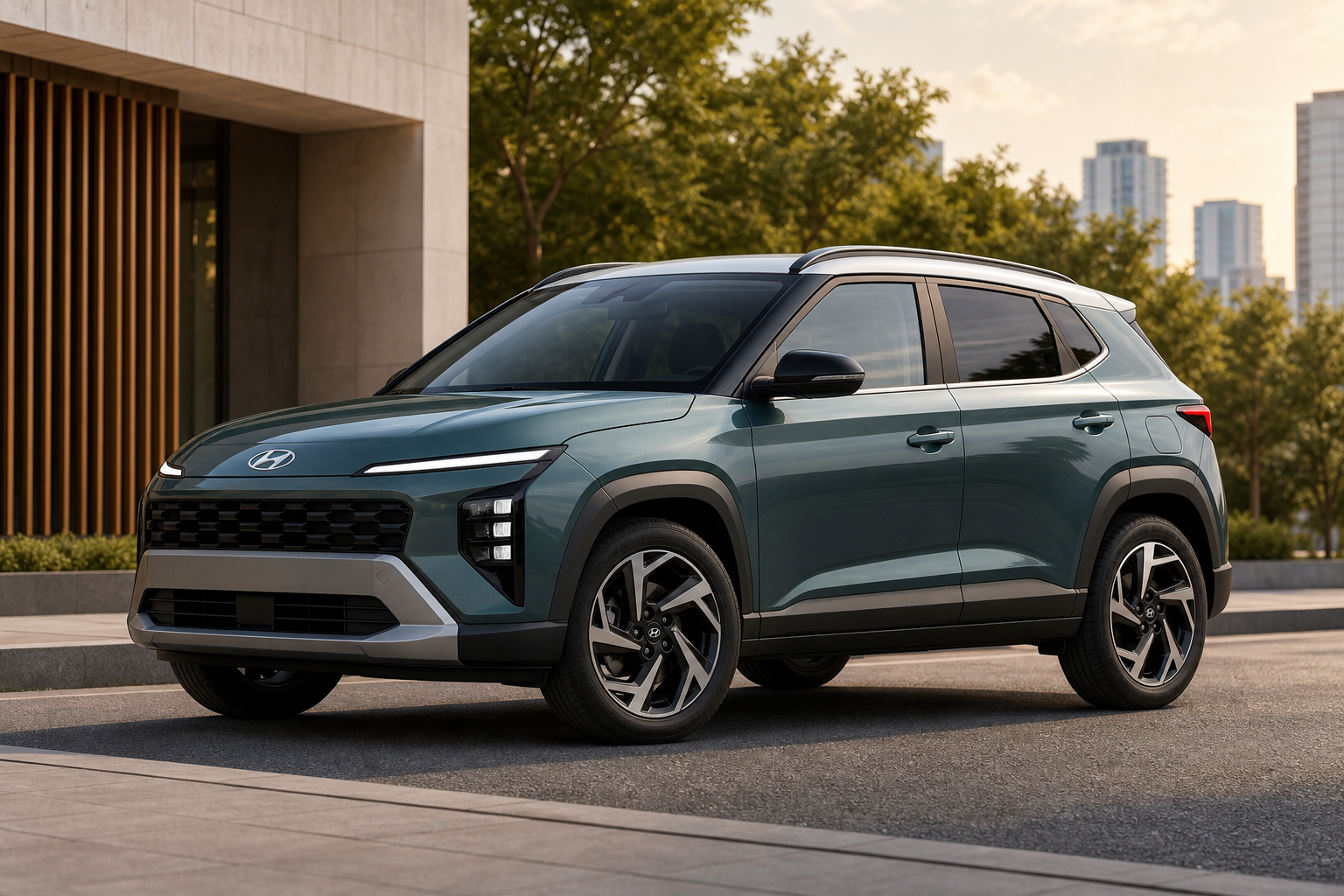

Hyundai is preparing a new-generation Bayon, and the clearest sign of its direction is already visible in the proportions. The current car has long occupied an awkward middle ground, wearing hatchback-like styling while serving as one of the brand’s smallest crossovers in Europe. The replacement appears to lean more decisively into the small-SUV brief, with a shape that should look less like a raised hatch and more like a genuine crossover.
A clearer SUV identity
The Bayon has always been Hyundai’s answer to buyers who wanted the practicality and higher seating position of a crossover without moving up to the larger Kona. That positioning made sense in a crowded European market, where cars such as the Renault Captur, Nissan Juke, Toyota Yaris Cross and Ford Puma have helped define the compact-SUV class. But the outgoing Bayon’s proportions have often made it stand out more for its tall hatchback stance than for traditional SUV presence.
The next generation seems set to correct that. Even from the limited image available, the new car looks more upright and more closely aligned with current crossover design trends. That shift matters because styling is a big part of how these vehicles sell. In this segment, buyers tend to expect a stronger visual separation from conventional hatchbacks, and Hyundai appears to be moving the Bayon further in that direction.
Why the redesign matters for the Bayon
The Bayon sits in one of the most competitive parts of the market. It is not a performance hero, and it is not meant to be a rugged off-roader. Its value lies in packaging, visibility, ease of use and the sense of space that a small SUV can provide over a regular supermini. A redesign that emphasizes those traits should make the car easier to position in Hyundai’s European lineup.
That also helps Hyundai keep the model distinct from the i20, which underpins the current Bayon and gives it much of its basic mechanical character. For manufacturers working in this segment, differentiation is critical. If a crossover looks too close to the hatchback it’s based on, it can become harder to justify the extra money buyers are asked to pay. A more SUV-like design gives Hyundai a stronger hand in that argument.
What we can infer from the new shape
Although Hyundai has not released a full technical breakdown, a more upright body generally points to a greater emphasis on cabin practicality and road presence. Expect the packaging philosophy to stay focused on the same fundamentals that made the original Bayon relevant: compact external dimensions, a simple footprint for city use and a cabin that should be easy to live with in dense urban environments.
It is also likely that Hyundai will continue to keep the Bayon below the Kona in hierarchy. The Kona has grown into a more ambitious product, with a broader powertrain and equipment strategy, so the Bayon needs to remain the accessible entry point. In practical terms, that means a model aimed at buyers who want a crossover shape and a higher driving position, but not the size or cost associated with a larger SUV.
The current Bayon’s place in Hyundai’s European lineup
Hyundai introduced the Bayon in 2021 as a Europe-focused model, and its role was clear from the start: provide a stylish, affordable crossover option below the Kona. It arrived at a time when small SUVs were no longer niche products but one of the most important categories in the market. For many buyers, they had become the default family or urban car.
The current car’s visual formula—slim lamps, a low bonnet line and a shape that reads more like a raised hatch than a chunky SUV—helped it stand out without looking oversized. Still, as rivals have become more assertive in their design, Hyundai seems to have decided that the Bayon needs a stronger identity. The next generation’s move toward a more conventional SUV stance should help it fit current expectations more naturally.
Design as a sales tool in the small-SUV class
In this segment, design does a lot of work. Buyers are not just comparing boot space and fuel economy; they are also comparing character. The Bayon will likely need to balance practicality with a more confident appearance if Hyundai wants it to compete effectively against the many familiar names in the class.
That is particularly important because the small-SUV market is full of models that already execute the brief well. Some lean toward style, others toward efficiency or value, but nearly all of them make an effort to look like proper crossovers. If Hyundai’s next Bayon can deliver that while retaining the usability of the original car, it should strengthen the model’s appeal without needing a wholesale reinvention.
What buyers will be watching for next
The obvious unknowns are under the skin. Hyundai has not detailed the new Bayon’s engines, chassis changes or interior updates, and those will be the details that determine how complete the redesign really is. If the model follows the direction suggested by its new shape, expect Hyundai to focus on making it feel more polished, more modern and more distinct from the i20 donor vehicle.
For now, the headline is simple: the Bayon is moving away from its hatchback-like appearance and into clearer small-SUV territory. That may sound like a styling tweak, but in this part of the market, it is often the difference between a car that blends in and one that has a more defined role on the showroom floor.


0 Comments