
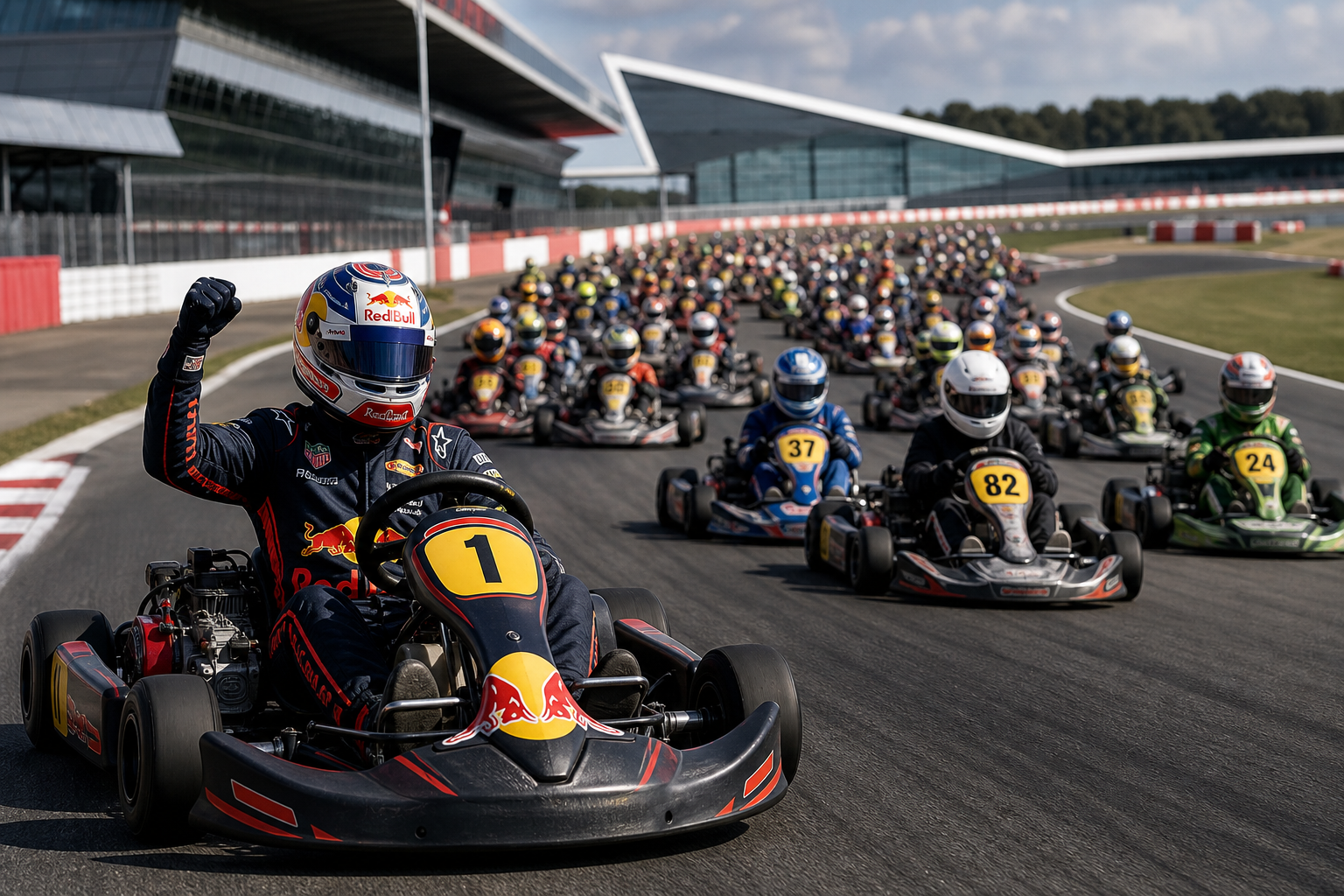

Max Verstappen turned a crowded gimmick event into a demonstration of pace at Silverstone, charging from the back of a 101-kart grid to the front in just 14 laps. The four-time Formula 1 world champion needed around 37 minutes to work his way through traffic in Red Bull’s ‘Max vs 100’ challenge, an event built around the simple but eye-catching idea of putting Verstappen against 100 amateur drivers at once.
The race took place on a purpose-built karting layout at Silverstone, using parts of the venue’s karting facilities to stage what was essentially a live traffic-management exercise with a very fast driver at one end of the grid. The field was made up of content creators, athletes and motorsport fans, all of whom started with one thing working against them: Verstappen had to get past every single one of them.
A one-off karting race with a clear shape
On paper, the format was straightforward. In practice, the logistics were anything but. A 101-kart grid is unusual even for exhibition racing, and the event relied on a track configuration that could accommodate a large pack while still giving Verstappen enough room to exploit his speed and racecraft. The result was a short, intense karting sprint in which the Dutchman had to manage both outright pace and the hazards that come with passing huge numbers of slower karts in close quarters.
Events like this work because they strip racing down to something very basic: one driver, one kart, and a lot of traffic. The spectacle came from the scale of the grid as much as the result. A 14-lap winning drive is impressive in any kart race, but the context here matters. Verstappen wasn’t simply leading from the start; he was forced to recover from the back of the field and complete 100 passes without losing control of the race.
Why Verstappen was the obvious centerpiece
Red Bull has long understood that Verstappen’s appeal extends beyond Formula 1 weekends. He has the kind of reputation that makes an event like this instantly legible to casual fans and dedicated followers alike: put him in traffic, and people want to see how quickly he gets to the front. That’s especially true in karting, where racecraft, judgement and aggression all matter just as much as raw pace.
Karting is also a useful reminder of how many top-level drivers develop their instincts. Verstappen, like most modern Grand Prix drivers, built his early career in the discipline before moving into single-seaters. The compact format, limited grip and close-quarters racing make karting a natural environment for showing how quickly an elite driver can read a pack, identify space and make decisive moves without overdriving the machinery.
The Silverstone setting added to the theatre
Silverstone gave the event a fitting backdrop. The circuit is best known as one of Formula 1’s most important venues, but its karting facilities allowed Red Bull to stage a race that felt tied to the wider Silverstone complex rather than merely borrowed from it. That helped give the event a sense of occasion without needing a full grand prix weekend to support it.
Using a purpose-built kart track also made practical sense. A large, mixed-ability field needs a layout that can cope with repeated overtaking and enough width to reduce bottlenecks. Even then, the challenge of threading through a grid this size would have been significant. The fact Verstappen completed the task in 14 laps underlines just how much pace difference there was between him and the rest of the field.
What the format said about Verstappen’s strength
There is a difference between being quick in clean air and being fast in traffic. Formula 1 amplifies that gap because modern races are heavily shaped by tyre management, strategy and the turbulent air created by following another car. Karting changes the equation again: the cars are lighter, the tracks tighter and the margins far smaller. Passing 100 other karts is not a matter of brute force; it requires timing, patience and the ability to avoid unnecessary contact while still moving decisively.
That’s why the result was notable even though it was staged as a showcase rather than a conventional competition. A driver with Verstappen’s level of commitment can make a large field look stationary if the event is structured in a way that gives him a realistic chance of carving through it. The speed at which he did it suggests the format was less about a fantasy matchup and more about displaying just how efficient an elite racing driver can be when the field is made up of amateurs.
Red Bull knows how to turn a race into content
The event also fits into Red Bull’s long-standing approach to motorsport marketing. The company has built a reputation for turning racing into entertainment without losing the core sporting reference point. From demonstration runs and stunt pieces to more elaborate social-first projects, Red Bull often packages its drivers in ways that create a simple, visually obvious hook.
‘Max vs 100’ works because the premise is instantly clear even before a lap is completed. There’s no need for explanation beyond the idea that Verstappen must pass everyone on the grid. The result is the sort of format that translates well on video, because every overtake adds to the pace of the narrative. By the time the race is over, the story is self-explanatory: a world champion in a kart can still look a class apart when the field is made up of enthusiasts and personalities rather than professional racers.
Karting remains the purest racecraft test
For all the spectacle, the event also reinforces why karting remains such a respected proving ground. The machinery is simple, but the skill set is not. Drivers need sharp spatial awareness, clean hands, strong judgment and the ability to attack without compromising exit speed or momentum. Those are the same qualities that matter in formula racing, only amplified by the lack of bodywork and the proximity of competitors.
That is what made Verstappen’s run through the field interesting beyond the headline number of 100 overtakes. It was a reminder that top-level drivers do not become fast only because of downforce, power and data systems. They become fast because they know how to place a kart or car precisely where it needs to be, over and over again, while making the whole thing look almost routine.
In this case, the routine part was finishing at the front. The unusual part was everything it took to get there.
0 Comments