
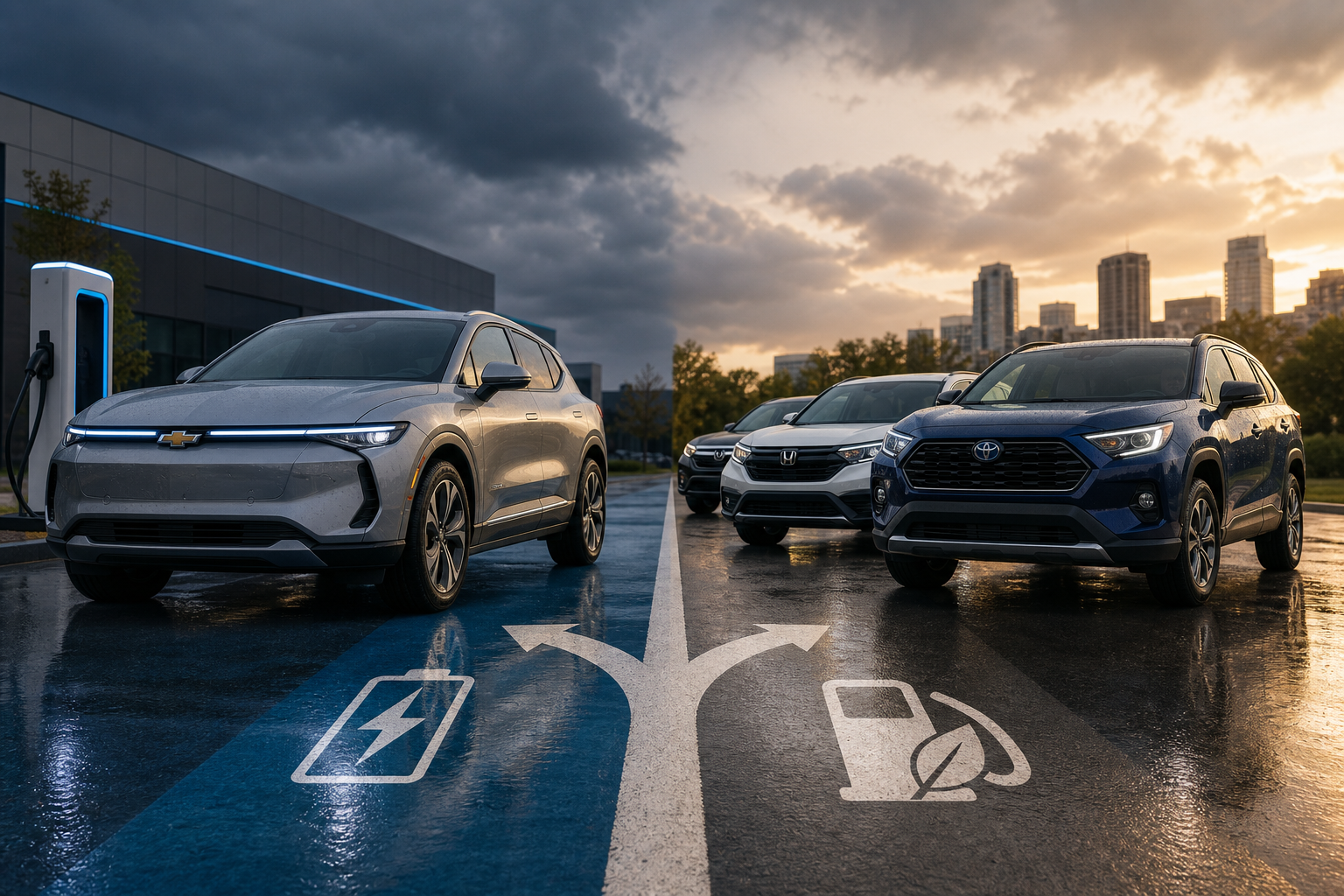

General Motors has spent heavily on electrification, but the market is not rewarding that commitment in the same way it is for competitors leaning more aggressively into hybrids. While GM has built out a broad battery-electric portfolio, brands with hybrid lineups are currently seeing stronger sales traction, and that contrast is becoming harder to ignore.
The tension is straightforward: GM has committed significant resources to EV development, manufacturing, and platform architecture, yet customer demand has not shifted as quickly as the company and other legacy automakers once expected. At the same time, hybrids have emerged as a profitable bridge technology for buyers who want better fuel economy without the range, charging, or pricing compromises that still shape the EV market.
Why GM’s EV strategy looks different from rivals’
GM’s electrification plan has been built around the idea that full battery-electric vehicles will eventually define the market. That has meant substantial investment in dedicated EV hardware, software, battery supply, and production planning. The company has also worked to spread EV development across multiple brands rather than treating it as a single niche effort.
That approach gives GM long-term credibility in electric propulsion, but it also exposes the company to near-term demand risk. EV adoption has been uneven, and buyers are still sensitive to purchase price, charging access, winter range, and resale values. Hybrids sidestep some of those concerns by pairing conventional engines with electric assistance, which makes them easier to sell to customers who are not ready to go fully electric.
For manufacturers, that difference matters. A hybrid can be profitable quickly because it uses much of the existing internal-combustion product cycle, while a pure EV usually requires a larger upfront investment in architecture, software, and battery technology. When demand shifts, the brands with the more flexible mix often capture the stronger short-term return.
The hybrid advantage in today’s market
Hybrid vehicles have become one of the most commercially effective responses to consumer caution around EVs. They deliver real-world efficiency gains, and they do it without forcing buyers to redesign their habits around charging infrastructure. For many shoppers, that makes the decision easier.
This is especially important in segments where customers are cost-conscious or where long-distance use remains part of the vehicle’s mission. A hybrid SUV or pickup can offer lower fuel consumption while still behaving like the familiar gasoline vehicle underneath. That combination has made hybrids a strong selling point for brands that have kept them in steady rotation rather than treating them as a transitional afterthought.
GM’s challenge is not that its EVs lack engineering effort. It is that the market has not fully converged on EVs as the default answer for every buyer, every use case, or every price point. In that environment, the manufacturers with broader hybrid offerings have an easier time matching demand with product.
What this means for GM’s portfolio
GM is not abandoning EVs, and there is no indication that it plans to reverse course on its long-term electrification strategy. But the gap between investment and immediate sales performance is a reminder that product planning and consumer behavior rarely move in lockstep.
The company’s portfolio still spans multiple brands and body styles, which gives it some room to adjust. If demand for EVs grows more slowly than expected, GM can rebalance its mix through gasoline and hybrid products where applicable. The broader industry has already shown that flexibility can be worth as much as conviction when the market is unsettled.
For buyers, the takeaway is simple: the best-selling powertrain is not always the most advanced one on paper. Right now, hybrid technology is proving easier for many customers to adopt, while GM’s heavier bet on full electrification is asking the market to move faster than it has been willing to move.
That does not make GM’s EV investments irrelevant. It does, however, explain why the sales scoreboard looks the way it does. The company has chosen to push harder toward an all-electric future, and competitors that kept hybrids front and center are benefiting from a market that still values transition over commitment.
0 Comments