
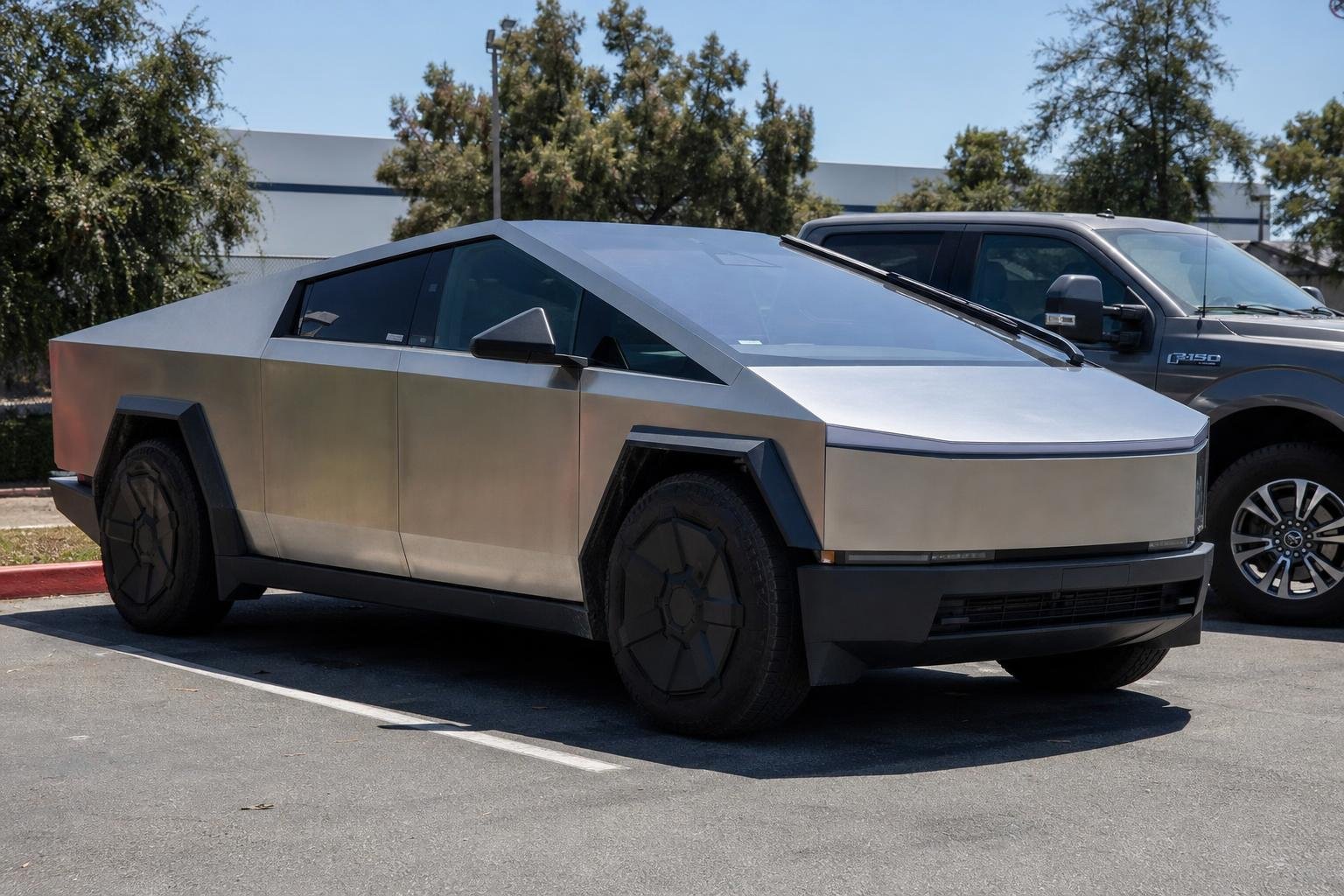

The Tesla Cybertruck was the fastest-selling used pickup in iSeeCars’ latest October analysis, reaching a buyer in an average of 39.1 days. That was substantially quicker than both the gas-powered Ford F-150 and Ford’s electric F-150 Lightning, but the result says more about demand, inventory and the unusual position of Tesla’s angular pickup than it does about resale strength alone.
The study examined approximately 1.1 million used vehicles that changed hands during October. It covered vehicles between one and five years old and measured how long each model remained listed before selling. Used pickups averaged 65.5 days on the market, putting the Cybertruck more than three weeks ahead of its segment average.
The Cybertruck led a surprisingly competitive group
With an average selling time of 39.1 days, the Cybertruck narrowly outpaced the Ford Maverick Hybrid, which averaged 43.3 days. The Rivian R1T followed at 45.2 days, while the Ford F-150 Lightning took 47.4 days. Toyota’s Tacoma, a strong candidate on the strength of its reputation and traditionally robust demand, finished fifth in the ranking.
The conventional F-150 required considerably longer to sell. The source report places a gas-powered F-150 at 72 days on average, approximately a month longer than the Cybertruck. That comparison is notable because the Ford is one of America’s most familiar and established pickup nameplates, while the Cybertruck remains a much newer and more polarizing product.
The contrast within the electric-truck market was even sharper. A used Chevrolet Silverado EV averaged 107.5 days before finding a buyer, the slowest result among the 24 pickups included in the study. The difference between the Cybertruck and Silverado EV was therefore more than two months.
Fast sales do not necessarily mean strong resale values
Days on market is a useful indicator of buyer activity, but it does not reveal the final transaction price. A vehicle can sell quickly because the seller priced it aggressively, because dealers reduced the asking price, or because a small supply of available examples attracted a narrow group of motivated buyers.
That distinction is especially important for the Cybertruck. The model’s used-market history has been volatile. In 2024, some sellers reportedly reduced asking prices by as much as $30,000 after listing trucks for close to $200,000. Later that year, used Cybertrucks were reported to be spending roughly 75 days on dealer lots, compared with 27 days in May.
Trade-in figures have also highlighted the potential for steep depreciation. One reported example involved a Dual Motor Foundation Series truck originally priced at $99,990. After 6,211 miles, Tesla reportedly offered the owner a $65,400 trade-in estimate in May 2025. That is not a complete measure of the model’s entire resale market, but it demonstrates why speed of sale and retained value should not be treated as interchangeable metrics.
Why buyers may be moving quickly
The Cybertruck occupies an unusual position in the used market. Its styling is distinctive, its brand attracts a committed audience, and its electric powertrain gives it a different identity from mainstream pickups such as the F-150. Those factors can create strong interest among shoppers specifically seeking a Cybertruck, even if the broader truck market is less enthusiastic.
Supply may also be influencing the result. Tesla plans to end Cybertruck production toward the end of summer 2027 after extending the production run to work through its remaining order backlog. The company’s current new-truck availability is reportedly limited to the roughly $110,000 tri-motor Cyberbeast, leaving shoppers who want a less expensive Dual Motor version dependent on the used market.
That does not automatically make every used Cybertruck valuable. However, the end of new production could eventually make clean, low-mileage examples easier to distinguish from ordinary used inventory. Buyers who want a specific configuration, such as a Foundation Series truck, may be more willing to travel or pay a premium for the right vehicle once local supply becomes less predictable.
Practical buyers still have more conventional choices
For customers choosing an electric pickup primarily for work, towing or daily utility, rarity is unlikely to be the only consideration. Battery condition, remaining warranty coverage, charging access, vehicle history and the truck’s condition will matter more than the date of its final production run.
The Ford F-150 Lightning and Rivian R1T both sold faster than the overall used-pickup average in the study, while the Maverick Hybrid performed even better than the two electric full-size trucks. That range of results suggests that buyers are not simply rejecting established brands in favor of Tesla. Instead, demand appears to vary considerably by price, body size, powertrain, availability and the appeal of each model’s overall package.
There is also a technical reason to be cautious when comparing any pickup by nameplate alone. Towing capability, payload, traction and real-world range depend on configuration, equipment and usage. A Cybertruck that attracts a buyer because of its design and acceleration may not be the same buyer’s preferred tool for frequent long-distance towing. Similarly, a gas-powered F-150’s slower average sale may reflect its much larger range of trims, engines and use cases rather than weak demand for the nameplate.
The Cybertruck’s used-market story is still developing
The October result is a snapshot, not a verdict on the Cybertruck’s long-term resale performance. It shows that used examples were moving quickly during the period measured, but it does not establish whether sellers received their asking prices or accepted discounts to close deals.
That qualification matters as Tesla approaches the end of Cybertruck production. Scarcity can support demand for well-maintained examples, but it can also make parts, repairs and specialized service more important ownership considerations over time. The used Cybertruck market will ultimately be shaped by both emotional appeal and practical value.
For now, the most defensible conclusion is that the Cybertruck has attracted buyers faster than several far more conventional pickups. Whether that momentum represents durable demand, temporary curiosity or aggressive pricing will become clearer as more trucks accumulate mileage and the final new examples leave Tesla’s inventory.
Sources: InsideEVs.

0 Comments