
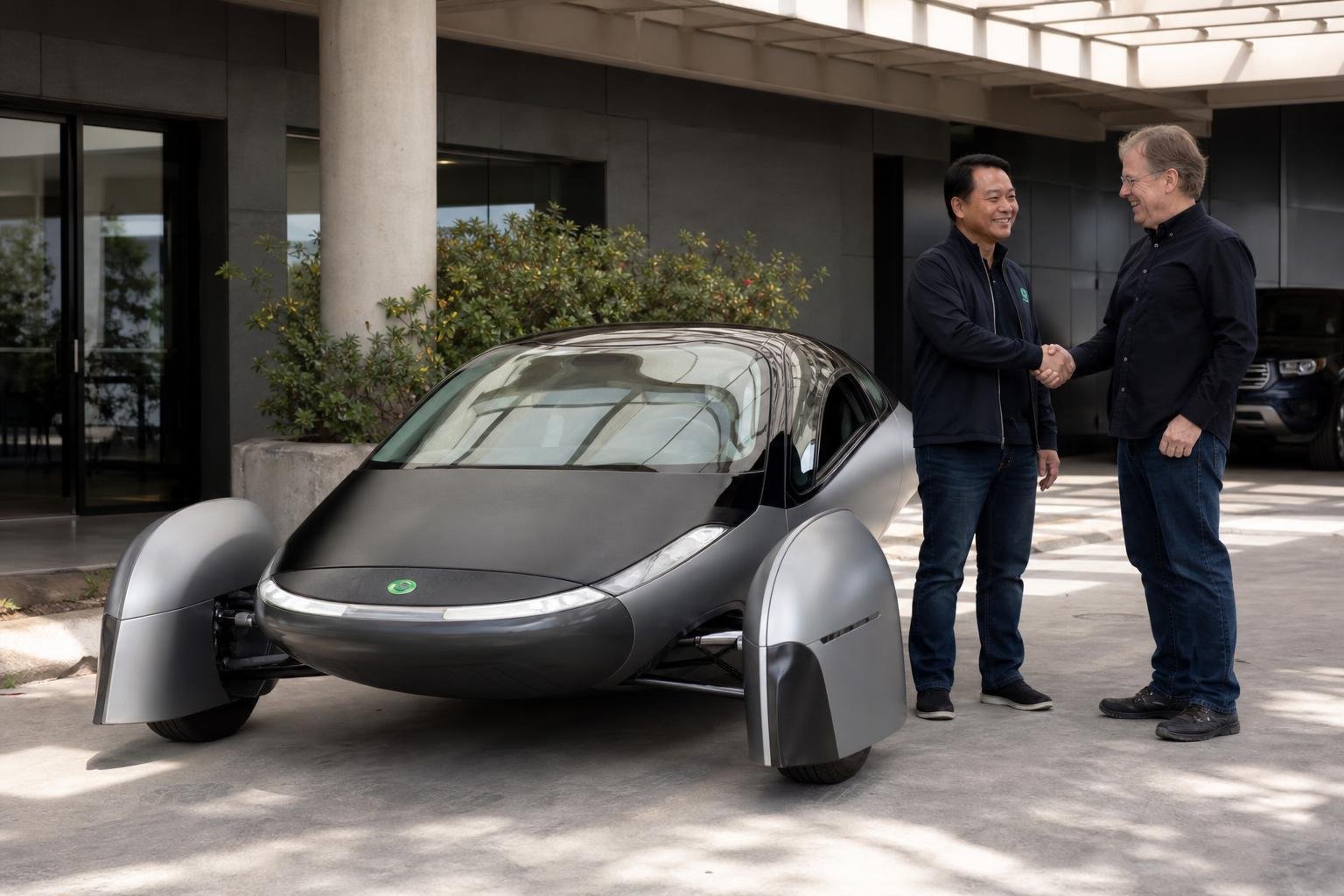

Aptera Motors has finally completed and delivered its first production vehicle to a customer—an important milestone for a company that has spent roughly two decades developing an ultra-efficient, solar-assisted electric vehicle without reaching regular production.
The matte-black Aptera, finished in the company’s “Noir” specification, was handed over in Carlsbad, California, to a representative of GDP Ventures. Martin Hartono, the CEO of GDP Ventures, is Aptera’s first “Accelerator,” the name Aptera uses for its early investors. The vehicle is now expected to be exported and operated outside the United States.
A delivery that matters beyond one vehicle
One customer delivery does not make Aptera an established automaker, but it does represent a meaningful change in the company’s long-running story. Aptera has repeatedly shown prototypes and production-intent vehicles while pushing back its manufacturing plans. This is the first reported customer-bound vehicle to emerge from that process as a road-legal production car.
Chris Anthony, Aptera’s co-CEO, described the delivery as the result of years of work and thanked reservation holders, shareholders and early investors. Hartono likewise characterized the vehicle as an example of how solar generation, battery power and aerodynamic efficiency could reduce energy consumption in everyday transportation.
The achievement should still be viewed in proportion. Aptera is beginning with a very small number of vehicles rather than a conventional production run. Earlier reporting indicated that the company initially planned a batch of approximately 40 customer vehicles. That would make the first delivery an important validation of the manufacturing process, but only a tiny step toward addressing a reservation list reported to contain roughly 50,000 names.
Why Aptera is so different
Aptera’s vehicle is built around efficiency rather than the usual electric-car formula of adding a larger battery. Its enclosed three-wheel body is shaped to reduce aerodynamic drag, while its lightweight construction is intended to reduce the energy required to move the vehicle. The result looks more like a streamlined aircraft cabin than a conventional sedan or hatchback.
The company has previously described a Launch Edition with a battery capacity of approximately 44 kilowatt-hours and a targeted range of up to 400 miles. Those figures are company targets and should not be confused with independently confirmed EPA results for every customer vehicle.
Aptera has also said the initial configuration will use front-wheel drive, with one electric motor powering the two front wheels. A quicker all-wheel-drive version, using an additional motor at the rear wheel, is planned for a later stage. Earlier company claims put the front-drive model’s 0-to-60-mph time below six seconds, while the planned all-wheel-drive version could reduce that time to below four seconds.
Solar power is useful, but not unlimited
Solar generation is the feature that most clearly separates Aptera from other EVs. Solar cells integrated into the roof and other upper surfaces are designed to add energy while the vehicle is parked outdoors. Aptera has claimed that the full solar array can provide up to 40 miles of driving range per day under ideal conditions.
That number depends heavily on weather, season, location, parking orientation and the vehicle’s energy consumption. It is therefore better understood as a potential daily energy contribution than as a guaranteed substitute for charging. In cloudy conditions, during winter or when the vehicle is parked in shade, the gain will be considerably lower.
Even so, the concept has a practical advantage for drivers with short commutes. A vehicle that spends much of the day outside could recover some of its consumed energy without using a public charger or household outlet. The solar system cannot eliminate the need to plug in for every owner, but it could reduce charging frequency for some driving patterns.
The difficult road from prototype to production
Aptera’s history explains why this delivery has attracted so much attention. The company’s earlier incarnation closed after financial difficulties in 2011, and the current business was relaunched later. Since then, it has relied on crowdfunding, reservations and outside investment while developing a vehicle that combines composite construction, a specialized chassis and integrated solar hardware.
Moving from prototypes to customer cars requires more than proving that the vehicle can drive. Aptera has had to develop repeatable assembly procedures, validate the battery and thermal systems, complete braking and durability testing, source components and address regulatory requirements. Previous reporting described production-intent vehicles and a low-volume assembly process intended to support validation before larger-scale manufacturing.
The company has also faced the familiar financial challenge confronting low-volume EV startups: the cost of tooling, parts, testing and labor must be paid before meaningful customer revenue arrives. Building a few vehicles demonstrates technical progress, but it does not yet prove that Aptera can produce thousands of cars economically or support them with service and parts infrastructure.
What happens next
The first export is best viewed as a beginning rather than a conclusion. Aptera must complete additional vehicles, deliver them to reservation holders and demonstrate that its production process can be repeated consistently. It will also need to show that the vehicle’s unusual three-wheel layout, composite body and solar systems can be supported over the long term.
For now, the delivery gives Aptera something it has lacked through years of announcements: a real customer vehicle outside the prototype cycle. Whether the company can turn that breakthrough into a sustainable business remains unresolved, but the first step toward answering that question has finally taken place on the road.
Sources: InsideEVs, InsideEVs production preparation report, Autoweek, and Business Insider.

0 Comments