
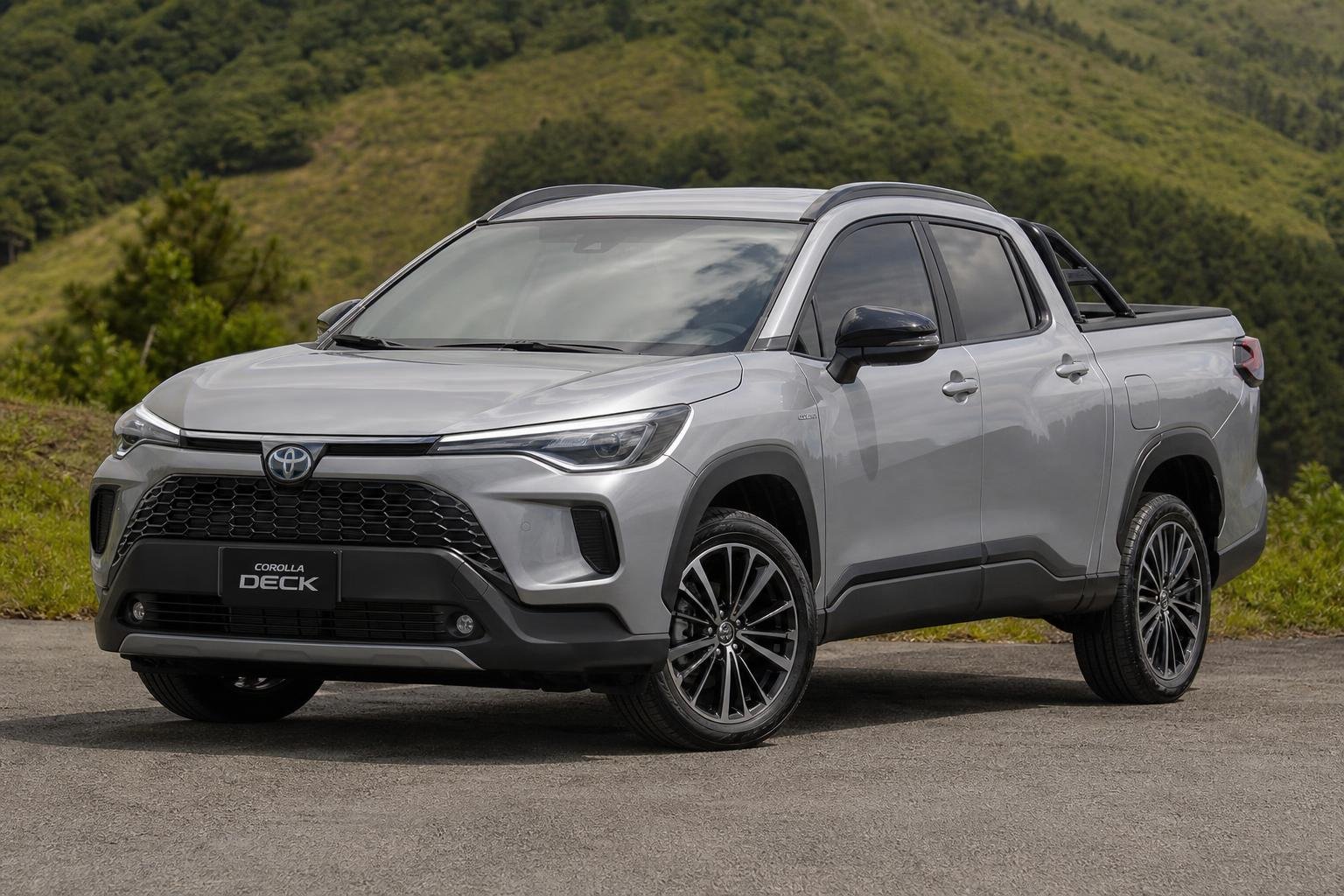

Toyota has turned the Corolla Cross into a small pickup for Brazil, creating the Corolla Deck—the first pickup to use the globally familiar Corolla nameplate. The unibody truck combines a five-seat cabin with a compact cargo bed and a self-charging hybrid powertrain, but its debut does not yet answer the question many North American buyers are asking: when will Toyota challenge the Ford Maverick?
For now, the Corolla Deck is a Brazilian-market product. Toyota has not confirmed plans to sell it in the United States or Canada, and the company’s earlier comments suggest that a North American compact pickup, if approved, could instead be based on the larger RAV4.
A Corolla Cross with a cargo bed
The Corolla Deck’s design makes its mechanical relationship with the Corolla Cross immediately apparent. The two vehicles share the hood, headlights, front fenders, windshield, front doors, mirrors and roofline. Toyota has revised the front bumper, however, giving the pickup a distinct appearance with a body-color insert, reshaped cooling openings and repositioned fog lights.
The more substantial changes begin behind the cabin. Toyota has extended the wheelbase and rear overhang to create space for a small cargo bed behind the five-seat passenger compartment. The pickup receives full-width LED taillights, a custom tailgate, a bed cover and a rear bumper incorporating a step for easier access.
Although Toyota has not released detailed dimensions, the layout places the Corolla Deck firmly in the lifestyle-oriented compact pickup category rather than alongside traditional body-on-frame work trucks. Its unibody construction gives it the same basic architectural approach as the Corolla Cross, while the bed adds versatility for everyday cargo and recreational use.
Hybrid power is central to the truck’s identity
The HEV badge visible on the tailgate confirms that the Corolla Deck will use a self-charging hybrid system. Toyota has not announced engine output, battery capacity, towing limits, payload or fuel-economy figures, so the truck’s practical capability remains unknown.
Toyota is also yet to confirm whether all-wheel drive will be offered. The company’s existing hybrid systems can be paired with electric rear-axle drive in some applications, making AWD a possible option, but it should not be treated as confirmed for this pickup until Toyota publishes the specification sheet.
There has also been reporting about a possible flex-fuel plug-in hybrid version for the future. Such a system could combine gasoline, ethanol and electric power, but Toyota has not formally detailed that variant. The launch model’s confirmed configuration is limited to the hybrid designation shown at its unveiling.
Why Brazil is an important market for the Corolla Deck
The new pickup arrives in a South American market where compact unibody trucks have become an increasingly crowded part of the vehicle landscape. The Corolla Deck will face established competitors such as the Fiat Toro and Ram Rampage, along with upcoming models including the Volkswagen Tukan, Renault Niagara and BYD Mako.
That competitive environment helps explain why Toyota has adapted an existing crossover rather than developing an entirely separate truck architecture. The Corolla Cross already provides the company with a familiar foundation, while the pickup body broadens the model’s appeal without requiring the size or traditional chassis structure of a midsize truck.
The strategy also gives Toyota a way to combine a recognized passenger-car name with the pickup format. Customers who need additional carrying ability may find the Deck more approachable than a larger truck, while the hybrid system gives the model a distinct powertrain identity in its segment.
Production will expand Toyota’s Brazilian footprint
Toyota plans to manufacture the Corolla Deck at its new Sorocaba 2 facility. The plant forms part of a reported 11.5 billion Brazilian real investment through 2030 and is expected to begin with annual capacity of 100,000 vehicles. Once fully integrated, the facility is intended to help raise Toyota’s total Brazilian production capacity to 270,000 units per year.
Local production is significant because it supports a vehicle tailored to regional market conditions rather than relying on imports. It also gives Toyota a base for producing a compact pickup aimed at Brazilian customers and the local market’s established preference for utility vehicles.
Why the Corolla Deck probably will not become Toyota’s U.S. pickup
The Corolla Deck’s Brazilian debut will inevitably invite comparisons with the Ford Maverick and Hyundai Santa Cruz, but there is no confirmation that Toyota intends to export this model to North America. Tetsuo Ogawa, chief executive of Toyota Motor North America, previously indicated that a future U.S.-market compact pickup would more likely use the RAV4 as its starting point.
A RAV4-based truck would occupy a different position from the Corolla Deck. The larger SUV platform could provide more room and a closer match for North American customer expectations, while the Corolla-derived vehicle appears optimized for the more compact South American segment.
That approach would also allow Toyota to develop a pickup specifically around North American safety, regulatory, packaging and market requirements rather than adapting a Brazilian product after the fact. The disadvantage for buyers is timing: Toyota has indicated that such a project would take time, leaving the company without a direct Maverick rival in the immediate future.
A promising idea with important details still missing
The Corolla Deck is notable not because it transforms the Corolla into a conventional truck, but because it demonstrates how far a modern unibody platform can be stretched. Toyota has retained the crossover’s passenger-focused foundation while adding a bed, hybrid power and market-specific styling.
Its eventual success will depend on details Toyota has not yet disclosed, including payload, bed length, drivetrain availability, pricing and the extent of its structural changes. Those specifications will determine whether the Corolla Deck is primarily a stylish utility vehicle or a genuinely useful alternative to established compact pickups.
For Brazil, the model expands Toyota’s local lineup into a crowded compact-pickup segment. For North America, it is a preview of what the Corolla nameplate can support—but not yet the Ford Maverick competitor many Toyota customers are waiting for.
Sources: Carscoops
0 Comments