
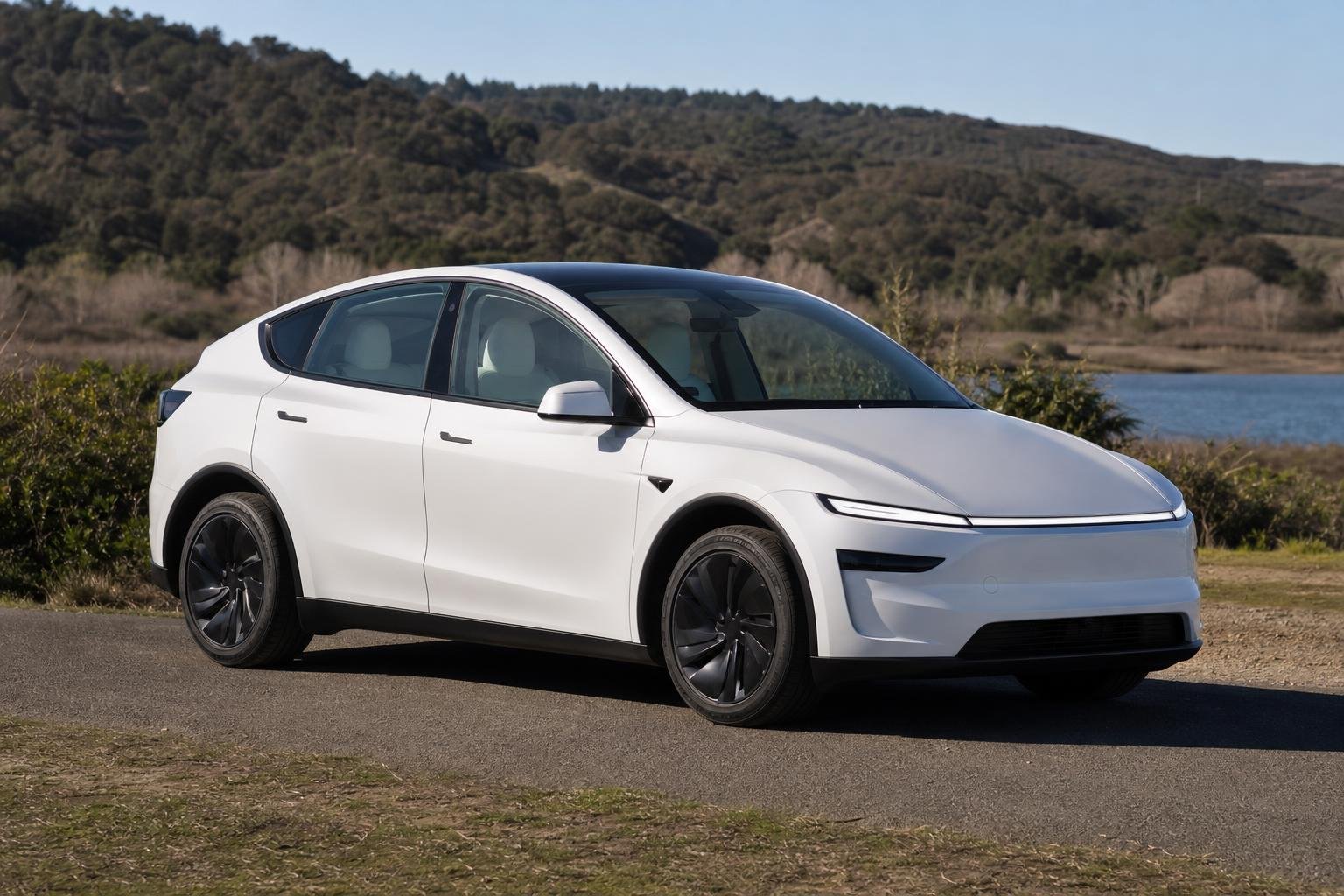

Tesla is planning a fully autonomous version of the Model Y with no steering wheel or pedals, according to CEO Elon Musk. Unlike the compact two-seat Cybercab, the proposed vehicle would be designed to carry larger groups, including families of six or seven people.
Musk disclosed the plan at the New York Times DealBook Summit, describing it as an extension of Tesla’s robotaxi strategy. The conventional Model Y would continue to be sold with normal driving controls, but a separate autonomous version could be built specifically for passenger service rather than private driving.
Why Tesla wants a larger robotaxi
Tesla’s Cybercab is intended to handle the majority of individual trips with a small, efficient cabin. Musk has said that two-seat vehicles could cover roughly 90 percent of passenger miles, allowing Tesla to reduce the vehicle’s size, interior complexity and production cost.
That approach does not address every journey, however. Families, airport groups, assisted passengers and customers traveling with luggage may need more seating. A two-seat robotaxi could require multiple vehicles for a single trip, reducing the efficiency advantage of autonomous transport. A larger vehicle based on the Model Y would give Tesla a way to cover those remaining journeys without abandoning the smaller Cybercab.
“What we plan to do is have an autonomous version of the Model Y that won’t have steering wheels or pedals and would be good for transporting groups of six or seven people,” Musk said, as reported by InsideEVs.
The Model Y is a logical starting point
The Model Y already occupies one of Tesla’s most useful vehicle formats: a relatively compact electric crossover with a taller body, flexible cargo space and room for more passengers than the Model 3. Tesla also already uses Model Y vehicles in its autonomous fleet, although those cars retain their steering wheels and pedals.
Removing those controls at the factory would allow Tesla to design the cabin around passengers rather than a driver. The dashboard, seating position and control layout could be simplified, while space normally reserved for the steering column and pedal box could potentially be used for storage or improved passenger access.
That does not mean the conversion would be straightforward. A vehicle without manual controls must be engineered around the assumption that occupants cannot take over if the automated system encounters a situation it cannot handle. Cameras, computing hardware, braking and steering systems, electrical redundancy and remote-support procedures would all become more important than they are in a conventional Model Y.
It would be more than a software update
Tesla has frequently presented autonomy as a software-driven capability, but a steering-wheel-free Model Y would require meaningful hardware and regulatory changes. A conventional Model Y can be driven by a human if its driver-assistance system is unavailable. A purpose-built autonomous vehicle cannot rely on that fallback.
The difference is also important from a safety and certification standpoint. A car sold to private owners with a steering wheel can be operated as a normal vehicle, even if advanced driver assistance is disabled. A vehicle with no pedals or steering wheel would need to be approved and operated as a genuinely driverless system in the places where it is deployed. Local rules, operating limitations and emergency-response procedures could determine where such a vehicle is usable.
For that reason, the proposed Model Y robotaxi may initially make more sense as a managed fleet vehicle than as a normal retail product. Fleet operators could control where the vehicles run, schedule maintenance and monitor their operating condition. Private buyers, by contrast, would expect to use the vehicle wherever and whenever they wished.
The business model remains uncertain
Tesla has not said when the autonomous Model Y would enter production, how much it would cost or whether customers would be able to purchase one outright. The company has also not provided confirmed specifications for its seating arrangement, battery, range or autonomous operating area.
The Cybercab provides some indication of Tesla’s intended commercial model. InsideEVs reported that select customers had begun receiving access to Cybercab orders at a stated price below $30,000, while a mandatory autonomy subscription was described as costing $300 per month. Those arrangements, along with operating restrictions, suggest that Tesla may view autonomous vehicles as connected services as much as conventional cars.
A monthly fee could be easier to justify for a robotaxi fleet that generates revenue from passengers throughout the day. For a private owner, the calculation would be different. A customer would be paying for a vehicle that cannot be driven manually, while also depending on Tesla’s software, connectivity and service coverage to make the vehicle useful.
Seven seats could expose a practical compromise
The Model Y has previously been offered in seven-seat form, but a third row in a midsize crossover inevitably involves compromises in legroom, access and cargo capacity. Tesla has not explained whether the proposed autonomous version would use the same layout or adopt a longer body to provide more comfortable space for six or seven adults.
That distinction matters for a robotaxi. A private owner may accept occasional third-row use for children, but a commercial passenger vehicle would need to accommodate a wider range of occupants and luggage. Easy entry, durable upholstery, cleanable surfaces and dependable climate control could be more important than outright acceleration or styling.
Autonomous operation could also change how passengers judge the vehicle. Without a driver, riders would need clear information about the trip, the vehicle’s status and what to do during a technical problem. A larger cabin might therefore need stronger passenger communication systems, emergency controls and remote assistance than a conventional Model Y.
Tesla’s autonomy strategy is becoming broader
The proposed vehicle shows that Tesla’s robotaxi plan is not limited to one small, low-cost model. The Cybercab would target individual journeys and cost efficiency, while an autonomous Model Y could cover group travel and higher-capacity trips.
That broader lineup would give Tesla more flexibility if autonomous demand develops unevenly across markets. It could also allow the company to use a familiar crossover body rather than waiting for an entirely new larger vehicle. Still, the project’s success will depend less on removing the steering wheel than on proving that the vehicle can operate safely, legally and economically in ordinary traffic.
For now, Tesla’s announcement is a product strategy rather than a production commitment. The standard Model Y remains the consumer vehicle buyers know, while the steering-wheel-free version appears aimed primarily at a future autonomous transport network. If Tesla can make that network reliable, a six- or seven-passenger robotaxi could fill an important gap between the two-seat Cybercab and conventional driver-operated vehicles.
Sources: InsideEVs; Tesla Engage; Business Insider.
0 Comments