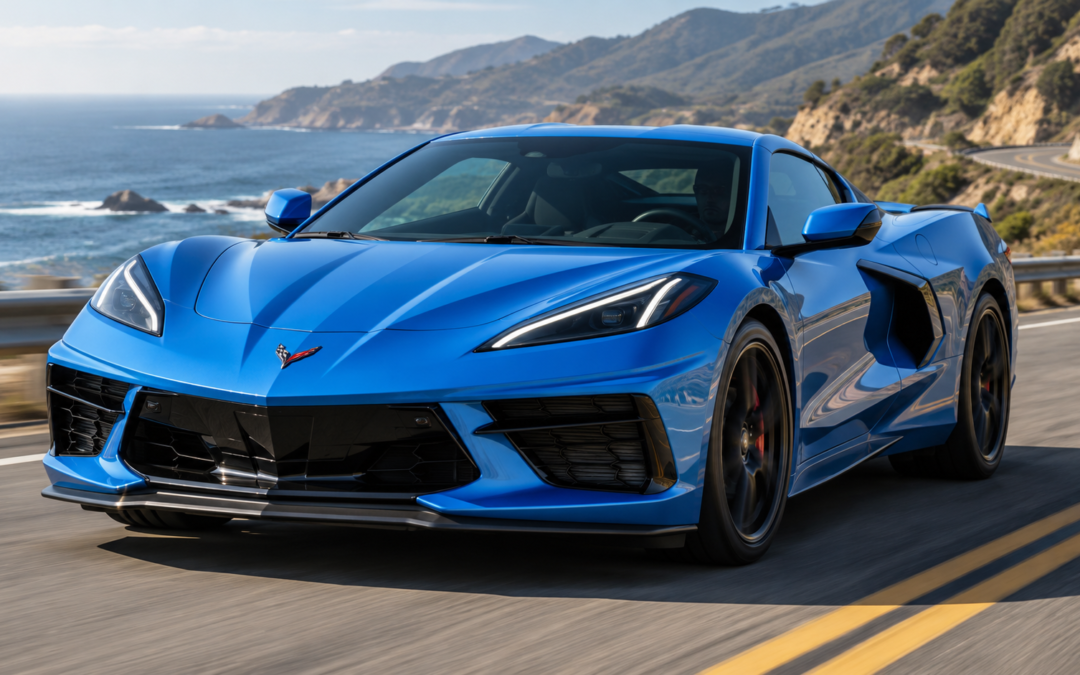
The 2027 Chevrolet Corvette Stingray proves that the entry point to the Corvette family can still deliver an extraordinary driving experience. With a new, larger-displacement V-8, more power, and a claimed 200-mph top speed, the latest Stingray offers a compelling blend of everyday usability and serious performance. Better yet, it achieves those numbers without requiring buyers to step up to one of Chevrolet’s exotic-level, four-figure-horsepower variants.
The new Stingray arrives at a time when the Corvette lineup has expanded dramatically. The Z06, ZR1, and hybrid-powered ZR1X have pushed the C8 platform into supercar territory, while the returning Grand Sport adds another performance-focused option. Against that backdrop, the Stingray might appear modest. But time behind the wheel reveals that Chevrolet’s entry-level Corvette remains one of the most complete and accessible performance cars on the market.
A Bigger, More Powerful Small-Block
The headline change for 2027 is the arrival of the new 6.7-liter LS6 V-8. Displacing 409 cubic inches, the naturally aspirated engine produces 535 horsepower and 520 pound-feet of torque—an increase of 40 horsepower and 50 pound-feet over the previous Stingray’s 6.2-liter LT2.
The new engine retains the traditional pushrod, cam-in-block architecture that has defined Chevrolet’s small-block V-8 family for generations. However, the LS6 is far from a simple displacement increase. It features forged pistons and connecting rods, a 13.0:1 compression ratio, a 95-millimeter throttle body, and an intake system designed to improve airflow. Both port and direct fuel injection are used, while tubular tri-Y exhaust headers help the engine breathe.
The result is a powertrain that combines modern engineering with the character enthusiasts expect from a naturally aspirated American V-8. There is no turbocharger or electric motor required to deliver the Stingray’s extra punch. Instead, the engine’s larger displacement and revised internals provide a familiar but more potent approach to performance.
Chevrolet offers standard corner-exit exhaust outlets, while an optional active center-exit quad-exhaust system adds visual drama and a more aggressive sound. The upgraded exhaust costs $1,995 but does not increase the LS6’s power output.
The engine’s character is a major part of the Corvette experience. Its naturally aspirated response makes throttle inputs feel immediate, and its soundtrack provides a sense of occasion even when the car is being driven at ordinary road speeds.
200 MPH for Less Than $75,000
The most attention-grabbing statistic attached to the 2027 Stingray is its claimed top speed. Chevrolet says the entry-level 1LT can reach 200 mph, making it one of the most affordable cars capable of joining that exclusive club.
The 2027 Corvette Stingray starts at $73,495 for the coupe, including the published starting price. The convertible begins at $80,495. For a mid-engine sports car with 535 horsepower and supercar-level speed potential, those figures make the Corvette an unusually strong performance proposition.
Chevrolet estimates that the Stingray can accelerate from zero to 60 mph in 2.8 seconds and cover the quarter-mile in 11.0 seconds at 124 mph. Those figures put the base Corvette firmly in territory once reserved for far more expensive machinery.
The standard Stingray uses an eight-speed dual-clutch automatic transmission and rear-wheel drive. Its carryover 4.89:1 final-drive ratio contributes to the car’s ability to combine strong acceleration with a high terminal speed.
The distinction between the base car and the optional performance package is important, however. The Corvette that can reach 200 mph is not necessarily the best choice for buyers who prioritize cornering performance.
The Z51 Package Trades Top Speed for More Capability
For $5,395, Chevrolet offers the Z51 Performance package. It adds several upgrades designed to make the Stingray more effective during spirited driving and track use, including:
Michelin Pilot Sport S 5 summer tires.
Performance-tuned suspension and stiffer springs.
Larger performance-oriented iron brakes.
An electronically controlled limited-slip differential.
Additional cooling hardware and aerodynamic components.
A shorter 5.56:1 final-drive ratio.
The shorter gearing is one of the most noticeable changes. While it reduces the car’s ultimate top speed to approximately 180 mph, it makes the Corvette feel more responsive when accelerating out of corners. The engine reaches its useful power range more quickly, and the car feels more eager under throttle.
The Z51 package also brings a more focused chassis. Stiffer suspension tuning reduces body movement, while the summer tires provide additional grip and sharper turn-in. The result is a Stingray that feels more alert and athletic than the standard car.
There is a trade-off. The added aerodynamic equipment and shorter gearing reduce the car’s top-speed potential. Buyers seeking the headline 200-mph figure must choose the standard configuration, while those who want the most engaging driving experience may find the Z51 package more attractive.
For most performance-minded owners, the Z51’s additional grip, braking capability, and gearing are likely to matter far more than a top-speed number that is difficult to explore outside a controlled environment.
A Surprisingly Comfortable Everyday Sports Car
Despite its performance credentials, the Stingray is not an intimidating car to drive around town. The mid-engine layout gives it a low, exotic stance, but the car remains approachable in ordinary traffic.
The standard suspension is tuned to absorb road imperfections, and the Corvette can handle potholes, broken pavement, and daily commutes with more composure than its dramatic styling might suggest. Its two-seat cabin and practical storage areas also make it more usable than many traditional supercars.
The Corvette’s mid-engine configuration provides a strong foundation for handling. With the engine positioned behind the occupants and ahead of the rear axle, the car benefits from a balanced layout that supports traction and agility. The Stingray feels planted during acceleration and confident through corners, while its compact dimensions make it manageable on winding roads.
The optional Magnetic Ride Control system adds another layer of versatility. Its adaptive magnetorheological dampers can adjust to changing road and driving conditions, helping the Corvette deliver a comfortable ride when desired and more controlled body movement during spirited driving.
The system can be paired with the Z51 package and Performance Traction Management, which allows drivers to adjust how the electronic stability and traction systems intervene. This gives experienced drivers more control over the car’s behavior without requiring them to abandon electronic assistance altogether.
Steering Feel Remains a Weak Point
The Corvette’s chassis is highly capable, but not every aspect of the driving experience is equally convincing.
Steering response becomes sharper with the Z51 package and its summer tires. The front end reacts quickly to driver inputs, and the additional grip makes the car feel more precise when pushed through corners.
However, steering feedback remains less communicative than some enthusiasts might expect from a sports car of this caliber. The Touring setting can feel light, and switching to Sport adds weight without completely solving the problem. At lower speeds, the steering does not always deliver the natural buildup of effort or detailed feedback that drivers may want.
This is a relatively minor flaw in a car with so much overall ability, but it is worth considering for buyers who value tactile communication as highly as outright performance.
The C8 Corvette’s Familiar Interior Quirks
The Stingray’s cabin offers a more premium experience than earlier generations of Corvette. Its driver-focused layout, modern displays, and available upscale materials help reinforce the car’s move into more expensive performance-car territory.
Nevertheless, some of the C8’s unusual interior decisions remain. The steering wheel’s squared-off shape is distinctive, though not universally loved. The closely grouped climate controls that separate the driver and passenger areas remain an acquired taste, and the positioning of the turn-signal and wiper stalks can feel less natural than expected.
These details do not undermine the Corvette’s performance, but they serve as reminders that the C8 is designed around a particular cockpit philosophy. Buyers should spend time inside one before committing, especially if the car will be used frequently.
A Strong Performance Value Across the Lineup
The 2027 Corvette Stingray exists in a lineup that now includes some of the most powerful and technologically advanced cars Chevrolet has ever built. The Z06 offers a high-revving flat-plane-crank V-8, while the ZR1 and ZR1X push output into four-figure territory. The returning Grand Sport adds a more aggressive chassis, and the Grand Sport X introduces electrified all-wheel-drive performance.
Yet the Stingray does not feel obsolete beside those cars. Its new LS6 engine provides more than enough power for public roads, and its relatively approachable price makes it a sensible choice for enthusiasts who want the Corvette experience without paying for the most extreme versions.
The standard car is particularly appealing to buyers who value long-distance comfort, high-speed capability, and the drama of a naturally aspirated V-8. The Z51 version is better suited to drivers who plan to spend more time on winding roads or at track events.
Verdict: The Corvette’s Sweet Spot Still Exists
The 2027 Chevrolet Corvette Stingray is a reminder that performance does not have to become complicated or prohibitively expensive. Its new 6.7-liter LS6 V-8 delivers a meaningful increase in power, while the car’s mid-engine layout, dual-clutch transmission, and comfortable ride preserve the qualities that made the C8 Corvette such a breakthrough.
The 200-mph capability of the base 1LT is an impressive headline, but the Stingray’s real strength is its balance. It can deliver supercar acceleration, provide an unmistakable V-8 soundtrack, and remain comfortable enough for everyday use.
The Z51 package sacrifices some top speed in exchange for sharper handling, stronger braking, and more responsive gearing. That trade-off makes it the version many driving enthusiasts will prefer, even if the standard car is the one that earns the more dramatic performance statistic.
With a starting price below $75,000, the 2027 Corvette Stingray remains an exceptional performance bargain. It may no longer be the most powerful Corvette, but it continues to offer one of the most convincing combinations of speed, character, usability, and value in the sports-car market.
2027 Chevrolet Corvette Stingray: Key Specifications
| Specification | 2027 Corvette Stingray |
|---|---|
| Engine | 6.7-liter naturally aspirated LS6 V-8 |
| Horsepower | 535 hp |
| Torque | 520 lb-ft |
| Transmission | 8-speed dual-clutch automatic |
| Drivetrain | Rear-wheel drive |
| Starting price, coupe | $73,495 |
| Starting price, convertible | $80,495 |
| Claimed 0–60 mph | 2.8 seconds |
| Claimed quarter-mile | 11.0 seconds at 124 mph |
| Claimed top speed | 200 mph standard; approximately 180 mph with Z51 |
| EPA combined fuel economy | 18 mpg |
| Seating capacity | 2 |
| Cargo volume | 13 cubic feet |
Performance figures and pricing are based on published manufacturer and automotive-media information. Actual results may vary with configuration, conditions, and testing methods.