
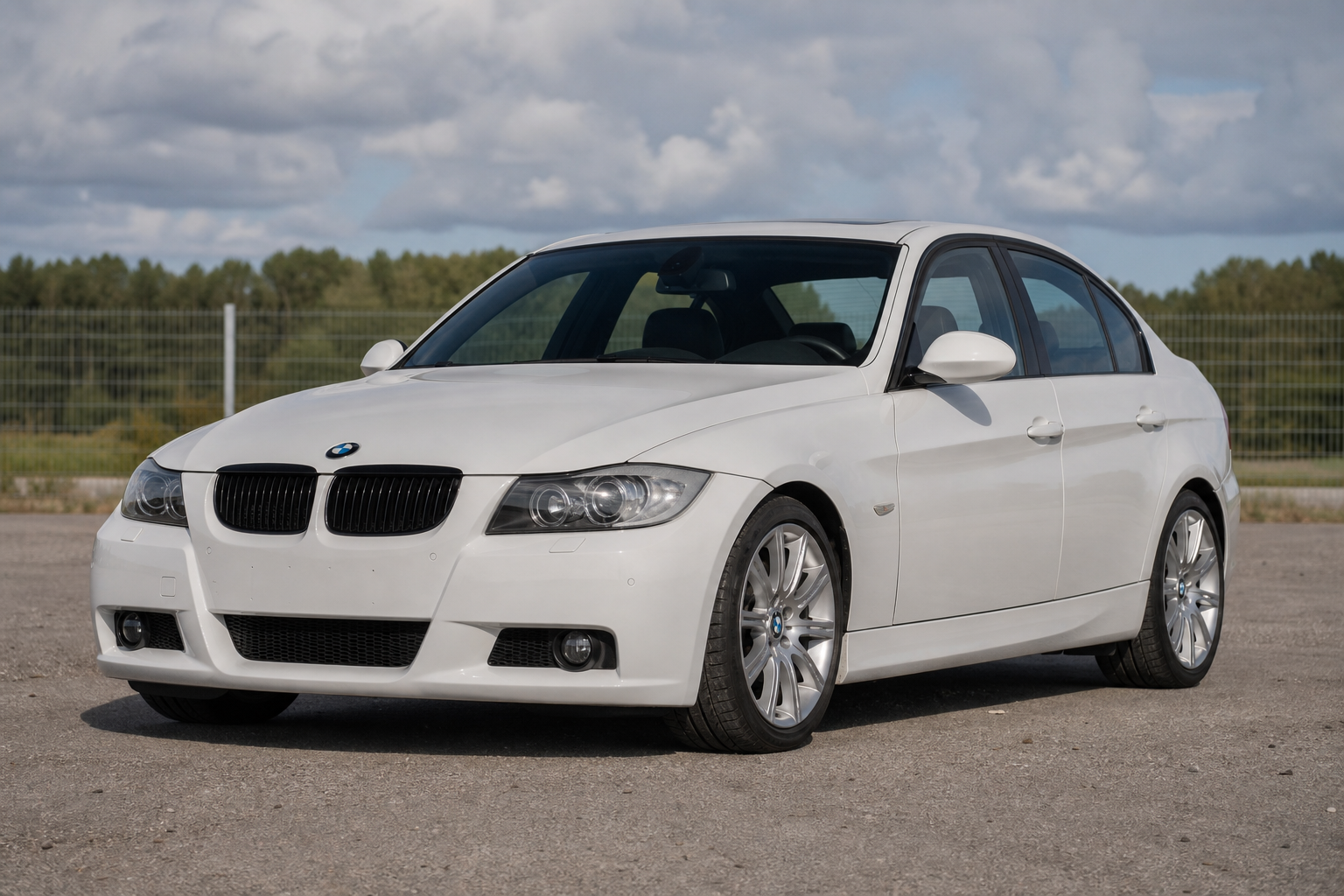

The BMW E90 320Si is one of the brand’s least-known homologation specials, combining a motorsport-developed four-cylinder engine with a production run of roughly 2,600 cars. Despite its limited availability and competition success, examples can still be found for less than $10,000.
BMW developed the 320Si for the World Touring Car Championship, where Super 2000 regulations limited competitors to naturally aspirated 2.0-liter engines. The E90 M3 was still several years away and would not have fit those rules, so BMW created a lighter, high-revving four-cylinder alternative inspired in concept by the E30 M3.
A revised four-cylinder engine
The car used the regular 320i’s 1,995cc N46 engine as its starting point, but BMW increased the bore from 84 to 85 millimeters and reduced the stroke by 2mm. Larger valves, a higher 11.0:1 compression ratio and a conventional throttle butterfly replaced the standard engine’s Valvetronic system.
The resulting 1,997cc engine could rev to 7,300 rpm, or 800 rpm higher than the regular 320i. BMW also used a carbon-fiber valve cover, which reduced weight by 22 pounds (10 kilograms). The cylinder head was cast at the same Landshut facility that produced BMW’s Formula 1 engine components.
Modest road-car performance
Despite its specialized hardware, the 320Si produced 171 horsepower (173 PS) and 143 lb-ft (194 Nm) of torque. That was a significant gain over the standard 320i’s 141 hp (143 PS), but the car needed 8.1 seconds to reach 62 mph (100 km/h). The competition version developed 271 hp (275 PS).
Most of the road car’s visual changes were subtle. Its distinguishing details included motorsport-style 18-inch wheels, wider tires, larger front brakes and satin-chrome mirror caps. Beneath the body, BMW fitted a shorter 4.10:1 final-drive ratio while retaining the standard M Sport suspension package.
That gearing allowed the car to reach a claimed 140 mph (225 km/h) in sixth gear. The front braking system was also upgraded, although the 320Si otherwise remained easy to mistake for an ordinary E90 3-Series.
Championship success and an engine concern
FIA rules required BMW to produce 2,500 road cars, but production reportedly reached 2,600 units. None were sold in the United States. On the track, the 320Si race car helped BMW and driver Andy Priaulx secure both the drivers’ and manufacturers’ WTCC championships in 2006 and repeat that result in 2007.
The road car does have a significant mechanical weakness. Its specialized aluminum cylinder liners can deteriorate, and replacing them with steel liners during an engine rebuild is considered the preferred solution if failure occurs. That repair is costly, even though the cars themselves remain inexpensive.
Used examples remain inexpensive
Three UK-market cars were recently listed between £3,900 and £7,995, equivalent to approximately $5,200 to $10,600. Higher-mileage examples can sell for less than $6,000, while low-mileage cars may remain below $10,000.
The 320Si’s future value is uncertain, but its rarity and championship history give it a stronger pedigree than its subdued performance suggests. Because it was introduced in 2005, the model could become eligible for U.S. importation under the 25-year rule in 2030.
0 Comments