
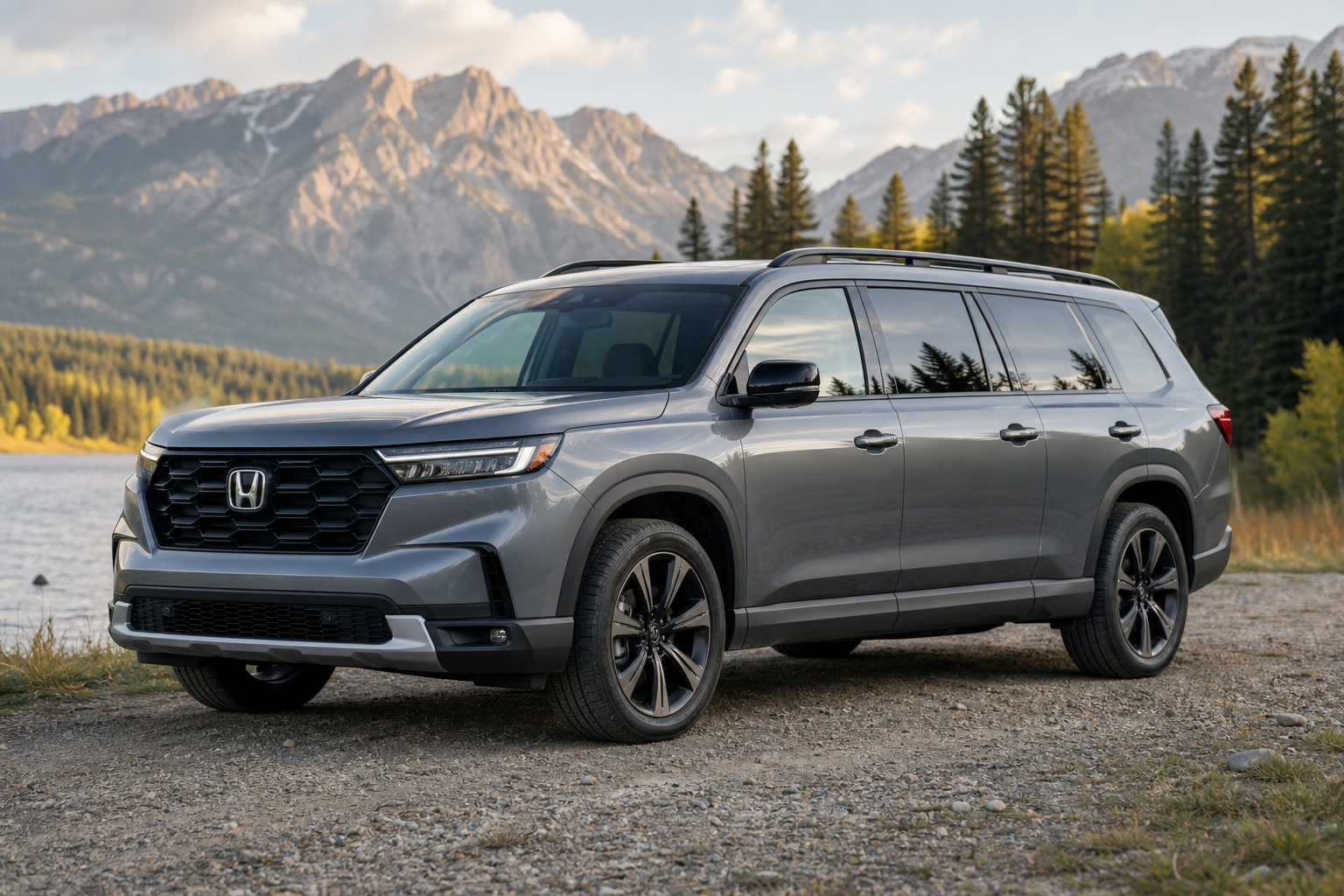

Honda may be preparing a larger sibling for the Pilot, and the reason is refreshingly simple: the current three-row SUV apparently isn’t roomy enough in the back for what some families expect. A reported future “Pilot XXL” could arrive in the early 2030s with additional third-row legroom while also improving fuel efficiency compared with the standard Pilot.
That is the entire known brief so far, which means there is no official powertrain, price, dimension, seating configuration, or launch date to dissect. Still, the idea tells us something useful about where Honda sees the Pilot—and where the company believes its customers want it to go.
The Pilot’s Awkward Bit Is the Third Row
The Honda Pilot already occupies the familiar three-row SUV role: larger and more family-focused than a compact crossover, but not quite the sort of enormous highway furniture that requires its own postal code. That middle ground makes it easier to park and generally less intimidating than a full-size SUV, but it also imposes limits on interior space.
Third-row seating is where those limits become obvious. A row can exist on a specification sheet without being particularly pleasant for adults. Legroom, seat height, access, shoulder room, and the amount of usable cargo space behind the seats all matter. If Honda wants the Pilot to serve larger families or compete more directly with roomier three-row rivals, simply adjusting the seat cushions will only get the engineers so far.
A longer vehicle would provide the obvious solution. Extra length could be divided between the passenger compartment and the rear cargo area, giving the third row more useful space without forcing the second row into an awkward compromise. The challenge, as ever, is that adding size tends to add weight as well. That is where the fuel-efficiency claim becomes more interesting.
More SUV, Less Fuel? That Is the Engineering Challenge
The report says the proposed larger Pilot would deliver better fuel efficiency than the regular model. On paper, that sounds like the automotive equivalent of ordering a larger dessert with fewer calories. It is possible, but somebody in the kitchen has to do some clever work.
A stretched body typically brings additional mass and a larger frontal area. Both can hurt efficiency, particularly at highway speeds. Honda would therefore need to offset those penalties through some combination of a more efficient powertrain, improved aerodynamics, reduced mechanical losses, lighter construction, or greater use of electrification.
That does not mean the future SUV must be fully electric or even a plug-in hybrid. The available information does not establish any particular propulsion system. It only establishes the target: more interior space and better fuel economy than the standard Pilot. Still, timing matters. A vehicle arriving in the early 2030s would be developed in a market where hybrid and electric systems are likely to play a larger role in large family transportation than they do today.
Honda could use a more efficient hybrid system to make the extra size less painful at the fuel pump. It could also pursue a longer-wheelbase architecture with careful attention to weight, rather than simply stretching the existing body and bolting on a bigger engine. The latter approach has produced plenty of large SUVs over the years. It has also produced plenty of fuel bills that arrive with the subtlety of a brick through a window.
Why Honda Might Want a Larger Pilot
The three-row SUV market has developed a distinct split. Some buyers want a vehicle that is manageable in daily traffic but still has a usable third row. Others want near-minivan levels of passenger space without driving something shaped like a rolling family room. The Pilot sits between those demands, and a larger companion could allow Honda to cover more ground without turning the existing model into a much bigger and heavier vehicle.
A Pilot XXL could also give Honda a clearer answer to customers who like the Pilot’s brand, driving position, and general format but find the rear seats too tight for regular adult use. That is a more credible reason for a new model than the usual industry habit of adding a few inches and describing the result as a revolution in lifestyle mobility.
The larger SUV would need to justify itself in practical terms. Third-row legroom is the headline, but buyers would also expect easy access to the rear seats and enough cargo capacity to make all three rows useful at once. If the third row is comfortable but leaves only a narrow shelf behind it, the improvement would be rather less impressive during an airport run with several suitcases.
What Remains Unknown
Honda has not publicly confirmed the Pilot XXL name, and the report does not provide final dimensions or technical details. It is therefore too early to discuss horsepower, towing capacity, drivetrain layout, pricing, or fuel-economy figures. Any confident claims on those points would be brochure fiction written before the brochure exists.
The timing is also broad. “Early 2030s” could mean a production vehicle several years away, with decisions about its platform and powertrain still subject to change. Automotive programs are not famous for proceeding in a perfectly straight line. A vehicle can gain a new battery system, lose a body style, change factories, and acquire three different marketing names before the public sees the first official photograph.
What can be said is that the proposal appears to target a specific weakness rather than chase size for its own sake. Honda would be trying to make the Pilot more accommodating in the row that often exposes the compromises of three-row SUVs, while avoiding the usual efficiency penalty associated with a larger body.
A Bigger Pilot Could Be the Sensible Kind of Excess
There is nothing inherently wrong with making an SUV larger. The problem is making it larger without making it more useful. A future Pilot XXL would need to earn its extra sheet metal through genuine third-row comfort, sensible cargo space, and efficiency that does not collapse under the weight of the vehicle itself.
That is a demanding brief, particularly in a segment where buyers want family practicality but still care about operating costs. If Honda can meet it, the bigger Pilot could become a logical flagship for families who have outgrown the standard model without wanting to leap straight into the most enormous SUVs on the market.
For now, the story is only a report and the name remains unofficial. But the basic idea makes sense: give the Pilot more room where passengers actually need it, then use newer engineering to prevent that extra space from becoming an expensive exercise in moving air and metal around town.
0 Comments