
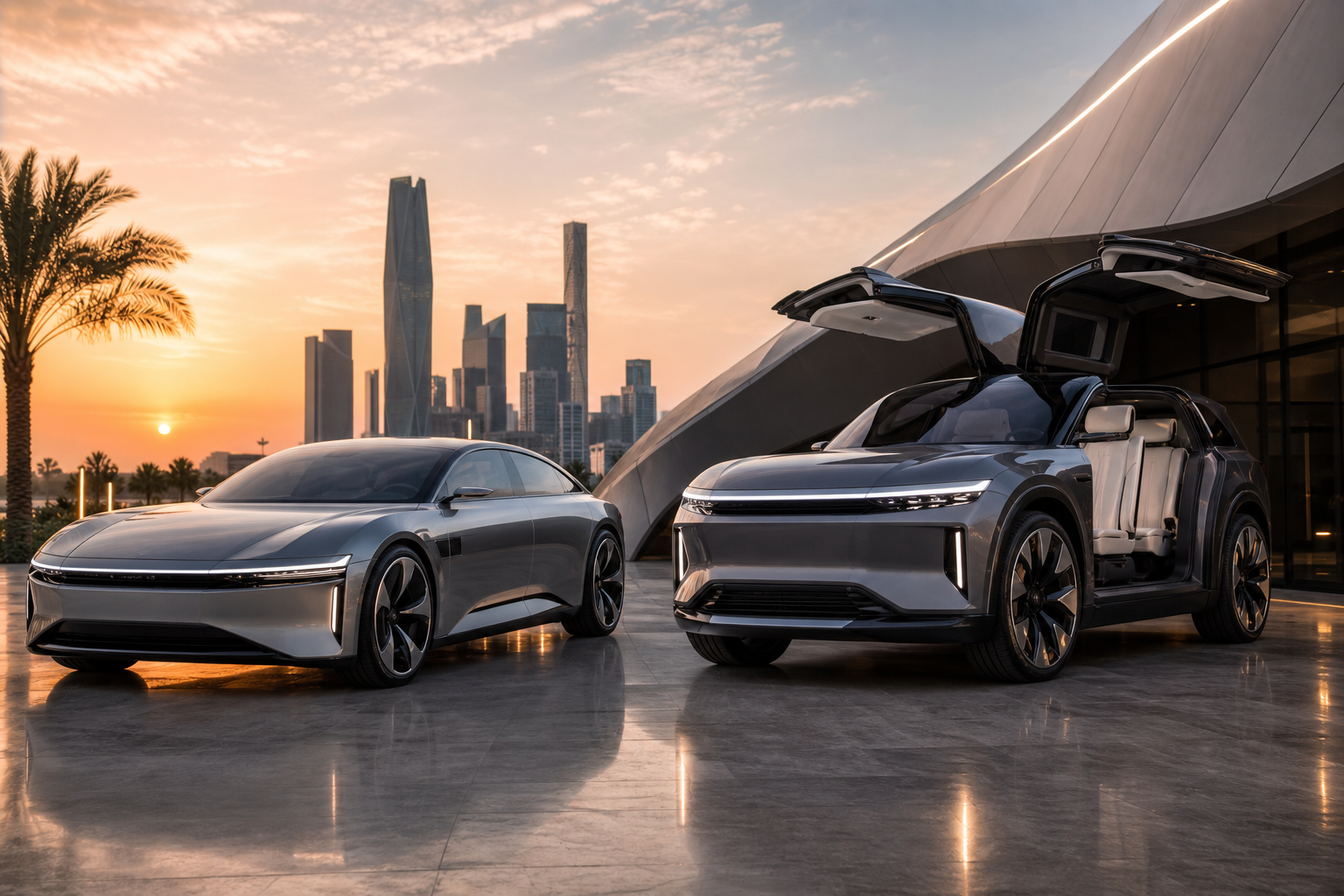

Saudi Arabia’s CEER Exobot is not attempting to sneak quietly into the electric-vehicle market. It arrives with an 850-horsepower tri-motor powertrain, a vast 48-inch display, and gullwing doors — the sort of specification sheet that appears to have been assembled after someone asked, “What would make a normal car considerably less normal?”
The Exobot will be offered in both sedan and SUV forms, giving CEER two distinct ways to apply its deliberately dramatic recipe. One version will sit low and sleek; the other will provide the taller, more imposing shape currently favored by buyers and marketing departments alike. Both are intended to establish CEER as a serious electric-vehicle manufacturer, but the details released so far suggest the company is equally interested in making an entrance.
A New EV Brand With Very Little Interest in Being Shy
CEER is Saudi Arabia’s own automotive brand, and the Exobot appears to be its statement piece. Rather than beginning with a modest compact car or a sensible crossover designed to blend into traffic, CEER has gone straight for extravagant power, theatrical doors, and an enormous digital interface.
That approach is risky, but it is also understandable. A new manufacturer has to give potential customers a reason to remember its name. A competent electric crossover with agreeable styling and a 250-mile range might be commercially sensible, but it would disappear into a very crowded conversation. An 850-hp sedan and SUV with gullwing doors are considerably harder to forget.
The challenge, naturally, is turning that memorable first impression into a convincing product. Spectacle can attract attention, but it cannot disguise poor software, awkward packaging, disappointing efficiency, or a difficult ownership experience for very long. The Exobot therefore has plenty to prove beyond the numbers that make for a lively launch announcement.
850 Horsepower From Three Motors
The headline figure is the tri-motor layout, which produces a claimed 850 hp. Three electric motors give CEER considerable freedom when it comes to managing traction and torque. Depending on how the system is calibrated, the additional motor can help distribute power between the axles or individual wheels, allowing the vehicle to deliver its output with more control than a simple rear-drive arrangement.
That is the theory, anyway. Eight hundred and fifty horsepower is a substantial amount in any road car, and electric motors deliver their torque immediately rather than waiting for engine speed to build. The Exobot’s performance potential should therefore be considerable, even if CEER has not yet released acceleration figures, top speed, battery capacity, or range.
Those missing figures are important. Horsepower makes a good headline, but electric performance depends on far more than motor output. Battery size, thermal management, vehicle weight, traction software, tire choice, and the ability to sustain power after repeated acceleration runs will determine whether the Exobot is genuinely rapid or merely capable of producing one spectacular shove before the electronics begin quietly protecting themselves.
There is also the question of restraint. A tri-motor electric vehicle can be engineered to feel smooth and composed, or it can behave like a particularly enthusiastic office chair fired from a catapult. The best systems make their power accessible without turning every wet intersection into a small philosophical crisis. CEER will need that calibration to be right.
Two Body Styles, Two Very Different Jobs
The Sedan
The sedan should provide the Exobot with its clearest performance identity. A lower body can help reduce aerodynamic drag and place the mass closer to the ground, both of which are useful when working with a high-output electric powertrain. It also gives CEER more room to create a dramatic silhouette without the visual bulk that comes with a tall roof and upright seating position.
That does not automatically make it the better car. Sedans have lost ground to SUVs in many markets because buyers increasingly want a higher seating position and easier access. A flagship electric sedan can still make a powerful design statement, but it must offer something beyond being the sleek alternative. Space, ride quality, charging convenience, and long-distance refinement will matter just as much as the ability to embarrass sports cars away from a stoplight.
The SUV
The SUV version is likely to be the more commercially important of the two. It matches the shape many buyers already prefer and gives CEER a practical route into the premium electric market. A higher body can also provide more cabin space and make those gullwing doors easier to justify — at least on paper.
Yet an 850-hp SUV is a peculiar object. It has the stance and versatility of a family vehicle, but the output of a serious performance car. That contradiction is hardly unique; the modern luxury market is full of tall, heavy vehicles with enough power to make physics look uncomfortable. Still, CEER will have to ensure that the Exobot SUV feels properly engineered rather than simply overpowered.
Gullwing Doors Are Brilliant Until Real Life Arrives
Gullwing doors are among the most effective ways to make a vehicle look expensive, futuristic, and faintly unreasonable. They also have a long association with memorable performance cars, most famously the Mercedes-Benz 300 SL. On the Exobot, they should give both body styles a visual signature that ordinary hinged doors simply cannot match.
But gullwings are not free theater. They need careful engineering, strong roof structures, reliable sensors, and enough clearance above the vehicle to operate without striking a low ceiling, neighboring car, or unfortunate garage door. Parking lots are not designed around automotive drama. Neither, for that matter, are many residential garages.
Access can also become awkward if the surrounding space is tight. The doors may lift upward rather than swing into the next vehicle, which is useful, but their operating envelope still matters. CEER will need to make sure the doors work quickly and consistently, because nothing drains the glamour from a futuristic car faster than waiting beside it while a warning chime explains that the gullwing cannot open.
The 48-Inch Screen Could Be Impressive — or Just Enormous
Inside, the Exobot features a 48-inch screen. That is a great deal of real estate for navigation, vehicle controls, entertainment, and whatever else modern software teams decide belongs in front of the driver.
A large display can create a strong visual centerpiece and give designers flexibility when presenting information. It can also make the cabin feel more like a lounge than a traditional cockpit. The danger is that screen size becomes a substitute for good interface design. A 48-inch display is not automatically better than a well-organized 12-inch one. It is simply larger, in the same way a billboard is larger than a road sign. Neither guarantees useful information.
The crucial questions remain unanswered. How much of the vehicle can be controlled through the screen? Are frequently used functions backed up by physical controls? Can the display show useful driving information without becoming a glowing wall of distractions? And will the software remain responsive after years of updates, heat, dust, and ordinary use?
Those details may sound less glamorous than 850 hp, but they will shape the daily experience far more often. Owners spend more time adjusting climate settings and navigating menus than launching their cars at illegal speeds. A spectacular cabin needs usable logic behind the spectacle.
What the Exobot Still Needs to Prove
CEER has revealed the elements most likely to attract attention, but the fundamentals have not yet been fully detailed. Battery capacity, charging performance, driving range, dimensions, curb weight, interior space, pricing, production timing, and availability will determine whether the Exobot is a real contender or an ambitious piece of automotive theater.
That distinction matters because electric vehicles are judged harshly once the novelty wears off. Customers may admire a dramatic design, but they will still want predictable charging, sensible software, comfortable seats, a quiet ride, and a service network capable of dealing with a three-motor powertrain and electrically operated gullwing doors. The more unusual the vehicle, the less tolerance buyers tend to have for small failures.
The Exobot also faces an engineering trade-off familiar to every high-performance EV: adding motors and power generally means adding mass, while large screens, elaborate doors, and luxury equipment do little to improve efficiency. CEER can make the vehicle fast. Making it fast without turning it into a very expensive battery with doors will be the harder trick.
A Bold First Move for CEER
As an introduction to CEER, the Exobot is difficult to ignore. The combination of sedan and SUV body styles, 850-hp tri-motor power, gullwing doors, and a 48-inch screen gives the brand an unmistakable personality from the outset. It is not trying to look like a cautious first draft.
Whether that personality translates into a successful production vehicle will depend on the less theatrical details. The Exobot needs convincing efficiency, polished software, credible usability, and engineering quality to match its outrageous specification sheet. If CEER can deliver those fundamentals, the drama will be an advantage rather than a distraction.
For now, the Exobot is best understood as a declaration of intent: Saudi Arabia wants a place in the electric-car conversation, and CEER has chosen to arrive wearing a cape. Slightly impractical, very powerful, and impossible to overlook — which, to be fair, is a rather effective way to introduce yourself.
0 Comments