
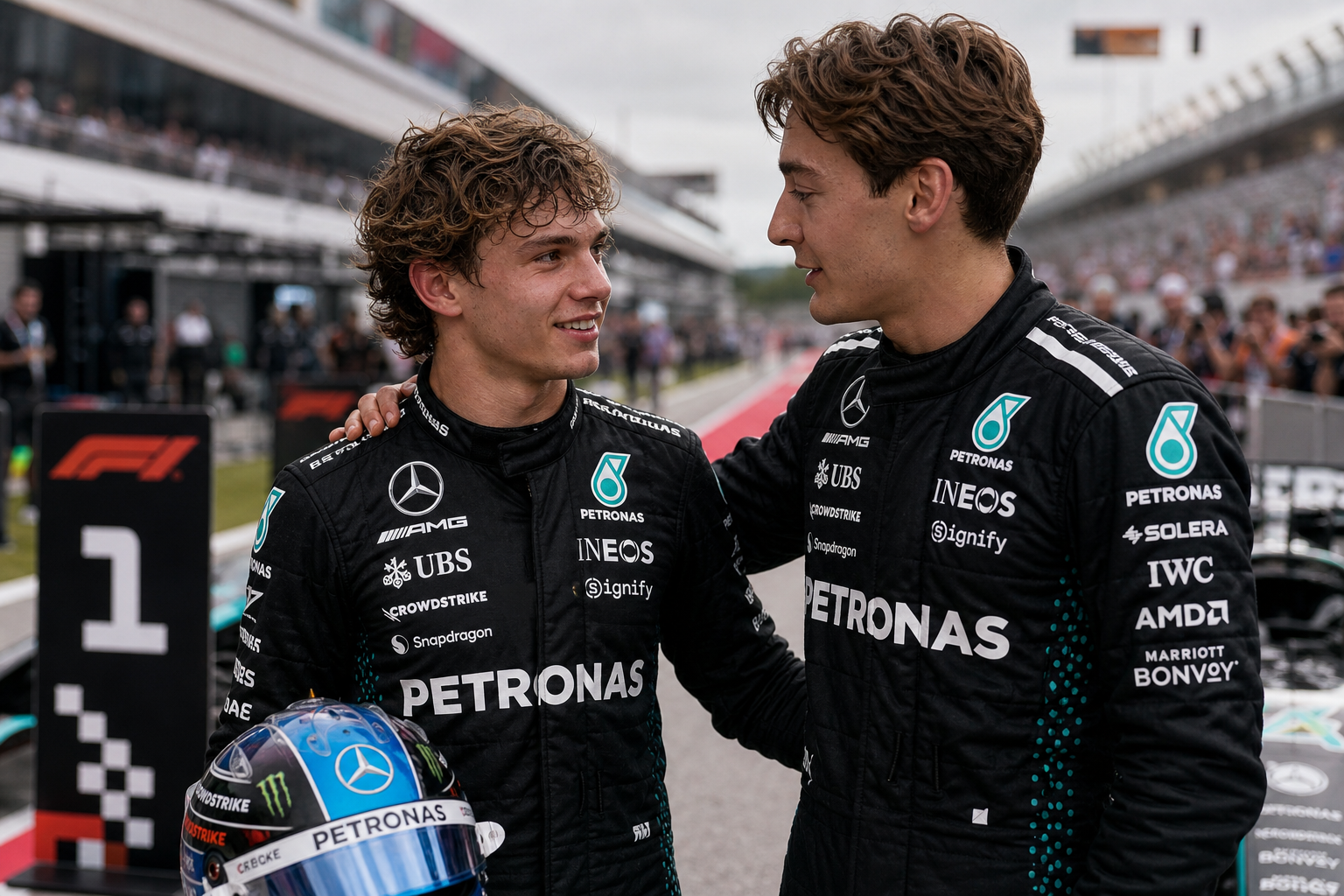

George Russell has earned an unusual kind of compliment in Formula 1: he admitted that his Mercedes teammate is currently doing a better job than he is.
That teammate is not a veteran champion or an established grand prix operator. Kimi Antonelli is the current championship leader, and after taking his eighth victory of the season at the inaugural Spanish Grand Prix, the Mercedes driver has built an 81-point advantage over Russell in second place.
Former Formula 1 driver David Coulthard praised Russell for acknowledging the gap rather than hiding behind the usual collection of carefully polished explanations. In a sport where every driver is expected to present himself as the fastest person in the room, that sort of candor is surprisingly rare.
Russell Has Admitted the Obvious, Which Is Harder Than It Sounds
Formula 1 drivers are not generally trained to volunteer evidence against themselves. Their careers depend on confidence, and confidence is often packaged for public consumption as certainty. A difficult weekend becomes a setup issue, a bad result becomes a strategy problem, and a teammate’s strong performance becomes something to be explained away with traffic, tire temperatures, or an unfortunate alignment of the planets.
Russell’s admission cuts through that ritual. Antonelli is ahead of him in the championship, has won eight races, and now leads the standings by a substantial margin. Saying that the younger Mercedes driver is doing the better job is hardly a radical interpretation of the table, but it is still the sort of statement that can carry professional risk.
Every internal comparison matters in Formula 1. Drivers are judged against their teammates because they share the same car, the same technical resources, and broadly the same opportunities. The comparison is never perfectly clean—motorsport remains full of variables—but it is the closest thing the sport has to a controlled experiment.
That makes Russell’s comments more meaningful than a routine gesture of sportsmanship. He has effectively accepted that Antonelli has set the stronger benchmark inside Mercedes so far.
Antonelli’s Season Has Changed the Mercedes Conversation
Antonelli’s eight wins have transformed the shape of Mercedes’ season. The team is no longer merely trying to recover ground or wait for a more favorable competitive cycle. Its newest leading driver is producing championship-level results immediately, and he has done so while sharing a garage with a driver who has already established himself as a highly rated member of the current grid.
The detail that matters is not simply the number of victories. It is the margin over Russell. An 81-point lead after the Spanish Grand Prix is large enough to make the standings impossible to dismiss as a short-lived streak. Antonelli has not merely grabbed a couple of fortunate wins while Russell suffered a bad afternoon; he has created a meaningful separation over the course of the season.
That changes the questions Mercedes must ask internally. Russell remains second in the championship, which is hardly a crisis requiring a manila folder and a stern meeting. But the performance hierarchy inside the team has shifted, at least for now. Mercedes must understand why Antonelli is extracting more from the car and whether the difference comes from qualifying pace, race execution, tire management, consistency, or some combination of those details.
The answer matters because small advantages compound rapidly in Formula 1. A driver who qualifies slightly better starts in cleaner air. A driver who manages tires more effectively gains strategic options. A driver who makes fewer mistakes turns competitive pace into points. By the time the checkered flag falls, the gap can look much larger than it did on Friday afternoon.
The Madring Victory Gives Antonelli Another Defining Result
Antonelli’s latest victory came at the inaugural Spanish Grand Prix held at the new Madring circuit. A new venue always adds an extra layer of uncertainty: teams have less historical data, drivers are still learning the track’s rhythms, and the usual collection of setup assumptions has not yet been tested across multiple seasons.
Winning at a brand-new circuit therefore carries a different flavor from adding another victory at a familiar stop on the calendar. The teams arrive with simulation work and preparation, but the real circuit still has the final word. Surface behavior, corner sequences, braking references, and tire demands must all be understood at speed rather than merely modeled on a screen.
For Antonelli, victory at Madring became his eighth of the season and further strengthened his position at the top of the championship. For Russell, it sharpened the contrast between the two Mercedes cars. That is the awkward beauty of a teammate battle: one driver’s triumph is also a measuring stick placed directly beside the other driver’s performance.
Why Coulthard’s Praise Matters
Coulthard knows the particular pressure of being evaluated against the driver occupying the other side of the garage. In Formula 1, a teammate is not merely another competitor. He is the person with access to the same machinery, engineers, data, and operating window. If that driver keeps finishing ahead, the explanation becomes increasingly difficult to outsource.
That is why Coulthard’s praise focused on Russell’s honesty. The admission does not concede that Russell is suddenly a poor driver, nor does it erase his position as championship runner-up. It recognizes a more specific point: on the evidence available, Antonelli is currently delivering the stronger season.
There is also a practical benefit to that kind of openness. A driver who accepts the problem can work on it. A driver who insists that nothing needs improving is left arguing with the timing screens, which rarely lose an argument.
What Russell Must Do Next
Russell does not need a dramatic reinvention. He needs to reduce the gap. That could mean finding more qualifying performance, matching Antonelli’s consistency, improving race execution, or extracting a better understanding of how the Mercedes responds across different circuit types. The source of the deficit will determine the remedy.
His current championship position also provides important perspective. Second place is evidence that Russell is operating at a high level, even if Antonelli is operating at a higher one. The challenge is to turn an honest assessment into a useful one rather than allowing it to become a public acceptance of defeat.
Mercedes, meanwhile, has the sort of problem teams usually dream about: both drivers are near the front, but one has emerged as the clear reference point. Managing that situation will require technical discipline and a little political care. Formula 1 garages are peaceful right up until they aren’t.
For now, Russell’s candor deserves the attention it has received. Admitting that a teammate is doing a better job does not weaken a driver automatically. In this case, it shows that Russell understands the scoreboard, respects the scale of Antonelli’s season, and knows precisely what Mercedes must chase. The next step is considerably less comfortable: making the admission obsolete.


0 Comments