
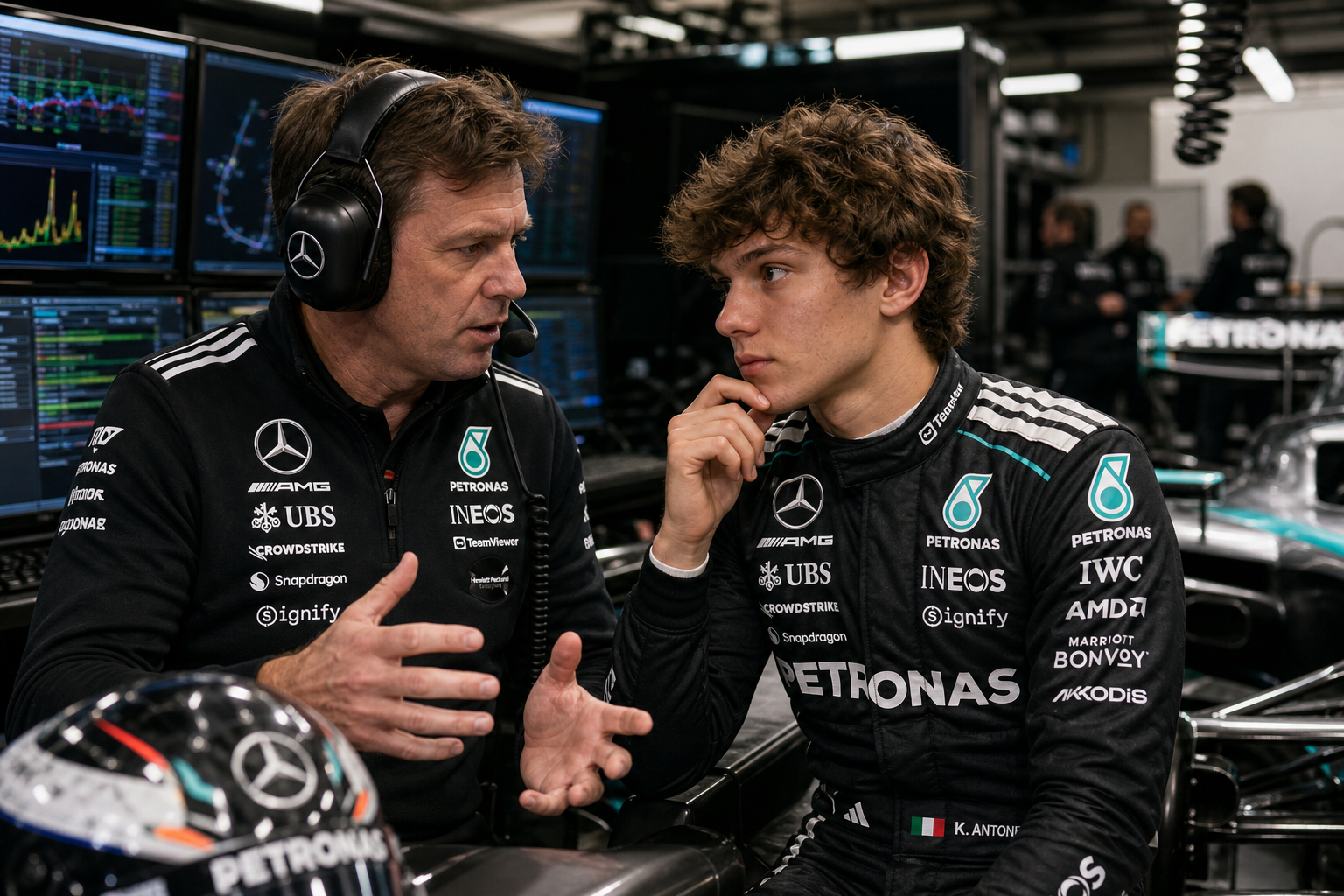

Kimi Antonelli may be the driver collecting the points, managing the tires, and threading a Formula 1 car through corners at speeds that make ordinary road traffic look mildly embarrassed. But former F1 race engineer Rob Smedley believes Peter “Bono” Bonnington has been crucial to the Mercedes driver’s remarkable 2026 championship campaign.
Antonelli became the youngest driver to lead the world championship after winning the Chinese and Japanese Grands Prix back-to-back. That achievement has placed a very young driver in the most uncomfortable chair in motorsport: the one occupied by the championship leader, with every rival, microphone, and team radio message suddenly carrying extra weight.
Smedley’s point is not that Bonnington is somehow driving the car from the pit wall. The driver still has to deliver the lap, make the pass, manage the tires, and avoid turning a promising afternoon into an expensive collection of carbon fiber. But F1 is not a solo act, and the quality of the relationship between driver and race engineer can become decisive when the margins are tiny and the pressure is enormous.
The Driver Gets the Trophy, but the Engineer Shapes the Weekend
A Formula 1 race engineer sits at the junction between the driver and an enormous technical operation. The role involves interpreting data, coordinating with vehicle performance specialists, responding to changing track conditions, and turning a torrent of technical information into instructions a driver can use at speed.
That last part is harder than it sounds. A driver cannot process a committee meeting while braking for a corner at the end of a straight. Communication has to be concise, timely, and trusted. The engineer must know what information matters, what can wait, and when silence is more useful than another stream of numbers.
Bonnington’s reputation was built over years at the sharp end of Mercedes’ Formula 1 program. He became widely known through his long working relationship with Lewis Hamilton, where his calm radio manner and familiar exchanges became part of the sport’s soundtrack. That public profile can obscure the less glamorous truth: the job is not about producing memorable radio clips. It is about making thousands of small decisions and delivering them without creating panic.
For Antonelli, that experience is particularly valuable. The Italian driver has arrived in F1 with enormous speed and expectation, but speed alone does not provide a complete operating manual for the championship. Every circuit brings different demands. Tire behavior changes. Weather turns forecasts into comedy. Safety cars disrupt carefully planned strategies. The driver must learn not only how to be fast, but how to be fast when the race refuses to follow the plan.
Why Antonelli’s Start Has Changed the Conversation
Back-to-back victories in China and Japan are impressive under any circumstances. They become considerably more striking when they put Antonelli at the top of the standings and make him the youngest driver ever to lead the championship.
Leading the points changes the nature of a season. A driver chasing the championship can often attack every opportunity. The leader has to think about damage limitation, strategic risk, and the long arithmetic of a calendar that is nowhere near finished. One aggressive move may win a handful of points. One poorly judged move may cost a race, a car, and a substantial chunk of momentum.
That is where a trusted engineer can help keep ambition from becoming impatience. The race engineer does not remove pressure, but can give it structure. A calm voice can separate an actual problem from a moment of frustration, or remind the driver that a second-place finish may be far more valuable than a heroic attempt to force an unlikely pass.
Smedley’s assessment recognizes that distinction. Bonnington’s contribution may be essential, but Antonelli remains responsible for converting preparation and advice into results. The engineer can identify the tire window; the driver still has to keep the tires alive. The team can explain the traffic; the driver still has to place the car in the right piece of track. There is no radio setting for “please produce three tenths of a second.”
The Importance of Trust on the Radio
Strong driver-engineer partnerships are built on more than technical competence. They depend on trust, especially when the information coming through the headset conflicts with what the driver feels from the car.
A driver may report that the front tires are finished while the data suggests the car can continue. The engineer may call for a pit stop that looks premature from the cockpit. A strategy that appeared sensible before the start can become questionable after a sudden weather change or safety-car period. In those moments, the driver has to believe that the person speaking has the full picture.
Bonnington’s experience gives him a deep understanding of the rhythm of a Grand Prix weekend: how practice information should be treated, how qualifying can distort expectations, and how quickly a race plan can unravel. Experience does not guarantee the correct call every time. Formula 1 is too chaotic for that. It does, however, improve the quality and speed of the decision-making process.
It also helps that the engineer’s job is not confined to the race itself. Preparation begins long before the cars leave the grid. Teams study simulations, review previous sessions, analyze tire degradation, and build possible race scenarios. The driver enters the weekend with a technical framework, but the engineer remains the person helping translate that framework into actions from corner to corner.
Bonnington’s Role Is Support, Not Substitution
There is a tendency in Formula 1 to treat famous driver-engineer pairings as if one person’s success can be neatly credited to the other. That makes for tidy storytelling, but it misrepresents the sport. Bonnington cannot manufacture Antonelli’s braking ability, reaction time, confidence, or willingness to commit to a corner. Those belong to the driver.
At the same time, pretending the engineer is merely a voice reading lap times would be equally silly. A modern F1 driver operates inside a moving technical system involving tire behavior, energy management, car balance, traffic, weather, regulations, and strategy. The radio connection is the most visible part of that relationship, but it represents a far larger amount of work taking place in the background.
That is why Smedley’s comments are more useful than the usual argument over whether the driver or the car deserves credit. Antonelli’s victories belong to a team effort, but the final responsibility remains his. The partnership works precisely because the two roles are different: Bonnington helps Antonelli understand and manage the situation, while Antonelli has to execute when the lights go out.
A New Kind of Pressure for Mercedes
Mercedes now has to manage a driver who has moved from promising newcomer to championship leader in the space of two races. That shift affects more than the headlines. Rivals will study Antonelli more closely, qualifying mistakes will receive greater attention, and every radio exchange will be treated as evidence of either composure or crisis.
The team must protect Antonelli without smothering the qualities that made him quick in the first place. Too much caution can blunt a young driver’s instincts. Too little structure can leave him exposed when the race becomes politically and strategically complicated. Bonnington’s role sits directly in that gap.
There is also a practical advantage in having an experienced engineer beside a driver facing unfamiliar territory. Antonelli has now learned how to win consecutive Grands Prix and how to leave Japan leading the standings. The next lesson is more awkward: how to respond when everyone expects him to win again.
That is often where a championship begins to reveal its true character. Raw pace gets a driver noticed. Consistency, judgment, and the ability to recover from a bad weekend decide whether the season becomes a title fight or merely a spectacular early run.
The Partnership Will Be Tested by What Comes Next
Two victories do not settle a championship, and the available evidence does not yet tell us how Antonelli and Bonnington will respond to every possible problem. They will face circuits that suit the Mercedes less well, races where strategy goes wrong, and weekends when the car refuses to behave politely.
Those difficult days will probably say more about the partnership than the celebrations in China and Japan. A dominant win can hide communication problems. A messy race exposes them immediately.
For now, Smedley’s assessment offers a sensible reading of Antonelli’s rise. The young driver deserves the credit for delivering on the track, while Bonnington’s experience and judgment provide an important layer of support around him. Formula 1 may sell itself through heroic individual performances, but championships are usually built through relationships that function properly when the situation becomes thoroughly unpleasant.
Antonelli has supplied the speed. Bonnington is helping turn it into something more durable. The championship leader still has to do the driving, naturally. Even the finest pit-wall advice cannot take the first corner for him.


0 Comments