
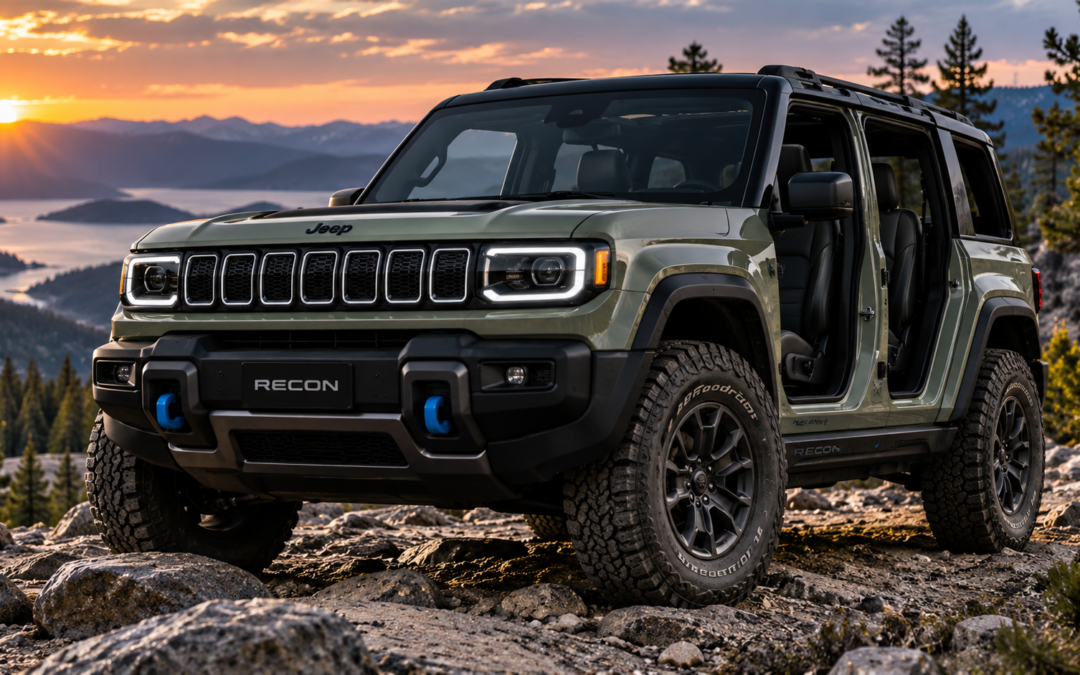
Jeep’s first fully electric off-roader brings 650 horsepower, removable doors, and genuine trail capability to the EV market. But its limited range, substantial weight, and premium price raise an important question: Is the Recon the future of adventure, or an expensive experiment?
The 2026 Jeep Recon EV arrives with a mission that sounds simple but is surprisingly difficult to execute: deliver the open-air freedom and off-road toughness of a traditional Jeep while replacing its gasoline engine with electric power.
On paper, the Recon looks like an impressive answer. It has a boxy, unmistakably Jeep-inspired design, removable doors, a removable or retractable roof configuration, four-wheel drive, and enough electric muscle to embarrass many performance cars. Its dual-motor powertrain produces approximately 650 horsepower and 620 pound-feet of torque, while specialized hardware gives it legitimate off-road ambitions.
Yet the Recon also exposes some of the fundamental compromises facing electric adventure vehicles. Its battery is heavy, its range is modest compared with some road-oriented EVs, and its charging architecture is not especially advanced. Add a starting price approaching $70,000, and the Recon becomes a fascinating but complicated proposition.
A Jeep That Looks Like a Jeep
The Recon does not attempt to disguise its identity as an electric vehicle, but neither does it abandon Jeep’s traditional visual language.
Its upright body, squared-off profile, prominent seven-slot grille, exposed tow hooks, chunky bumpers, and upright windshield all evoke the Wrangler. The styling is modernized rather than retro, with clean surfacing, contemporary lighting, and aerodynamic details integrated into a distinctly rugged silhouette.
That familiarity is important. Jeep buyers have traditionally valued vehicles that look ready for an expedition, even when their daily routine involves commuting and grocery shopping. The Recon preserves that sense of purpose while introducing an electric powertrain underneath.
The vehicle also offers one of the defining features of the Wrangler experience: the ability to remove the doors. The windows and other open-air elements are designed to make the process easier than the more involved disassembly required by some conventional off-road vehicles.
The result is an SUV that can transition from a relatively quiet, enclosed daily driver to something much more open and adventurous. For buyers who enjoy exploring trails, camping, or simply driving with the doors off on a warm day, that flexibility is a major part of the appeal.
650 Horsepower Meets Trail-Focused Engineering
The Recon’s dual-electric-motor powertrain is one of its most striking features. A motor drives the front wheels while another powers the rear, providing all-wheel drive without a conventional mechanical driveshaft connecting the axles.
Combined output is approximately 650 horsepower and 620 pound-feet of torque. Jeep says the Recon can accelerate from zero to 60 mph in roughly 3.6 seconds in its most aggressive driving mode.
That is extraordinary performance for a vehicle designed to crawl over rocks and traverse muddy trails.
Electric motors provide immediate torque, which can be useful off-road. Rather than waiting for an engine to build revs or a transmission to select the correct gear, the Recon can deliver power with precise accelerator control. Jeep has worked to tune the response so that the vehicle does not simply lurch forward whenever the driver touches the pedal.
That calibration matters. On a steep, loose, or technical trail, smooth and predictable power delivery is often more valuable than maximum acceleration. The Recon’s electric drivetrain gives Jeep an opportunity to make difficult terrain easier to manage, provided the software and traction systems work effectively.
On pavement, meanwhile, the Recon’s acceleration is expected to feel startlingly quick. Its power output is more than sufficient for highway merging and passing, although the vehicle’s considerable weight means it is not a sports car in the traditional sense.
Built for More Than a Gravel Road
The Recon is not merely a raised electric crossover wearing Jeep badges. It was engineered with genuine off-road capability in mind.
Its Trail Rated credentials reflect the vehicle’s focus on traction, ground clearance, water fording, maneuverability, and articulation. The design incorporates underbody protection, off-road-oriented suspension components, and drive modes intended to help the vehicle navigate different surfaces.
The Recon offers approximately 9.1 inches of ground clearance, while its approach and departure angles are designed to help it negotiate steep obstacles. Jeep also cites a water-fording capability of roughly 24 inches.
The Moab version goes further, adding equipment intended for more demanding terrain. Depending on configuration, that includes 33-inch all-terrain tires, steel skid plates, specialized axle and gearing hardware, and a rear electronic locking differential.
The rear locker is particularly significant. In difficult terrain, a locking differential can help maintain forward motion when one wheel loses traction. Combined with independent electric motors and software-managed traction control, it gives the Recon a different set of tools from a conventional gasoline-powered Jeep.
However, electric off-road capability is not simply a matter of adding motors and skid plates. The battery must be protected from impacts, the vehicle must manage its weight, and the control systems must work predictably in conditions where traction can change rapidly.
The Recon’s performance on challenging trails suggests that Jeep has taken those requirements seriously. But its real-world usefulness will depend heavily on how owners use it and how much range is consumed during demanding off-road driving.
The Weight of Going Electric
The Recon’s battery-electric powertrain provides immense torque, but it also contributes substantially to the vehicle’s mass.
With a curb weight of more than 6,000 pounds in some configurations, the Recon is a heavy machine. That weight is noticeable in several ways.
On the road, it can contribute to a less settled ride, particularly when the suspension is dealing with rough pavement. The vehicle may feel more substantial than agile, and its tall, boxy body is not naturally suited to rapid changes of direction.
Off-road, weight creates a different set of challenges. A heavier vehicle can place greater demands on tires, suspension components, and recovery equipment. It may also sink more readily into soft ground and require more energy to climb steep inclines.
The electric drivetrain partially offsets those disadvantages through its precise torque delivery. Still, the Recon cannot escape the physics of carrying a large battery and a rugged body structure.
The Moab’s larger all-terrain tires and specialized equipment help improve its trail performance, but they also add rolling resistance and weight. That is one reason the most off-road-focused version is not necessarily the most efficient or longest-ranging Recon.
Range Is the Recon’s Biggest Weakness
For all its impressive performance, the Recon’s range is likely to be the factor that determines whether it succeeds with adventure-oriented buyers.
The vehicle uses a battery of approximately 100 kilowatt-hours, with published range estimates varying by trim and configuration. The Moab has been reported with an EPA-estimated range of roughly 222 miles, while other versions have been associated with figures closer to 230–250 miles.
Those numbers are acceptable for an urban or suburban electric SUV. They are less reassuring for a vehicle marketed toward remote trails, wilderness exploration, and long-distance outdoor adventures.
Off-road driving can consume substantially more energy than steady highway travel. Low-speed crawling, steep climbs, loose surfaces, cold weather, heavy accessories, and large all-terrain tires can all reduce efficiency. A driver who begins a trip with a nominal 222-mile range cannot reasonably assume that the same figure will apply to a day of demanding trail driving.
This is particularly important because charging infrastructure is often sparse in the areas where serious off-road enthusiasts want to travel. A gasoline-powered Wrangler can be refueled in a matter of minutes at a station relatively close to civilization. The Recon requires a compatible charging location and sufficient time to replenish its battery.
For drivers who primarily use the vehicle for local trails and return home each evening, that may not be a major problem. For those planning multi-day backcountry trips, it could be a decisive limitation.
Charging Technology Has Room to Improve
The Recon’s charging system is another area where the vehicle does not lead the electric-vehicle industry.
Its 400-volt architecture is functional, but it is less ambitious than the higher-voltage systems used by some newer EVs. Charging speed depends on the station, battery temperature, state of charge, and other conditions, but the Recon is not positioned as a class leader for rapid long-distance charging.
That matters because the vehicle’s intended use often involves traveling far from home. When a driver is exploring remote regions, charging stops are not merely an inconvenience; they can determine where the trip is possible in the first place.
The Recon’s charging limitations are not necessarily deal breakers. Owners who charge at home and use the vehicle for short trips may rarely encounter them. But prospective buyers should consider their typical driving patterns carefully rather than assuming that a rugged electric SUV will automatically be suitable for remote travel.
A More Modern Cabin With Practical Details
Inside, the Recon combines contemporary technology with visual cues inspired by Jeep’s rugged heritage.
The dashboard features a large central touchscreen, a digital instrument display, physical controls for selected functions, and design elements intended to reinforce the vehicle’s outdoors-oriented character. Grab handles and durable-looking trim help create an atmosphere that feels more adventurous than luxurious.
The cabin also offers useful storage solutions and a practical layout for everyday driving. Compared with the Wrangler, the Recon provides a more modern electric-vehicle experience, with a quieter powertrain and a cabin that can feel more refined during ordinary travel.
There are compromises. Some interior materials and ergonomic details do not always match the Recon’s premium price. The vehicle’s heavy construction and upright shape also mean that it cannot deliver the spaciousness or efficiency of every similarly priced crossover.
Still, the cabin is a strong part of the Recon’s appeal. It feels like an electric Jeep rather than a generic EV with rugged styling applied afterward.
The Price Puts It in Difficult Company
The Recon enters a competitive market with a starting price in the high-$60,000 range, depending on the published configuration and destination charges.
That places it against a variety of vehicles with different strengths. Traditional gasoline-powered off-roaders such as the Ford Bronco and Jeep Wrangler offer established trail credentials and quick refueling. Electric alternatives such as the Rivian R2 and other emerging adventure-focused EVs emphasize range, technology, or value.
The Recon’s unique selling proposition is its combination of Jeep identity, open-air capability, and electric performance. There are not many vehicles that offer all three.
But uniqueness alone does not eliminate the need for value. Buyers must decide whether the Recon’s electric smoothness, instant torque, quiet operation, and distinctive design justify its range limitations and premium cost.
The answer will vary considerably depending on the owner. Someone who wants a daily driver that can tackle local trails and provide a quiet, open-air experience may find the Recon compelling. Someone who regularly ventures hundreds of miles into remote areas may find a gasoline-powered alternative more practical.
Verdict: An Exciting First Step, Not a Perfect Adventure Vehicle
The 2026 Jeep Recon EV is an ambitious attempt to bring electric power to one of the most demanding categories in the automotive world.
It succeeds in several important ways. Its styling feels authentic, its electric drivetrain delivers extraordinary acceleration, and its off-road equipment demonstrates that Jeep has not simply built a conventional crossover with a rugged appearance. The removable doors and open-air design preserve a central part of the Jeep experience.
But the Recon also highlights the challenges of electrifying a heavy, trail-focused SUV. Its limited range, charging constraints, substantial weight, and relatively high price make it less universally useful than its impressive specifications might suggest.
For the right owner, the Recon could be an exciting daily vehicle and a capable weekend adventure machine. It offers the quietness and immediacy of electric power without completely abandoning Jeep’s off-road character.
For long-distance wilderness travel, however, its range remains a serious concern.
The Recon is not a definitive replacement for the gasoline-powered Wrangler. Instead, it is a bold first chapter in Jeep’s electric off-road future—and a vehicle that demonstrates both how much EV technology can accomplish and how much work remains to be done.
2026 Jeep Recon EV: Key Specifications
| Specification | 2026 Jeep Recon EV |
|---|---|
| Powertrain | Dual electric motors |
| Drive system | Electric all-wheel drive |
| Combined output | Approximately 650 hp |
| Torque | Approximately 620 lb-ft |
| Claimed 0–60 mph | Approximately 3.6 seconds |
| Battery capacity | Approximately 100 kWh |
| Estimated EPA range | Approximately 222–250 miles, depending on trim |
| Charging architecture | 400 volts |
| Ground clearance | Approximately 9.1 inches |
| Water-fording depth | Approximately 24 inches |
| Seating | 5 |
| Starting price | Approximately $67,000–$69,000, depending on configuration |
Specifications, range figures, and pricing can vary by trim, equipment, and final market configuration. Performance and range may also vary substantially in real-world off-road use.