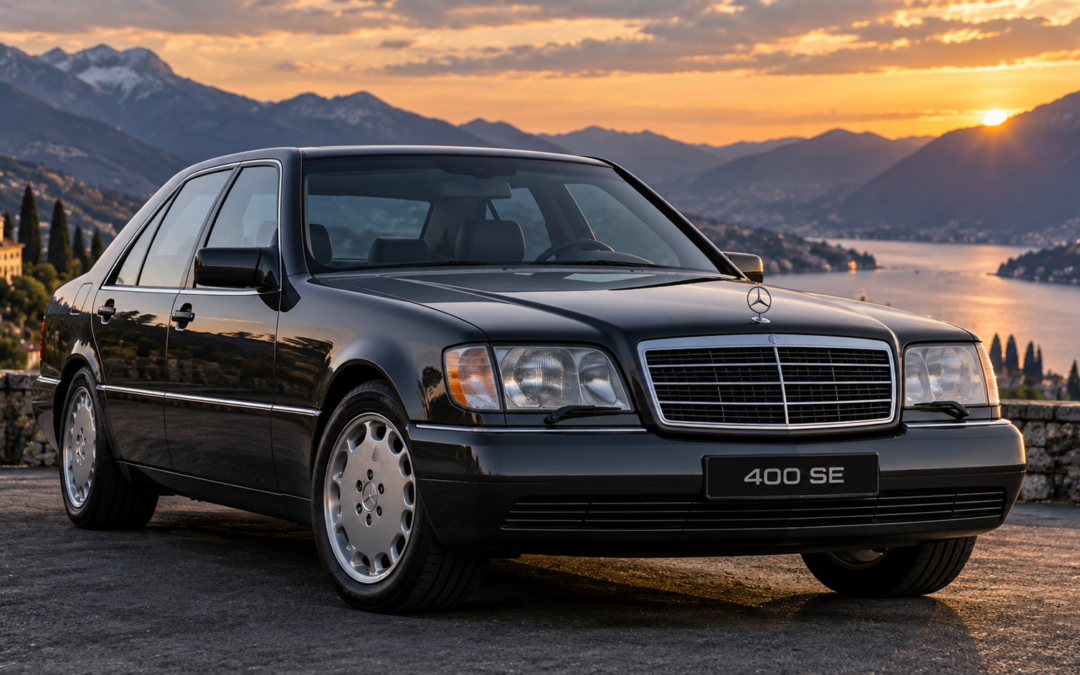
The W140 S-Class arrived with a simple ambition: to make an already prestigious luxury sedan even more comfortable, sophisticated, and imposing. The 1992 Mercedes-Benz 400SE delivered on that promise—with a remarkably quiet ride, an abundance of technology, and a silky V-8. But its enormous weight, eye-watering price, and less-than-sporting road manners revealed the compromises behind Mercedes-Benz’s vision of automotive perfection.
There was a time when the ultimate luxury car was not necessarily the fastest, most agile, or most technologically fashionable vehicle on the road. Instead, it was the car that made every journey feel effortless. It isolated its occupants from the outside world, offered seemingly endless comfort, and communicated its status without needing to shout.
The 1992 Mercedes-Benz 400SE was built around that philosophy.
As part of the newly introduced W140-generation S-Class, the 400SE represented a significant investment in engineering and luxury. Mercedes-Benz had developed a larger, more sophisticated flagship sedan with a new body, advanced safety systems, an elaborate suspension, and a cabin designed to accommodate occupants in exceptional comfort.
It was also expensive, heavy, and packed with technology that seemed excessive even by the standards of an era when luxury manufacturers competed to outdo one another.
More than three decades later, the 400SE remains an intriguing snapshot of what Mercedes-Benz believed a premium automobile should be. It was not intended to be a sports sedan in the mold of a BMW 7-series. It was a high-speed luxury cruiser, designed to make long journeys feel shorter and ordinary transportation feel distinctly special.
The W140: A New Definition of S-Class Luxury
The W140 S-Class replaced the long-running W126 generation in the early 1990s. Mercedes-Benz approached the redesign with an ambition that extended well beyond simply making the car larger or more powerful.
The new sedan was engineered around comfort, refinement, safety, and technical sophistication. Its body was substantial, but its designers sought to create a more modern and aerodynamic shape than the upright luxury cars of the previous decade.
The result was unmistakable. The W140 had a broad stance, a long hood, a formal roofline, and a solid, almost architectural presence. It looked expensive without relying on flamboyant styling.
The 400SE occupied an interesting position in the range. It was powered by a V-8 rather than the flagship V-12, but it offered much of the same engineering philosophy and cabin refinement. Buyers could enjoy the prestige of the new S-Class without paying the enormous premium associated with the range-topping models.
That distinction mattered. The 400SE was not the ultimate W140, but it was still a substantial luxury automobile, and its price reflected that.
A 4.2-Liter V-8 With Effortless Power
Under the hood sat Mercedes-Benz’s 4.2-liter V-8, producing approximately 282 horsepower. The engine was designed to deliver smooth, strong acceleration rather than the dramatic, high-revving character associated with a dedicated performance car.
The power delivery suited the 400SE perfectly. Its V-8 moved the large sedan with authority, building speed in a relaxed and refined manner. There was little need for the driver to work hard to access its performance. The engine’s strength was its ability to make the car feel unhurried even when traveling quickly.
Period testing recorded a zero-to-60-mph time of approximately 7.7 seconds, with a reported top speed of around 151 mph. Those figures were impressive for a large luxury sedan in the early 1990s, particularly one focused so heavily on comfort.
The 400SE did not feel like a car that was straining to achieve those numbers. Instead, the V-8’s smoothness helped preserve the sense of effortless progress that defined the S-Class experience.
The engine was also notably refined. Its power delivery was linear, and its mechanical character was subdued during ordinary driving. Under heavy throttle, however, the V-8 made its presence known, providing a satisfying reminder that this was still a substantial German performance sedan.
The 400SE’s engine was one of its strongest attributes: powerful enough for high-speed travel, smooth enough for luxury duty, and refined enough to avoid disrupting the cabin’s calm atmosphere.
The Four-Speed Automatic Was Less Impressive
The engine may have been polished, but the four-speed automatic transmission did not always match its level of refinement.
The transmission could select second gear during light-throttle starts, a strategy intended in part to improve fuel economy and smoothness. However, its part-throttle upshifts were not always as seamless as those in some competing luxury cars.
That was a notable shortcoming in a vehicle whose entire purpose was to make driving feel effortless.
The transmission was not a disaster. It performed its basic duties adequately, and the engine’s broad torque curve helped mask some of its limitations. But compared with the best gearboxes available at the time, it could feel somewhat clunky and less intuitive than expected.
In a car costing so much, even minor drivetrain imperfections became more noticeable. The 400SE was supposed to represent the best of Mercedes-Benz engineering, and the transmission occasionally reminded drivers that perfection was still out of reach.
A Ride That Defined the Car
If the powertrain was impressive, the 400SE’s ride quality was its defining achievement.
Mercedes-Benz invested heavily in reducing noise and vibration. The W140 incorporated double-pane window glass, extensive sound insulation, and suspension components designed to isolate the cabin from the road.
The effect was extraordinary.
On the highway, the 400SE could glide over imperfections with a level of composure that made ordinary road surfaces seem irrelevant. Broken pavement, expansion joints, and rough urban streets were handled with a calmness that few vehicles could match.
The seats were well shaped and extensively adjustable, while the steering column offered power tilt and telescopic adjustment. Drivers and passengers could find comfortable seating positions with relative ease, even on long journeys.
The suspension also maintained respectable control over the body. Despite its enormous mass, the 400SE did not simply float or wallow through every corner. Mercedes-Benz had engineered a chassis that could remain stable at high speeds while still delivering a soft and comfortable ride.
That balance was not easy to achieve. Many luxury cars of the period offered a comfortable ride but suffered from excessive body movement. The 400SE was more disciplined, giving it a reassuring sense of stability.
It was not a sports sedan, but it was an exceptionally accomplished long-distance cruiser.
The Problem With Nearly 4,800 Pounds
The 400SE’s greatest strength was also one of its greatest weaknesses.
The test car weighed approximately 4,795 pounds, an extraordinary figure for a sedan of its size. It was nearly 900 pounds heavier than the previous-generation 420SEL, despite being shorter than that model.
The weight was not simply a result of excessive dimensions. The W140’s mass came from its extensive equipment, structural engineering, sound insulation, safety systems, and sophisticated mechanical components.
Mercedes-Benz had essentially built a rolling fortress of comfort.
The downside became obvious when the road turned challenging. The 400SE could corner competently, but it did not feel eager or light on its feet. Its mass was always present, particularly when the driver began pushing the car toward its limits.
The steering could feel less communicative than expected, and the sedan did not deliver the same sense of agility as a BMW 7-Series. The 400SE was capable of covering ground quickly, but it was not especially enthusiastic about being driven like a sports car.
The car’s measured skidpad performance also reflected its priorities. Its grip was respectable, but not exceptional compared with more dynamically focused competitors.
The message was clear: Mercedes-Benz had prioritized serenity over excitement.
Luxury Features That Were Almost Excessive
The 400SE was filled with equipment designed to make life easier, quieter, and more comfortable.
Some features were genuinely useful. Others were examples of engineering excess that seemed designed to demonstrate what Mercedes-Benz could accomplish.
The car included power-assisted door closers that could gently pull a door shut after it was pushed against the latch. The system could also allow the doors to be closed with a more conventional slam.
The windows used double-pane glass to reduce outside noise. Remote-control door locks incorporated multiple receivers and changing infrared codes, adding a level of security sophistication that was unusual at the time.
The seatbelt retractors were designed with dual springs to provide a more comfortable fit while still retracting the belts efficiently when unlatched.
These details might seem ordinary today, but in 1992 they were part of a larger statement. Mercedes-Benz wanted the S-Class to feel like an engineering showcase, a car in which even minor inconveniences had been carefully considered.
The 400SE’s luxury was not limited to leather, wood, or a soft ride. It was built into the car’s mechanisms.
That approach helped distinguish Mercedes-Benz from competitors that focused more heavily on styling or performance. The S-Class offered a sense of technical depth that was difficult to replicate.
A Cabin Designed for Comfort, Not Drama
Inside, the 400SE was spacious, quiet, and exceptionally well suited to long-distance travel.
The short-wheelbase sedan still offered generous room for passengers. Its carefully shaped seats, adjustable steering column, and abundant cabin space made it easy to settle in for extended journeys.
The dashboard was formal and conservative, with an emphasis on function and durability rather than visual theatrics. Materials were substantial, and the overall atmosphere was one of understated luxury.
The cabin’s greatest achievement was how little it demanded from its occupants. Road noise was reduced to a minimum, the seats supported the body well, and the suspension worked tirelessly to keep the outside world at a distance.
That sense of isolation was central to the S-Class concept.
However, the interior was not without shortcomings. Some controls were less intuitive than those in Japanese luxury cars, and the sheer number of features could make the cabin feel complicated. The ergonomics were not always as straightforward as the car’s premium positioning suggested.
Still, for passengers, the 400SE was an exceptional environment. The back seat, in particular, reinforced the idea that the S-Class was designed as much for being driven in as it was for being driven.
Fuel Economy Was the Price of Luxury
A large, heavy sedan with a powerful V-8 was never going to be economical.
The 400SE’s fuel consumption reflected its mass and performance. Period projections placed city fuel economy in the low teens, while highway travel could produce better results under favorable conditions.
Testers reported approximately 15 mpg in typical driving and around 18 mpg during a long highway journey.
Those figures were not disastrous for the time, but they were hardly impressive. The 400SE required a substantial amount of fuel to move its considerable weight, and the V-8’s performance came with an unavoidable operating cost.
Fuel economy was not the only expense. Maintenance and repairs on a heavily engineered luxury sedan could also be costly, especially as the car aged.
The 400SE was built to a high standard, but its complexity meant that ownership required a willingness to spend money on proper upkeep. Today, a neglected example can become a financial burden, while a well-maintained car can still provide a remarkable driving experience.
The BMW 750iL Rivalry
The 400SE’s most significant contemporary rival was the BMW 750iL.
Both cars represented the pinnacle of German luxury engineering, but their philosophies differed.
The Mercedes-Benz emphasized ride comfort, quietness, prestige, and a sense of solidity. The BMW placed greater emphasis on driving engagement, handling balance, and performance.
The BMW was quicker, more agile, and generally more rewarding for an enthusiast behind the wheel. The Mercedes, however, offered a more serene ride and a quieter cabin.
The comparison illustrated a familiar divide between the two brands. BMW sought to make its luxury sedans appealing to drivers who wanted to be involved in the experience. Mercedes-Benz focused more heavily on making the automobile itself an exceptional place to spend time.
Neither approach was inherently wrong.
For someone who wanted a luxury sedan that could also feel entertaining on a winding road, the BMW was likely the stronger choice. For a buyer who valued high-speed comfort above all else, the 400SE made a compelling case.
The Mercedes was not the most exciting car in its class. It was arguably the most relaxing.
An Extraordinary Price Tag
The 1992 Mercedes-Benz 400SE carried a base price of approximately $86,375. With options, the tested example approached $91,000.
That was an enormous amount of money in the early 1990s.
The price placed the 400SE well above the mainstream luxury market and made it a serious financial commitment. It was not merely a more comfortable alternative to a family sedan; it was a statement of wealth and status.
The car’s price also exposed a problem. Buyers were paying a substantial premium for comfort and engineering sophistication, but competitors offered compelling alternatives.
The BMW 750iL delivered stronger performance and more engaging handling. Japanese luxury sedans offered impressive refinement at lower prices. Even within Mercedes-Benz’s own lineup, more expensive models promised additional prestige and power.
The 400SE therefore occupied a challenging middle ground. It was extraordinarily luxurious, but it was not the fastest, most agile, or most exclusive car in the range.
Its appeal depended heavily on whether the buyer valued its particular brand of luxury.
What the 400SE Got Right
The 400SE succeeded because it understood its mission.
It was designed to transport people quickly, quietly, and comfortably. It accomplished that with an impressive level of refinement.
The V-8 was smooth and powerful. The ride quality was outstanding. The cabin was spacious and well insulated. The car’s high-speed stability made it an excellent choice for long-distance travel.
Its technology was also remarkable for the period. Features that seem commonplace today were still unusual in 1992, and Mercedes-Benz incorporated them into a cohesive luxury experience.
The 400SE was not simply a large sedan with expensive materials. It was an engineering project intended to eliminate inconvenience.
That ambition was both its greatest strength and its defining characteristic.
Where the 400SE Fell Short
The car’s weaknesses were closely connected to its strengths.
Its extraordinary weight affected handling, braking, fuel economy, and overall responsiveness. The transmission was not as polished as the engine. The interior’s complex controls could be frustrating. The price was difficult to justify against more athletic competitors.
The 400SE also lacked the sense of lightness and immediacy that some drivers expected from a premium automobile.
It could travel quickly, but it did not encourage the driver to seek out winding roads. Its natural environment was the highway, where the suspension, sound insulation, and V-8 could work together to create a remarkably comfortable experience.
For buyers who wanted one car to do everything, the BMW 750iL was arguably the more balanced choice.
For those who wanted a luxury car that prioritized comfort above almost every other consideration, the Mercedes-Benz remained deeply compelling.
Buying a 1992 Mercedes-Benz 400SE Today
The 400SE is now a classic luxury sedan, but purchasing one requires careful consideration.
A well-maintained example can still offer an impressive combination of refinement, comfort, and presence. The W140’s solid construction and distinctive engineering make it appealing to enthusiasts who appreciate the era’s overbuilt luxury cars.
However, age has become a major factor.
Potential buyers should pay close attention to service history, transmission operation, suspension components, electrical systems, climate control, door-closing mechanisms, and the condition of the interior. The car’s extensive equipment can be expensive to repair when neglected.
The V-8 itself is an important attraction, but a smooth-running engine does not guarantee that the rest of the car is healthy.
A low purchase price should not be confused with low ownership costs. The most desirable example is often the one with the best maintenance history, not necessarily the lowest asking price.
For the right owner, a well-kept 400SE can be a fascinating way to experience the luxury-car philosophy of the early 1990s.
Verdict: A Monument to Comfortable Excess
The 1992 Mercedes-Benz 400SE was not a perfect luxury sedan. It was heavy, expensive, thirsty, and less agile than some of its competitors.
But it was also extraordinarily refined.
Its V-8 provided effortless performance, its suspension delivered a superb ride, and its cabin offered a level of quietness and comfort that few cars could match. Its technology demonstrated Mercedes-Benz’s willingness to engineer solutions to even the smallest inconveniences.
The 400SE represented a particular vision of automotive luxury: more insulation, more equipment, more engineering, and more substance.
That vision came at a price. The car’s mass and complexity compromised efficiency and agility, while its cost made it difficult to justify against more balanced alternatives.
Yet the 400SE remains memorable because it pursued its purpose with unusual conviction.
It was not designed to be the most exciting car in the world. It was designed to make the world outside the car feel farther away.
And in that respect, the 1992 Mercedes-Benz 400SE remains one of the most revealing examples of Mercedes-Benz’s pursuit of luxury excess.
1992 Mercedes-Benz 400SE: Key Specifications
| Specification | 1992 Mercedes-Benz 400SE |
|---|---|
| Model generation | W140 S-Class |
| Engine | 4.2-liter naturally aspirated V-8 |
| Horsepower | 282 hp |
| Transmission | 4-speed automatic |
| Drivetrain | Rear-wheel drive |
| Curb weight | Approximately 4,795 lb |
| 0–60 mph | 7.7 seconds |
| Top speed | Approximately 151 mph |
| Reported fuel economy | Approximately 15 mpg typical driving; 18 mpg highway trip |
| Base price when new | $86,375 |
| Price as tested | Nearly $91,000 |
| Seating capacity | 5 |
| Primary strengths | Ride comfort, quietness, refinement, luxury equipment |
| Primary weaknesses | Weight, fuel economy, handling agility, cost |
Performance figures and pricing reflect period test information. Actual specifications may vary with market, equipment, and testing conditions.