
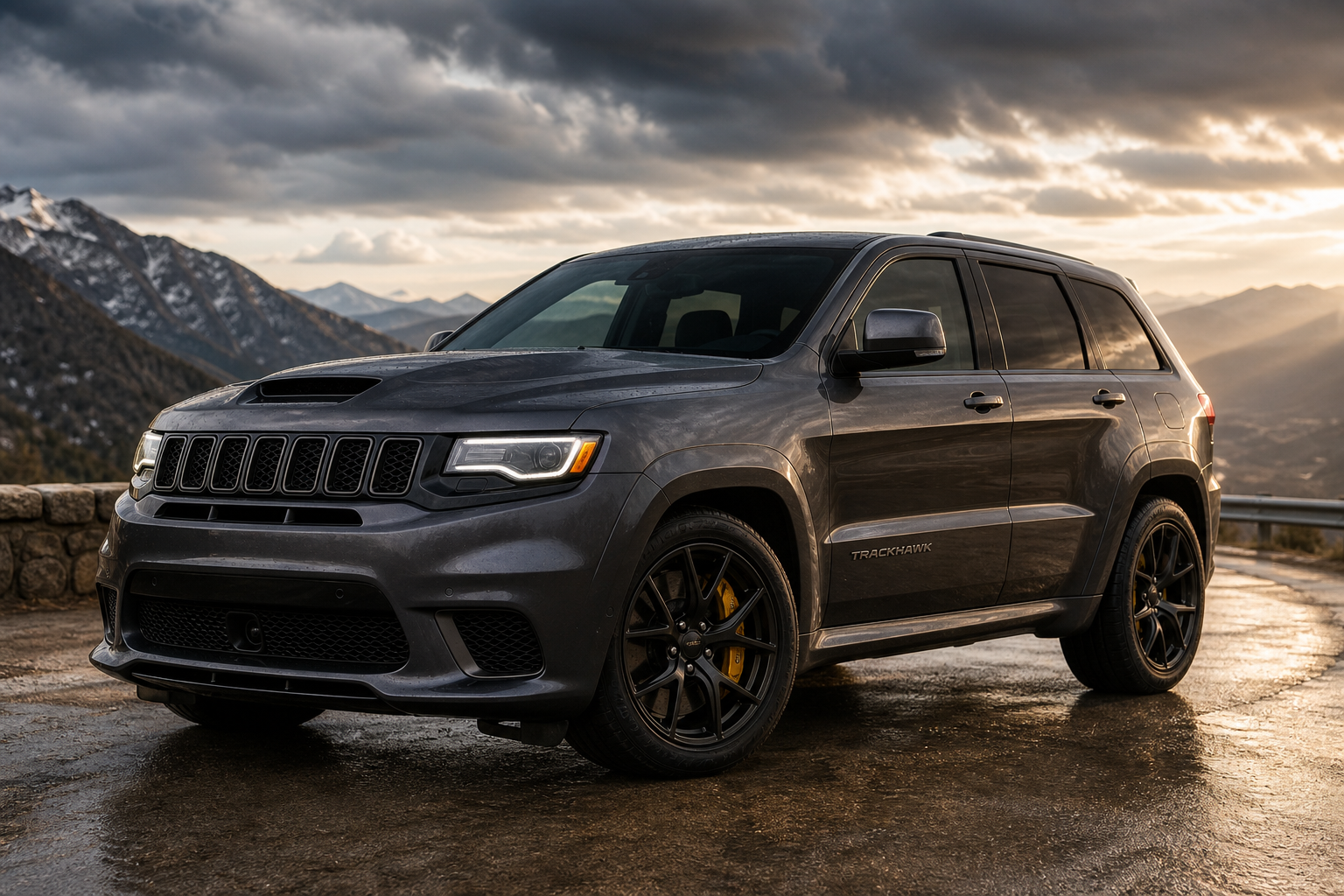

When the Jeep Grand Cherokee Trackhawk arrived, it was one of the most outrageous factory SUVs ever sold in the U.S. A Jeep with a supercharged 6.2-liter V8, 707 horsepower, and all-wheel drive was already excessive on paper. Years later, that same formula looks less like a novelty and more like a very specific answer to a very specific used-car question: what happens when one of the wildest performance SUVs ever built falls into the secondhand market?
The answer, for shoppers who can stomach the fuel bills and the maintenance risks, is that the Trackhawk has become far more compelling as a used buy than it ever was when new. It still occupies a strange and appealing space between muscle car, luxury SUV, and drag-strip special, and that combination is difficult for newer vehicles to replicate at the same price point.
The SUV that made overkill feel factory-approved
Jeep had already turned the Grand Cherokee into a serious performance platform before the Trackhawk arrived, but the Trackhawk pushed the idea to an extreme. Under the hood sat Chrysler’s supercharged 6.2-liter Hemi V8, the same general engine family used in the Hellcat lineup, tuned here for 707 hp. That figure alone was enough to separate the Trackhawk from almost everything else with a Jeep badge.
It was not just the engine. The Trackhawk paired that output with all-wheel drive and a driveline built to cope with repeated hard launches. In a straight line, it could embarrass sports cars and many dedicated performance sedans. For an SUV with genuine practicality, comfortable seating, and the upright driving position that buyers expected from a Grand Cherokee, the performance envelope was absurd in the best possible way.
That is part of why the Trackhawk has remained so memorable. Jeep did not build it as a subtle European-style performance SUV. It was never meant to disappear into traffic. The brief was to stuff an engine with far more output than most buyers would ever need into a midsize SUV and let the hardware deal with the consequences.
Why the used market makes more sense than the original sticker
New, the Trackhawk sat at a level where its appeal was limited to buyers willing to pay for excess without apology. That’s typical of halo performance models. Used, though, the calculation changes. Depreciation tends to hit large, thirsty performance SUVs hard, and the Trackhawk has not been exempt.
That is good news for buyers who want the engine, the Jeep badge, and the all-weather usability without paying flagship money. The used-market proposition is simple: there are cheaper ways to get into a fast SUV, but few that deliver this level of theatrical V8 performance. It’s also difficult to find a modern equivalent that offers the same blend of power, image, and real-world traction in the same package.
Buyers looking at the Trackhawk are usually not shopping for efficiency or restraint. They’re shopping for character. The appeal is tied to the engine’s supercharged punch, the noise it makes, and the fact that Jeep built it as a proper production model rather than as a one-off tuning exercise. That distinction matters in the used market because it gives the Trackhawk a credibility and parts support that many modified SUVs never enjoy.
How it fits into the Grand Cherokee lineup
The Trackhawk sat at the top of the Grand Cherokee range, and that placement is central to its appeal. The Grand Cherokee has long been one of Jeep’s key nameplates, balancing utility, off-road heritage, and premium ambitions. The Trackhawk took the same body style and shifted the mission almost entirely toward performance.
That makes it different from a lot of modern performance SUVs, which often focus on refinement and all-around pace. The Trackhawk was more direct. It delivered headline horsepower, serious acceleration, and the sort of straight-line force that made the SUV feel closer to an American muscle car in lifted form than a traditional luxury crossover.
It also arrived at a time when the market was broadening around the idea of high-performance utility vehicles. BMW, Mercedes-AMG, and others were already making performance SUVs a credible category, but Jeep gave the idea a distinctly American twist. The Trackhawk did not need an Autobahn to justify itself. It was built around the sort of acceleration and drama that translate anywhere.
What used buyers should keep in mind
The Trackhawk’s used-car appeal comes with obvious caveats. The same supercharged V8 that makes it special also makes it expensive to run. Fuel consumption is predictably heavy, and ownership costs will not be modest. Tires, brakes, and other wear items are all likely to see harder use than they would on a standard Grand Cherokee.
As with any high-output performance vehicle, condition matters more than mileage alone. A Trackhawk that was used sparingly and serviced properly is a very different proposition from one that spent its life at drag strips or on modified launches. Prospective buyers should pay close attention to service records, signs of aftermarket tuning, and the health of the driveline.
Still, the Trackhawk’s fundamentals help its case. This was a factory-engineered vehicle, not an internet-era swap project. The drivetrain, chassis calibration, and electronics were all developed together, which gives buyers a level of integration that can be difficult to duplicate after the fact. That matters in a segment where plenty of fast SUVs are the product of optional packages or cosmetic add-ons rather than full engineering exercises.
A halo model with lasting appeal
The Trackhawk’s relevance has only grown as new performance SUVs have become heavier, more expensive, and often more restrained in character. Some newer rivals may be faster on paper or more polished inside, but few have the same blunt-force personality. The Jeep’s appeal is in how unmistakable it is: a Grand Cherokee that can haul family and luggage during the week, then launch with serious intent when the road opens up.
That duality is what gives the Trackhawk durability in the enthusiast market. It is an SUV, yes, but one with a spec sheet that still reads like a dare. On the used market, that combination of rarity, capability, and sheer excess gives it a logic it never had at new-car prices.
For buyers who want a performance SUV with a genuine story behind it, the Grand Cherokee Trackhawk remains one of the more distinctive choices from the last decade. It may have been ridiculous when it was new. That’s exactly why it makes sense now.

0 Comments