
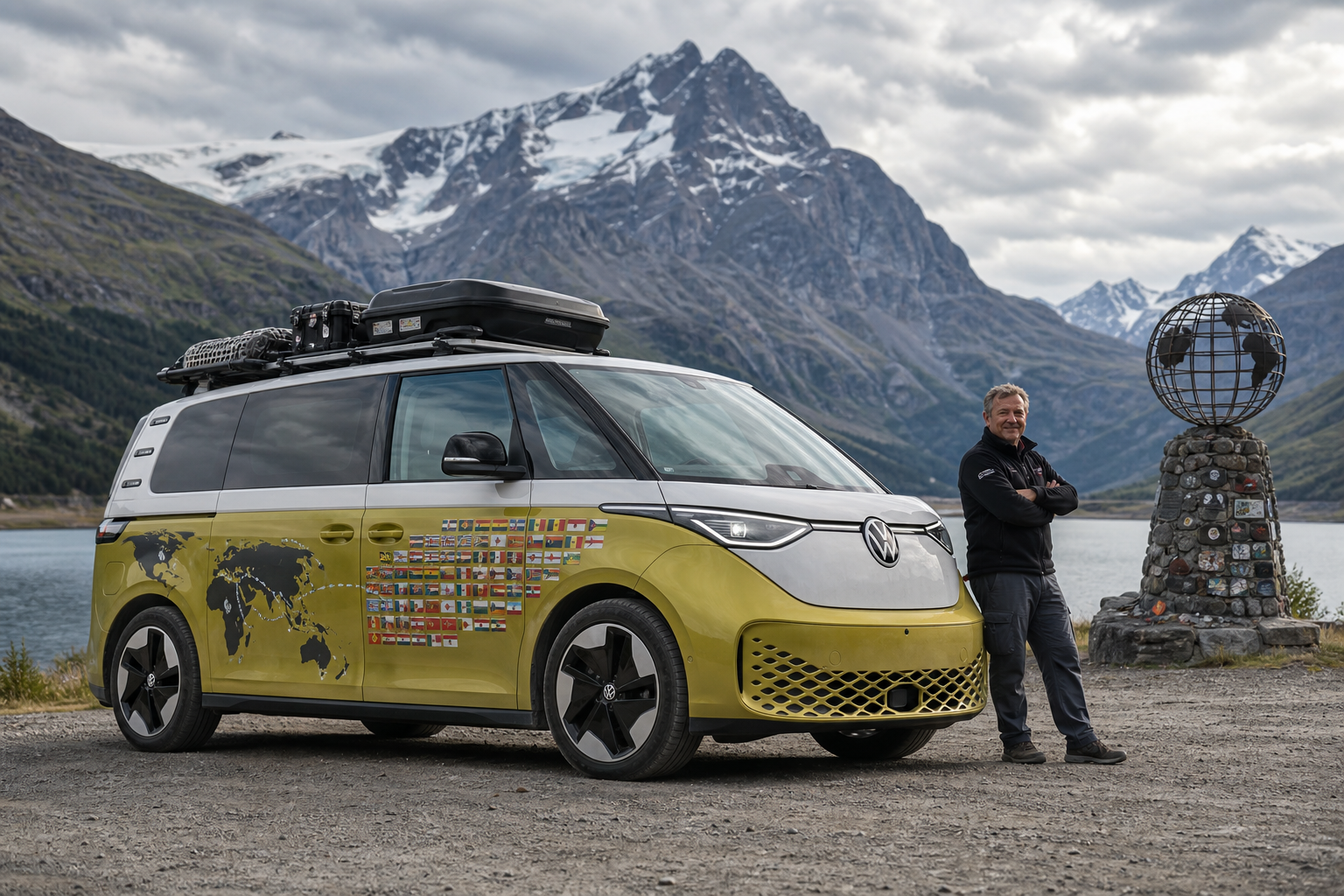

Electric road trips are usually judged by the least glamorous part of the adventure: how long the driver spends staring at a charging screen while quietly reconsidering the purchase of a gasoline-powered wagon. Rainer Zietlow has provided a rather more interesting test. He drove a Volkswagen ID. Buzz through 92 countries, covering 99,767 kilometers—roughly 62,000 miles—without a single technical breakdown.
That is not a short promotional loop around a manufacturer’s proving ground. It is a global endurance run in a large electric van, with all the logistical complications that come from crossing borders, changing road conditions, inconsistent infrastructure, unfamiliar traffic, and the general tendency of long journeys to reveal every weakness a vehicle would prefer to keep secret.
A Very Long Test Drive
The headline achievement is the combination of distance and geography. Zietlow’s ID. Buzz visited 92 countries and accumulated 99,767 kilometers before the journey was complete. The vehicle therefore had to function across a collection of environments rather less controlled than the average commute or school run.
That matters because an endurance journey is not just a matter of adding miles to an odometer. A vehicle traveling across multiple countries encounters different road surfaces, weather conditions, traffic patterns, fuel—or in this case charging—arrangements, service networks, regulations, and driving habits. Even a well-built car can become a rolling collection of small complaints when exposed to that sort of treatment for long enough.
The ID. Buzz completed the trip without a technical breakdown. That wording is important, and it deserves to remain intact rather than being inflated into something it does not say. The claim does not mean the vehicle required no charging, maintenance, inspections, tire attention, or ordinary journey planning. It means the van did not suffer a technical failure serious enough to stop the expedition.
That is still an impressive result. A breakdown-free journey approaching 100,000 kilometers suggests that the vehicle’s major systems remained dependable through an unusually demanding period of use. It also provides a useful counterweight to the idea that an electric vehicle is automatically too complicated, too fragile, or too dependent on perfect conditions to survive a serious road trip.
Why the ID. Buzz Is an Interesting Record Vehicle
The Volkswagen ID. Buzz is not a featherweight sports car built solely to chase a distance record. It is a modern electric van with a broad, upright body and the sort of shape that prioritizes usable space over aerodynamic mischief. That makes it a more revealing long-distance machine than a low-slung prototype with a tiny cabin and a support crew hovering nearby.
A vehicle in this class has to carry people, equipment, luggage, and all the practical baggage that accumulates during a journey spanning 92 countries. Its mission is fundamentally different from that of an efficiency demonstrator. The point is not merely to travel as far as possible on one charge. The point is to keep functioning while being used as an actual transport tool over a huge distance.
That distinction makes the achievement more relevant to ordinary owners. Most drivers will never attempt a 100,000-kilometer international expedition, thankfully. There are only so many border crossings one can endure before the romance begins to resemble administrative punishment. But owners do expect their vehicles to handle long highway runs, hot weather, cold weather, rough pavement, heavy loads, and repeated charging without developing a nervous tic in the dashboard.
The ID. Buzz’s record does not prove that every example will be trouble-free forever. No vehicle earns that guarantee, and anyone selling one should be treated with suspicion if they claim otherwise. It does show that the platform was capable of completing an extreme use case without a technical breakdown, which is a much more useful statement.
The Real Difficulty Was Probably the Logistics
Driving nearly 100,000 kilometers is a mechanical challenge, but a journey across 92 countries is also an enormous organizational exercise. The route would have required careful planning around borders, road access, charging opportunities, documentation, weather, and the availability of help if something did go wrong.
Electric vehicles add another layer to that planning. A gasoline vehicle can often be refueled in a few minutes almost anywhere, with little thought beyond finding the next station. An electric road trip requires more attention to charging locations, connector compatibility, operating hours, payment systems, electricity availability, and the time needed to replenish the battery.
The source information does not specify the route, charging network, number of charging stops, vehicle configuration, or support arrangements, so those details should not be guessed at. They would certainly make the expedition even more interesting, particularly in countries where fast-charging infrastructure is limited. But the absence of those figures does not diminish the central point: the van and its crew had to keep moving through a remarkably wide range of circumstances.
There is also a difference between a single long journey and normal ownership. A record attempt may involve technical preparation, planned inspections, specialist support, and a team dedicated to keeping the vehicle moving. That is not a criticism. It is how serious endurance projects work. It simply means buyers should view the result as evidence of capability, not as a promise that routine maintenance can be ignored.
What “No Technical Breakdowns” Tells Us
Reliability claims are often presented in vague language, so the precise wording here carries more weight than a parade of dramatic adjectives. The important fact is not that the ID. Buzz was supposedly flawless in every possible respect. The important fact is that it completed an exceptionally long and varied journey without suffering a technical breakdown.
That points toward several areas of engineering competence. The electric powertrain had to continue operating for tens of thousands of miles. The battery system had to tolerate repeated use over the length of the trip. The cooling, control electronics, suspension, steering, braking, and charging hardware all had to remain functional enough for the expedition to continue.
Again, the available information does not provide component-level data, so it would be foolish to turn one journey into a scientific verdict on battery degradation or long-term ownership costs. There is no stated battery-health figure, no repair log, and no claim that the vehicle emerged untouched. Still, endurance is valuable evidence. Cars can hide their weaknesses during short media drives. They have fewer places to hide after nearly 100,000 kilometers.
A Different Kind of Volkswagen Image Exercise
Volkswagen has long used distance, exploration, and unusual journeys to connect its vehicles with a sense of adventure. The ID. Buzz is particularly well suited to that role because its design deliberately recalls the company’s historic vans while using an electric platform. A global record run gives the modern vehicle a story that fits its visual identity without relying entirely on nostalgia.
There is a risk with any manufacturer-backed endurance story: it can become a polished advertisement wearing a utility belt. Yet this achievement has a sturdier foundation than the usual claim that a vehicle is “ready for anything,” a phrase that frequently means it survived a damp photo shoot near a scenic lake.
Almost 100,000 kilometers and 92 countries are concrete figures. They give readers something to examine. The most important question is not whether the trip makes the ID. Buzz adventurous in a brochure. It is whether the vehicle demonstrated that electric vans can be used for serious, sustained travel without treating their owners to a roadside melodrama.
The Record’s Meaning for Electric Van Buyers
No single expedition can settle every question about an electric vehicle. Range still depends on speed, temperature, load, terrain, and charging access. Charging remains more involved than filling a gasoline tank. Local infrastructure may be excellent in one region and frustratingly thin in another. Those realities do not disappear because one ID. Buzz completed a remarkable journey.
What the record does provide is a useful reminder that electric vehicles should be judged by their actual engineering and use case rather than by assumptions about what happens when the road leaves the familiar part of town. The ID. Buzz was asked to operate across an almost absurdly broad map, and it completed the trip without a technical breakdown.
That is a strong result for a vehicle whose greatest selling point is supposed to be usable, everyday transport rather than heroic expedition work. The van did not need to conquer a mountain or set a top-speed record. It simply had to keep going—again and again, country after country, for nearly 100,000 kilometers.
There is something pleasingly straightforward about that. No fireworks, no smoky finish line, no dramatic rescue helicopter. Just an electric Volkswagen van continuing to do its job for a very, very long time. In the automotive world, that can be rather more impressive than it sounds.


0 Comments