
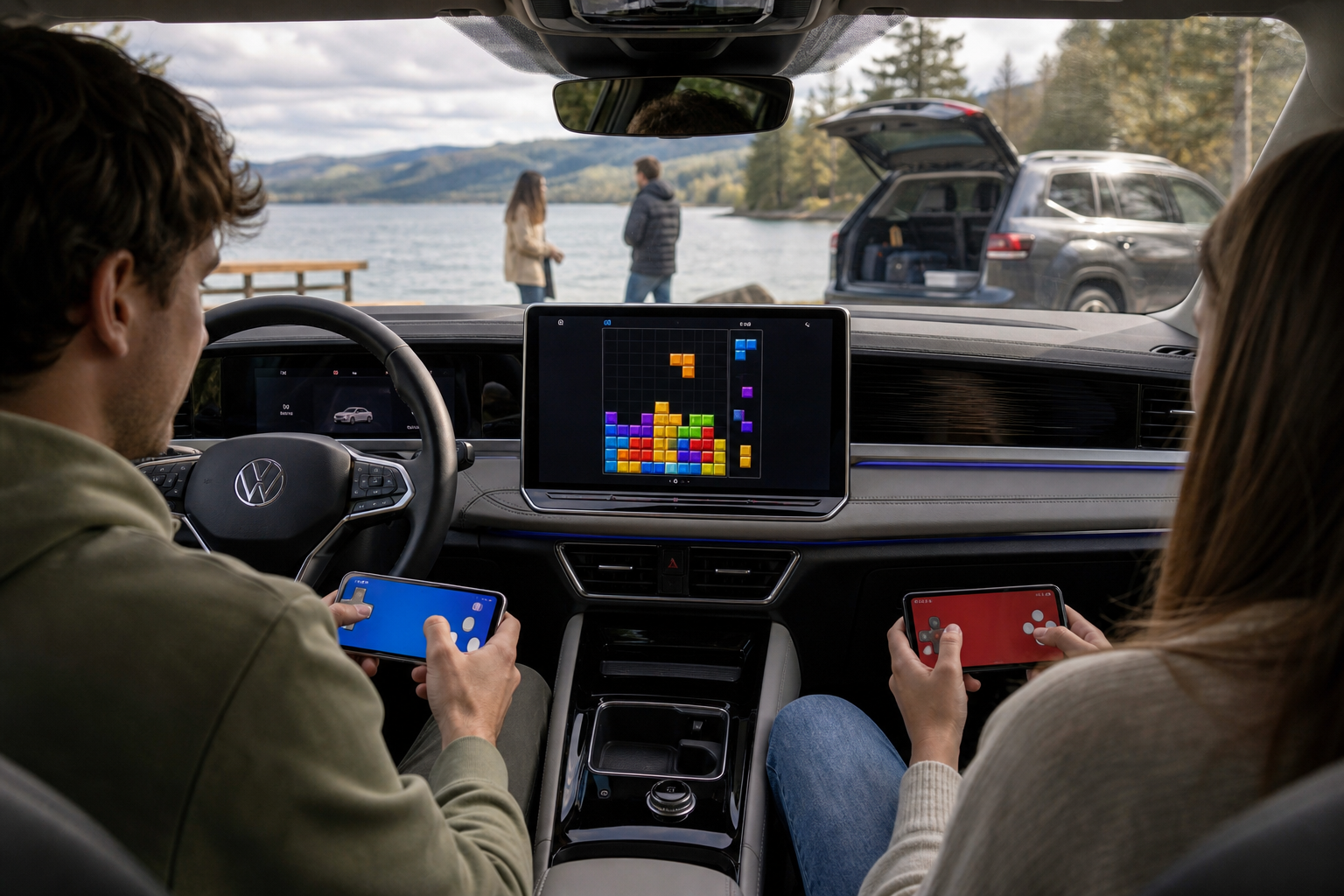

Volkswagen has found a new use for the enormous screens now spreading through its cabins: turning six of its cars into places where you can play Tetris while parked. The catch is familiar to anyone who has recently bought a connected device. The games are not simply there waiting for you. Continued access depends on Volkswagen’s paid In-Vehicle Premium service.
The system comes through AirConsole, a gaming platform designed for in-car entertainment. It brings multiplayer titles to selected Volkswagen vehicles, including Tetris, allowing occupants to play together from the cabin rather than staring at separate phones. The participating Volkswagen models include the Atlas, Tiguan, Golf, and ID.Buzz, with the service covering six vehicles in total across those model lines.
Yes, It Is Tetris in a Volkswagen
There is something wonderfully predictable about this development. Car companies spent years adding ever-larger displays, faster processors, app connectivity, and increasingly elaborate menus to their vehicles. Eventually, someone was bound to look at the central screen and ask the only sensible question: can it play Tetris?
Apparently, yes.
AirConsole turns the vehicle’s infotainment system into a multiplayer game hub when the car is stationary. That last detail is the important one. This is not an invitation to play while driving, nor should it be treated as another feature to fiddle with during a freeway journey. The appeal is aimed at the moments when the vehicle is already parked and the occupants have time to kill—waiting, charging, taking a break, or sitting around while somebody performs the ancient automotive ritual of saying, “I’ll only be five minutes.”
Tetris is an especially obvious choice. Its rules are understood by nearly everyone, a round can be short or unexpectedly lengthy, and multiplayer competition requires very little explanation. It is also less likely to provoke the sort of family argument normally associated with handing one person control of a video game. Though naturally, somebody will still complain about the pieces.
Which Volkswagen Models Get the Games?
The service is being offered across six Volkswagen vehicles drawn from four model families: the Atlas, Tiguan, Golf, and ID.Buzz. That gives the feature a broad spread, from Volkswagen’s three-row SUV to its compact crossover, familiar hatchback, and electric van.
Those vehicles have very different jobs. An Atlas is the sort of machine likely to carry a full collection of people and luggage. A Tiguan sits in the crowded middle of the SUV range. The Golf remains Volkswagen’s compact hatchback staple, while the ID.Buzz is practically designed for scenarios involving several people, a large interior, and someone asking whether there is anything to do yet.
Volkswagen has not presented the service as a performance feature or a reason to buy one model over another. It is cabin entertainment, plain and simple. That may sound trivial, but parked-car entertainment has become more relevant as vehicles spend more time waiting between journeys, particularly when occupants are charging an electric vehicle or traveling with children.
The Subscription Is the Real Story
The game itself is the colorful bit. The more significant detail is the payment structure.
Ongoing access to AirConsole depends on Volkswagen’s paid In-Vehicle Premium service. The supplied information does not specify the subscription price, the length of any trial period, or whether the package includes titles beyond Tetris. Those details matter because the difference between a one-time purchase and a continuing fee is not a small distinction. It determines whether this is a pleasant extra that owners can occasionally enjoy or another digital feature that quietly joins the monthly household budget.
Car buyers have already become accustomed to paying for navigation updates, remote functions, connectivity packages, and driver-assistance features. Games are a slightly different proposition. A subscription for something used during a parked wait may feel perfectly reasonable to one owner and faintly absurd to another. The latter may wonder why a vehicle with a screen, software, and an internet connection cannot simply play one game without requiring an ongoing membership.
That reaction is not entirely unfair. A car is already a remarkably expensive piece of connected hardware. When useful functions are locked behind a service plan, the arrangement can feel irritating. When the locked feature is a game, the emotional response may be even sharper. Nobody has ever been stranded at the side of the road because their Volkswagen ran out of Tetris.
A Sensible Use of a Parked Car’s Screen
Still, the idea itself is more sensible than many of the strange things manufacturers have tried to do with touchscreens. A stationary vehicle is a private, weatherproof space with seating, power, audio, and a large display. That is a decent foundation for entertainment, provided the software is simple and the feature stays disabled while the vehicle is moving.
AirConsole’s multiplayer format also fits the cabin better than a conventional console would. Players can use the space they already have rather than carrying extra hardware, and a short game can fill an awkward pause without requiring a complete entertainment setup. It is not going to replace a living-room console, nor is it supposed to. Expecting it to do so would be like criticizing a cup holder because it cannot accommodate a roast dinner.
The usefulness will depend heavily on execution. The interface needs to be quick to launch, the connection needs to be dependable, and the controls need to be intuitive enough for passengers who have never heard of AirConsole. If starting a game involves navigating six menus, accepting three permissions, and waiting for a software update, the novelty will expire before the first block drops.
Convenience Versus Another Monthly Charge
Volkswagen’s decision reflects the way modern vehicles are being treated as software platforms as much as transportation. The hardware is installed in the cabin, but the experience can be expanded—or restricted—through connected services after the vehicle leaves the dealership.
That approach gives automakers a way to add features without changing the physical car. It also gives owners another thing to check before deciding whether a feature is genuinely included. A buyer considering one of the six supported Volkswagen vehicles will want to ask a straightforward question: is AirConsole part of the car, or is it part of a subscription attached to the car?
For families, the answer may be worthwhile. A game that occupies passengers during a long stop could be more useful than another decorative cabin setting buried in a touchscreen menu. For occasional users, however, a continuing payment may make less sense than simply bringing a tablet. That solution lacks the novelty of playing Tetris on a Volkswagen’s main display, but it also does not require a meeting with the finance department.
Volkswagen’s AirConsole rollout is therefore both amusing and revealing. Yes, you can play Tetris in six Volkswagen cars. The clever part is making a parked vehicle more entertaining. The slightly less charming part is turning that entertainment into a service customers must continue paying to access. The falling blocks are free of drama. The subscription, naturally, is where the real game begins.

0 Comments