
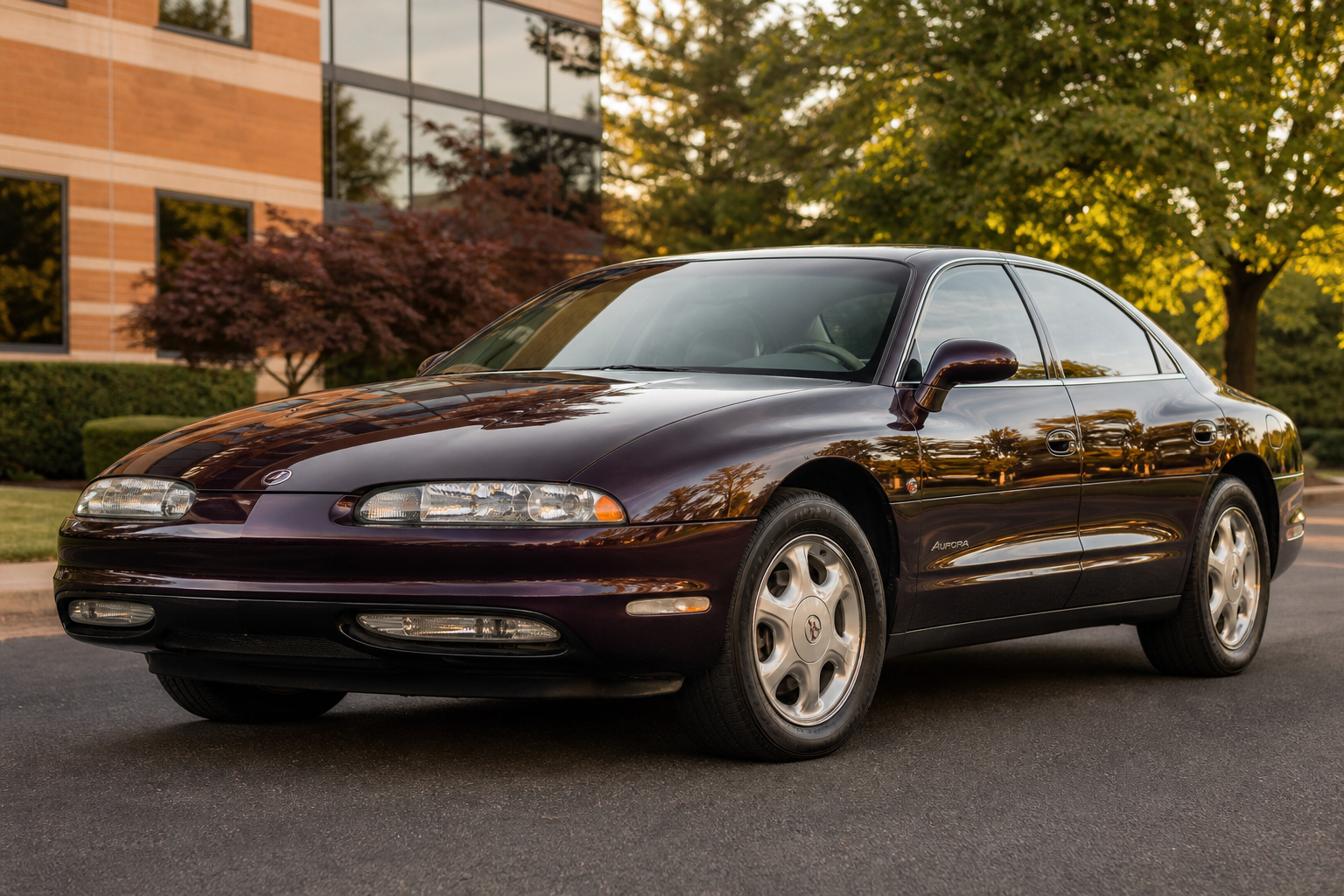

Return with us now to the 1990s, when Oldsmobile still had the nerve to build a large luxury sedan that didn’t look like a shrunken apartment building. A 1995 Oldsmobile Aurora has appeared on Bring a Trailer, offering a neat excuse to revisit one of General Motors’ most ambitious—and most frequently forgotten—cars of the decade.
The Aurora was not merely an Eighty-Eight wearing nicer shoes. Oldsmobile developed it as a serious attempt to move upmarket, giving the brand a distinctive flagship at a time when American manufacturers were trying to answer increasingly polished offerings from Lexus, Acura, Infiniti, BMW, and Mercedes-Benz. It arrived with a sleek, rounded body, a powerful V8, front-wheel drive, and an interior that aimed considerably higher than Oldsmobile’s traditional image suggested.
That makes a surviving 1995 example more interesting than its badge might initially imply. The Aurora was a car from the brief period when GM could spend real money on a new platform, a new engine variant, a new cabin, and a new design language—before every product decision had to pass through the grim arithmetic of platform sharing and quarterly cost cutting.
A Different Kind of Oldsmobile
Oldsmobile had spent much of the 1980s and early 1990s selling competent but rather anonymous family cars. The division’s “Not Your Father’s Oldsmobile” campaign tried to change that perception, but advertising can only do so much when the product lineup still contains a great many cars that look as if they were selected from a fleet manager’s filing cabinet.
The Aurora was the product that gave the slogan some mechanical backing. Its shape was clean and aerodynamic, with a low nose, a pronounced rear deck, flush glass, and carefully integrated bodywork. The design was rounded because this was the 1990s, naturally, but it avoided the melted-jelly look that afflicted several competitors. There was visual restraint to it. The Aurora looked expensive without resorting to a chrome grille large enough to require its own zip code.
It also introduced styling cues that influenced later Oldsmobiles. The split grille, wraparound lamps, and smooth body sides became part of the division’s new identity. Whether that identity arrived too late is another question entirely. Oldsmobile would be gone by 2004, making the Aurora one of the clearest examples of a manufacturer finding a promising direction just before the road disappeared.
Northstar Thinking Without the Full Cadillac Price
The first-generation Aurora used a 4.0-liter V8 derived from Cadillac’s Northstar engine family. It was not simply the 4.6-liter Northstar dropped into an Oldsmobile, though the family resemblance was obvious. The Aurora’s engine had a smaller displacement and was tuned for the model, producing 250 horsepower and 260 pound-feet of torque.
That output went through a four-speed automatic transmission to the front wheels. Today, a front-wheel-drive V8 luxury sedan sounds slightly peculiar, like serving steak at a children’s birthday party, but the layout made sense within GM’s engineering world. It provided a spacious cabin, good traction in poor weather, and the smooth, effortless acceleration buyers expected from a premium American sedan.
The Aurora’s engine also gave it a character that most ordinary Oldsmobiles lacked. The V8 was quiet when treated gently, but it had enough muscle to make highway passing pleasantly brief. This was not a sports sedan in the BMW mold, and nobody should pretend otherwise. The car’s mission was long-distance comfort with a bit of authority, not chasing apexes while wearing a helmet.
Still, the Aurora was more composed than its reputation suggests. Its independent suspension, four-wheel disc brakes, anti-lock braking system, and traction control gave it the hardware to operate in the modern luxury class. The 4T80-E automatic transmission was a substantial unit, developed for high-torque applications and used across several GM luxury models.
The Interior Was Trying Very Hard
Inside, the Aurora attempted something quite clever: it created a driver-focused cabin without copying the Germans too literally. The dashboard curved around the driver, the instruments were clearly arranged, and the center stack was integrated rather than decorated with an assortment of unrelated buttons. In an era when many American interiors were still a festival of gray plastic, the Aurora at least appeared to have met an interior designer.
Equipment included the expected luxury-car features of the period, such as power accessories, automatic climate control, a premium audio system, and a driver information display. Exact equipment varies by car and option package, which is why any specific example deserves closer inspection rather than a quick glance at a period brochure.
The cabin’s age will be part of the appeal and part of the challenge. A 30-year-old luxury car can offer excellent seats, a quiet ride, and more equipment than a basic new sedan. It can also contain a surprising number of aging electronic modules, motors, sensors, and trim pieces that were never designed to remain cheerful for three decades. The Aurora’s comfort may have been built for the long haul. Some of its electrical components were rather less optimistic.
What Makes a 1995 Aurora Worth Looking At?
Cars like this occupy an appealing corner of the collector market. They are not conventionally valuable, which is precisely why they can be interesting. A first-generation Aurora is unlikely to attract the same attention as a contemporary Corvette, Impala SS, or Cadillac Eldorado. It does, however, represent an important moment for Oldsmobile and for GM’s attempt to build a credible domestic alternative to imported luxury sedans.
The timing is also significant. The Aurora arrived when computer-controlled engines, advanced safety systems, aerodynamic styling, and increasingly sophisticated interiors were becoming normal rather than exotic. It sits on the dividing line between the analog American luxury car and the electronically managed vehicles that followed. There are still real buttons, a conventional automatic transmission, and a substantial V8, but the car was already heavily dependent on technology that seemed remarkably advanced in the showroom.
That combination gives it a certain charm. The Aurora is modern enough to feel usable, yet old enough to avoid the sensation that the car is trying to sell your driving habits to a data broker. It will not provide the fuel economy, compact dimensions, or infotainment convenience of a modern sedan. It does provide a large, smooth, unusually styled automobile with a genuine sense of occasion—and without the current fashion for turning every luxury car into a tall, electrically assisted lounge.
What Buyers Should Examine
Any 1995 Aurora should be judged as an old luxury car rather than as a cheap used sedan. A low purchase price does not make maintenance free. The V8 requires careful inspection for oil leaks, cooling-system problems, ignition issues, and evidence of neglected servicing. The transmission should shift cleanly, and the suspension should not produce a soundtrack resembling a toolbox being emptied down a staircase.
Electrical equipment deserves equal attention. Test the climate control, power seats, windows, locks, audio system, gauges, warning lights, and driver information display. Inspect the headliner, door panels, leather, and dashboard for age-related deterioration. Originality is valuable on a car like this, but condition matters more than a glossy claim that it is “all original.” Thirty-year-old neglect remains original, after all.
Rust, accident repairs, cooling-system maintenance, and service records should influence any buying decision far more than nostalgia. The Aurora’s specifications may look attractive on paper, but the best example is the one that has been maintained properly—not necessarily the one with the most dramatic auction photographs.
A Time Capsule With a V8
The 1995 Oldsmobile Aurora was an ambitious car from a manufacturer that had not yet realized how little time it had left. It brought together a distinctive design, a Northstar-related V8, serious highway comfort, and a cabin that made a genuine attempt at premium appeal. It was not perfect, and it was never going to frighten a contemporary BMW M5, but that was not the point.
Its appeal now lies in the mixture of intent and improbability. Oldsmobile built a large, technologically ambitious V8 sedan to prove that the division could still matter. Today, one has appeared on Bring a Trailer as a reminder of what American automakers were willing to attempt before the safe option became the default setting.
That is a rather good reason to take a second look. Not every forgotten car deserves rediscovery. The Aurora does.


0 Comments