
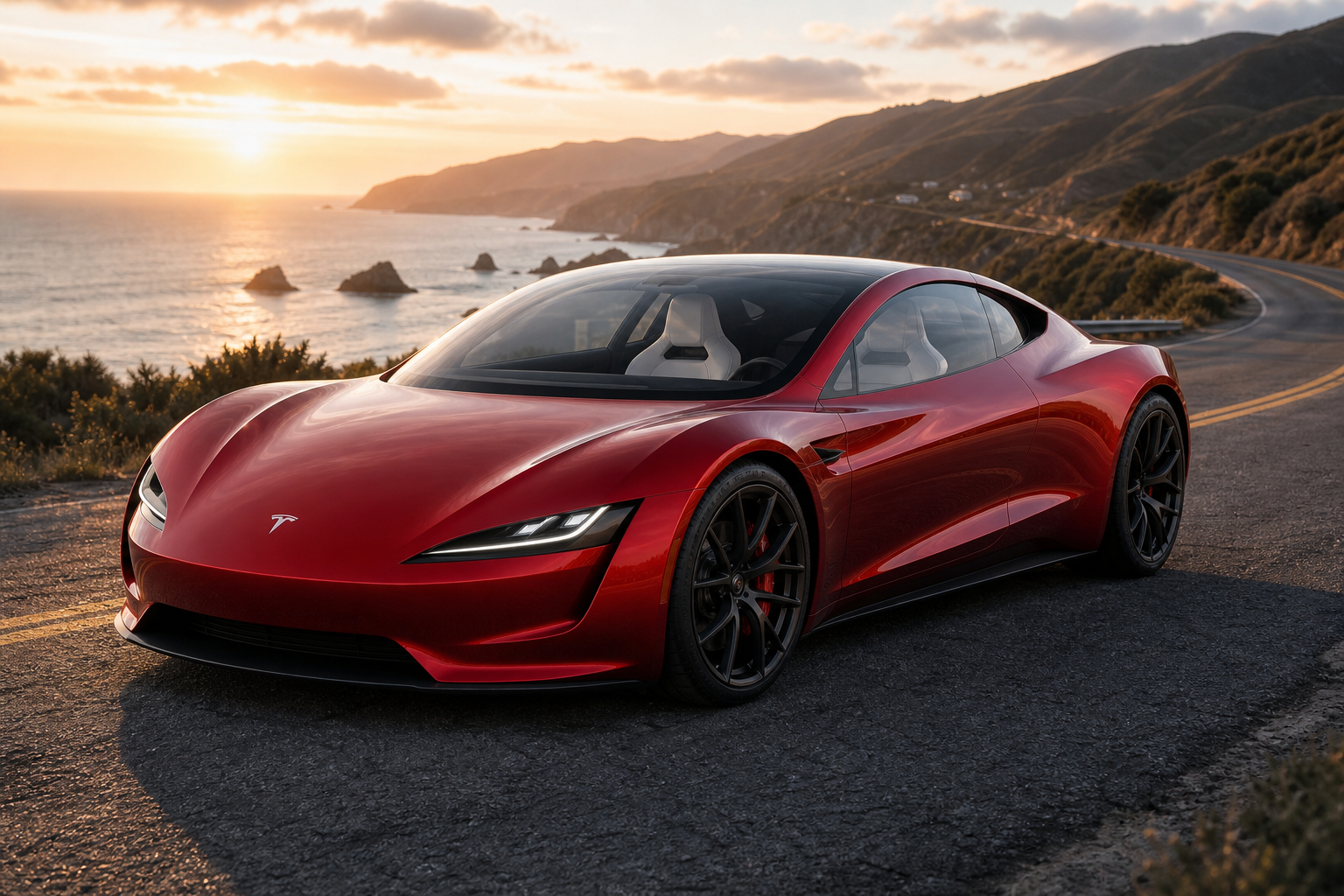

Tesla has reopened reservations for the second-generation Roadster, but the headline figure is not a typo: customers are being asked to put down $50,000 to secure a place in line. After nearly nine years of delays, that deposit does rather more than express interest. It also revives the awkward question Tesla has never fully answered: when, exactly, will the car reach production?
The Roadster was supposed to be Tesla’s great halo car—a battery-powered object of desire aimed squarely at the world of exotic sports cars. Instead, it has become one of the longest-running unfinished projects in the modern performance-car business. The reservation system’s return puts the car back in public view, but it does not yet provide the one detail prospective owners want most: a firm production schedule.
A $50,000 Deposit Changes the Conversation
There is a substantial difference between placing a small reservation fee and handing over $50,000. A modest deposit can be treated as a queue ticket. Fifty grand feels much closer to a serious financial commitment, even if its exact terms and relationship to the final purchase price need to be confirmed with Tesla.
That distinction matters because the Roadster’s history is unusually long for a vehicle that has never entered regular production. Tesla revealed the new Roadster in 2017, presenting it as a machine capable of humiliating conventional supercars while also offering the long-distance flexibility associated with an electric vehicle. The car was initially discussed for production around 2020. That date came and went, followed by more waiting, more revised expectations, and the gradual disappearance of the Roadster from everyday conversation.
Now the reservations are back. The car, however, remains a promised product rather than an available one. Tesla has not paired the reservation news with a confirmed delivery timeline in the information currently available, which makes the deposit more notable than any fresh mechanical detail.
The Numbers That Made the Roadster Famous
The second-generation Roadster made its debut with spectacular claims. Tesla said it would accelerate from 0 to 60 mph in 1.9 seconds, reach a top speed above 250 mph, and travel as far as 620 miles on a charge. Those figures were astonishing when announced and would still be extraordinary today.
Tesla also described a three-motor setup with torque delivered to all four wheels, along with a removable glass roof that could be stored in the trunk. The combination promised supercar acceleration, all-weather traction, open-air motoring, and a range figure that would make many luxury EV sedans look rather parochial.
But these remain the performance targets associated with the announced Roadster, not independently verified production specifications. That distinction is crucial. Electric-car development has moved quickly since 2017, battery technology has evolved, and performance expectations have risen. A production Roadster would need to deliver those numbers consistently, safely, and repeatedly—not merely produce one astonishing launch-control run for a presentation audience.
The engineering challenge is considerable. Extreme acceleration demands huge electrical output, while a 620-mile range target requires a large battery pack or exceptionally efficient vehicle design. Large battery packs add mass, and mass is the enemy of a sports car’s braking, cornering, and responsiveness. Tesla’s original claims therefore describe a difficult set of objectives that pull in opposite directions. Making a car brutally quick is comparatively straightforward. Making it brutally quick, genuinely engaging, durable, and capable of traveling hundreds of miles between charges is the harder trick.
Why the Delay Matters
Delays are hardly unusual in the automobile business, particularly when a vehicle depends on new software, unfamiliar battery packaging, or low-volume manufacturing. The Roadster, though, has spent long enough in limbo for the delay itself to become part of the story.
Tesla has prioritized higher-volume vehicles such as the Model 3, Model Y, and Cybertruck, all of which require enormous manufacturing capacity and supply-chain attention. A low-volume halo car sits in a very different commercial category. It can generate attention and strengthen a brand’s image, but it cannot contribute the same production scale as a crossover or sedan.
That creates a practical dilemma. The Roadster may be important as a technological showcase, yet it is unlikely to be the vehicle that keeps Tesla’s factories busy. Every engineering decision must therefore justify its cost, complexity, and effect on the rest of the company’s product plans. A car with supercar performance and an enormous battery may be exciting, but it is not an especially simple or inexpensive thing to build.
There is also the matter of credibility. Every additional year between announcement and delivery makes the original promise harder to evaluate. A claimed 1.9-second sprint was astonishing in 2017. It is still eye-widening now, but customers will reasonably expect a finished product to match not only the headline acceleration but also its charging capability, thermal management, braking performance, cabin quality, and everyday usability.
What Buyers Should Watch Before Sending Money
The $50,000 figure should not be confused with a confirmed final price. Tesla’s original presentation positioned the Roadster as a high-dollar performance car, but the actual production price, available configurations, destination charges, taxes, and delivery timing remain separate questions.
Potential customers should also look for clear answers on several practical points:
- Whether the deposit is refundable and under what conditions.
- How reservation holders are prioritized if production is limited.
- Whether the announced performance and range figures still apply to the production vehicle.
- When Tesla expects to finalize specifications and begin deliveries.
- What charging hardware and battery warranty provisions will accompany the car.
None of those questions diminishes the Roadster’s appeal. They are simply the details that separate a fascinating prototype from a usable, purchasable automobile. A reservation page can return overnight. Delivering a 200-plus-mph electric sports car is rather more involved.
The Roadster’s Place in Tesla’s Story
The original Tesla Roadster, based on the Lotus Elise, proved that an electric car could be genuinely entertaining rather than merely sensible. It was limited, imperfect, and not especially practical, but it gave Tesla something invaluable: proof that battery power could produce speed and character.
The second Roadster was intended to perform the same trick on a much grander scale. Instead of making electric performance credible, it was supposed to make conventional supercars look technologically old-fashioned. That was an ambitious target even before established manufacturers began producing extremely rapid electric sedans, SUVs, and sports cars of their own.
Reopening reservations suggests Tesla still sees value in that halo-car role. The company wants the Roadster to remain a symbol of what its technology can achieve, even while its most important business is built around larger-volume vehicles. Yet symbolism only carries a project so far. At some point, the car must leave the presentation stage and meet customers who have already committed serious money.
For now, the revived reservation program is a reminder of both Tesla’s ambition and the peculiar patience demanded by its most dramatic promises. The Roadster still has the ingredients of a sensational machine: huge claimed performance, long range, all-wheel drive, and a shape designed to make ordinary traffic feel like background scenery. But until production timing becomes concrete, the $50,000 deposit buys something less tangible than a sports car.
It buys a place in a very expensive queue—and, for the moment, another chapter in the Roadster’s remarkably long waiting game.
0 Comments