
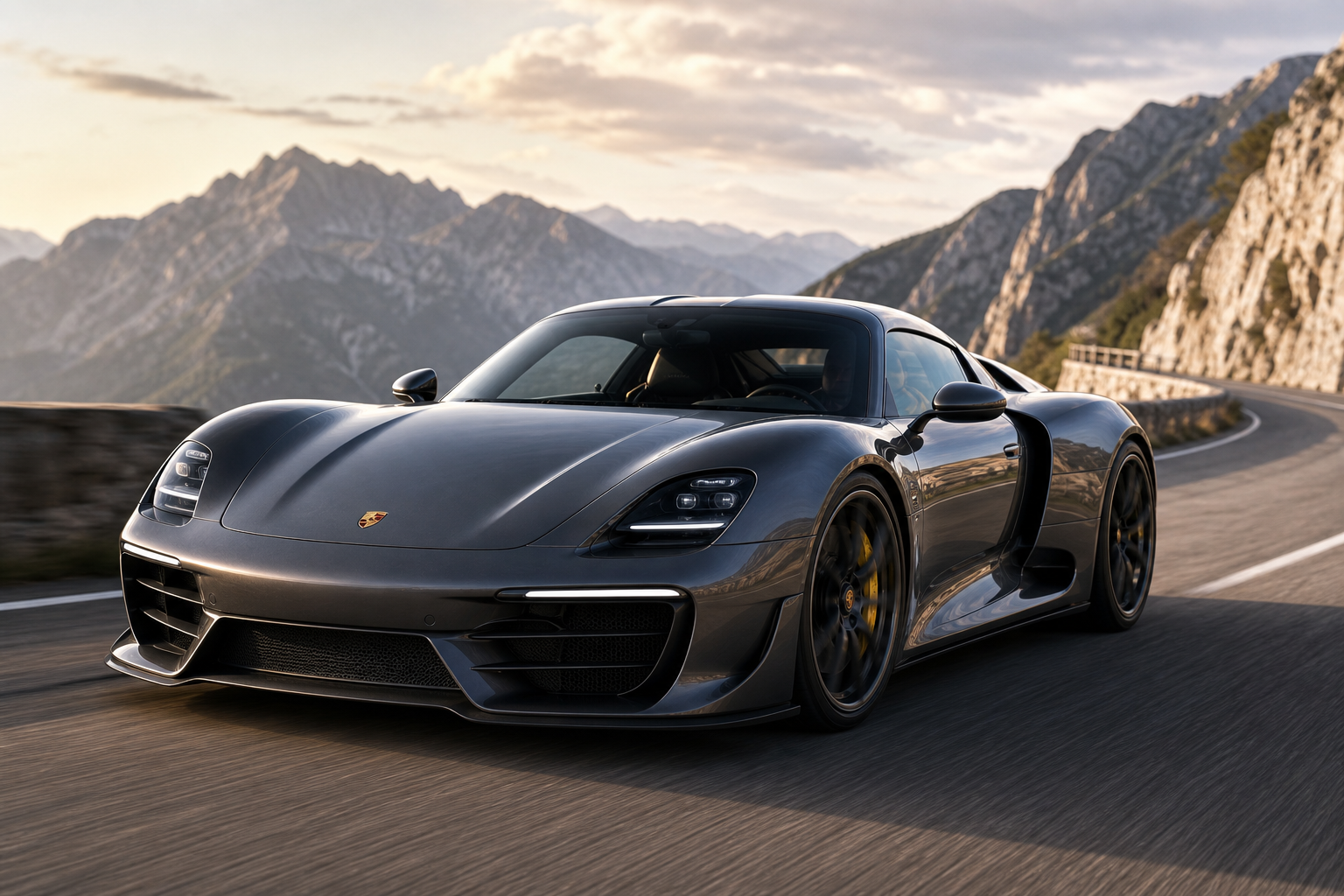

Porsche may be preparing something considerably more exotic than another high-performance 911. According to a new report, the company is considering a supercar known internally as the S1, powered by an eight-cylinder boxer engine and positioned well above the 911 in price.
That is about as much hard information as currently exists, which has not stopped the rumor mill from immediately reaching for its loudest megaphone. There are no confirmed power figures, production numbers, launch timing, or even an official statement from Porsche identifying the project. Still, the idea is intriguing for one very specific reason: a modern Porsche road car with a flat-eight engine would be an extraordinarily unusual machine.
A Flat-Eight Would Give the S1 Instant Mechanical Character
Porsche has built plenty of memorable engines, but the company’s most recognizable road-car layouts have been flat-fours, flat-sixes, and V8s. The 911’s rear-mounted flat-six is the obvious signature, while Porsche’s most ambitious recent supercars have taken rather different routes. The Carrera GT used a naturally aspirated V10, and the 918 Spyder combined a V8 with hybrid drive.
A flat-eight would sit in an interesting middle ground. It could provide more cylinders and greater displacement potential than a flat-six without the width and packaging complications of a larger V engine. The opposing-cylinder layout also keeps the center of gravity low, one of the reasons Porsche has remained so committed to horizontally opposed engines even when the rest of the industry has chased turbocharged V6s, V8s, and electric motors.
There is historical precedent, too. Porsche has used flat-eight engines in racing machinery, including the 1.5-liter engine developed for the 804 Formula 1 car in the early 1960s and the 908 sports-racing prototype that followed later in that decade. Those engines belong to a very different mechanical era, naturally, but they show that the layout is not some random fantasy generated by a bored internet forum.
Putting one into a modern road-going supercar would nevertheless be a substantial undertaking. A flat-eight would need to meet current emissions and noise requirements, deliver the durability expected from a road car, and fit into a chassis designed around cooling, crash protection, and increasingly complex hybrid or electronic systems. The phrase “just add two cylinders” has never survived contact with an engineering department.
The S1 Would Sit Above the 911
The report’s other important detail is the claimed price positioning. The S1 is said to cost well above the 911, placing it outside the normal sports-car range and into the territory occupied by Porsche’s limited-production halo cars.
That distinction matters. Porsche already sells expensive versions of the 911, including variants developed for customers who want extraordinary track performance without abandoning the car’s basic formula. A car positioned above the 911 would need to offer something fundamentally different rather than merely another wing, larger carbon-ceramic brakes, and an interior made entirely from expensive black alcantara.
The likely appeal would come from a combination of exclusivity, engine character, and engineering freedom. A dedicated supercar can use a more specialized carbon-fiber structure, more aggressive aerodynamics, and a seating position that would be entirely impractical in a regular 911. Porsche could also make the S1 deliberately scarce, allowing the model to function as a technological showcase and a high-margin product at the same time.
That is a familiar strategy for the company. Porsche’s halo cars have often served as rolling demonstrations of what its engineers can achieve when ordinary considerations such as rear-seat access and a tolerable luggage compartment are pushed down the priority list. The Carrera GT and 918 Spyder were not intended to replace the 911. They existed above it, both financially and technically.
Why Porsche Might Want Another Halo Car
A new supercar would give Porsche a way to reinforce its identity at a time when the company’s range is broader than ever. The brand now spans sports cars, SUVs, sedans, and electric vehicles. That expansion has been commercially successful, but it also creates the familiar luxury-brand problem: the more products a company sells, the more carefully it has to protect the specialness of its most desirable machines.
An S1 could act as a mechanical counterweight to the quieter, software-heavy direction taken by much of the industry. A flat-eight engine would not be necessary in the rational sense. A turbocharged six-cylinder or electric powertrain could almost certainly deliver more accessible performance with fewer packaging headaches. That is precisely why the idea has appeal. It would be an indulgent engineering exercise, and sometimes a manufacturer needs one of those to remind people why the badge carries emotional weight.
There is also a clear opportunity to separate the car from the 911. Porsche must be careful whenever it creates an even faster or more expensive version of its defining sports car. If the new machine is too similar, buyers may wonder why they should pay the premium. If it is too different, Porsche risks diluting the connection to the brand’s core engineering philosophy.
A flat-eight could help solve that problem. It would give the S1 an unmistakable identity without requiring Porsche to abandon the low-slung, horizontally opposed engine configuration that has shaped much of its history.
What the Report Does Not Tell Us
The missing details are substantial. The report does not establish whether the alleged S1 would use a naturally aspirated engine, turbocharging, hybrid assistance, or some combination of those technologies. It also does not confirm whether the name is a production designation, an internal project label, or simply a convenient description attached to an early rumor.
That uncertainty is particularly important because Porsche has a long history of developing technical concepts that never reach dealerships. A low-volume supercar must justify its cost not only through performance but also through certification, production complexity, and customer demand. Even at the top end of the market, people with enormous checkbooks tend to prefer cars that are fast, desirable, and actually available.
There is no confirmed power output or performance target, either. It would be pointless to invent one. The character of the engine may be more important than the eventual headline number. Porsche already knows how to make a 911 brutally quick. A flat-eight S1 would need to offer a different experience: a distinctive sound, a broader and more dramatic power delivery, and the sense that the engine exists because Porsche’s engineers wanted to build it rather than because a spreadsheet demanded another product line.
A Supercar Built for Theater, Not Necessity
If the report proves accurate, the S1 would be a wonderfully unnecessary car in the best possible sense. The 911 does not need a sibling with two extra cylinders. Porsche does not need another expensive performance flagship to demonstrate that it understands speed. Yet that excess is exactly what could make the project interesting.
The challenge will be keeping the car distinct from both the 911 and Porsche’s previous halo models. A flat-eight engine provides a promising starting point, but the final car would need more than a rare cylinder count. It would need a clear purpose, a convincing design, and an engineering character strong enough to justify its place above the company’s most famous sports car.
For now, the S1 remains a report rather than a confirmed Porsche product. But the notion of a modern Porsche supercar with a flat-eight engine has enough historical grounding and technical intrigue to deserve attention. If the project exists and survives the long march from engineering sketch to production car, it could become one of the company’s most distinctive machines in years—provided Porsche resists the temptation to turn it into merely another very expensive way to arrive at the same destination.
0 Comments