
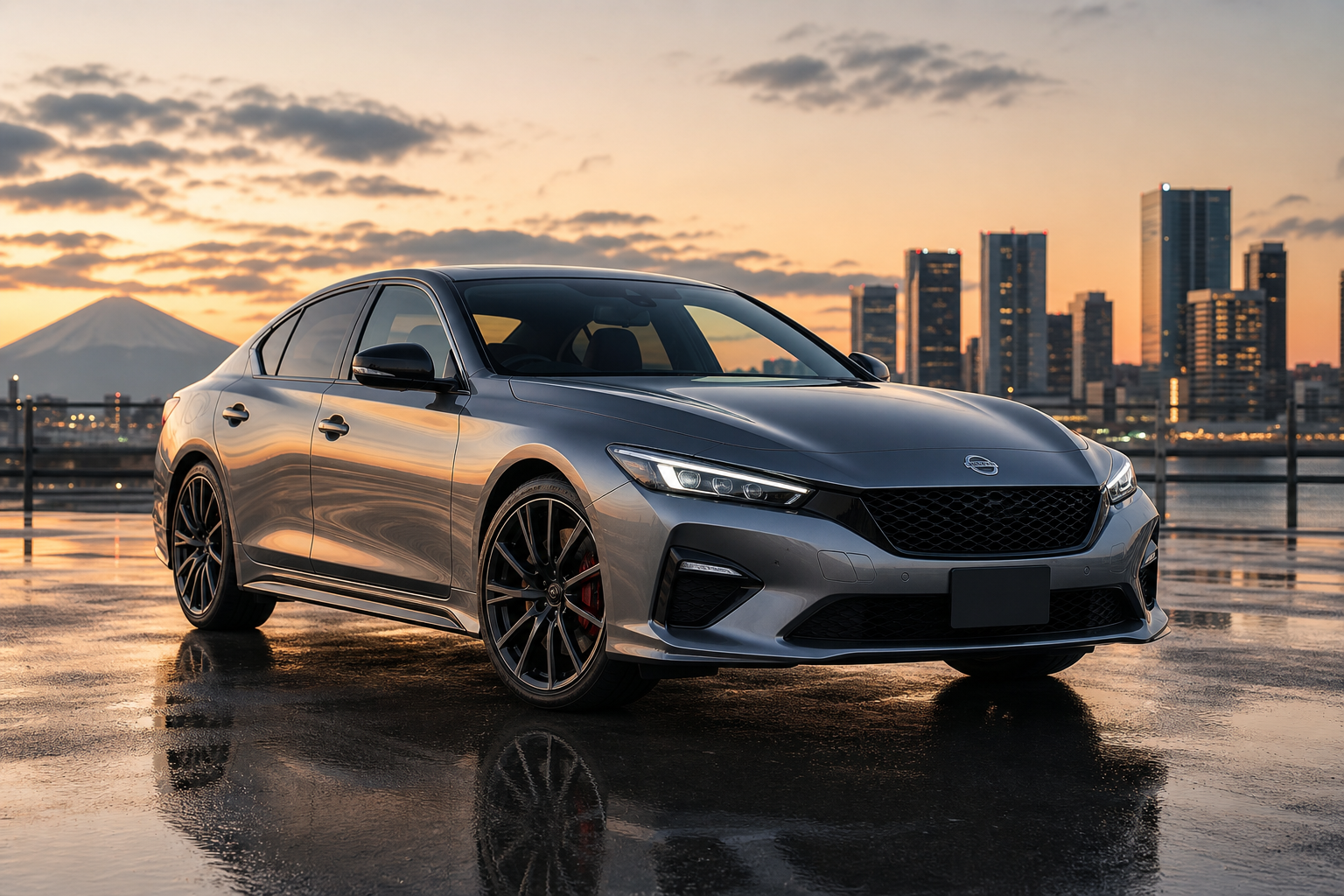

Nissan has put a date on one of its most familiar nameplates. The 14th-generation Skyline is scheduled to make its debut in December 2026, giving the long-running Japanese model a clear future after years of uncertainty surrounding its place in Nissan’s lineup.
That is the entire confirmed headline for now, but it is hardly a trivial one. The Skyline is not some anonymous crossover dragged from a spreadsheet. It is one of Nissan’s most historically important names, tied to performance cars, rear-wheel-drive sedans, motorsport, and the broader story of Japan’s enthusiast-car industry. A new generation therefore carries rather more baggage than the average family vehicle. It also carries rather more expectation, which is usually where things become complicated.
A Long-Running Nameplate Gets a Firm Date
The 14th-generation Skyline is expected to appear in just a few months, with December 2026 now established as the debut timing. Nissan has not yet provided the details that would normally turn a date announcement into a full product story: there is no confirmed powertrain information, no published output figures, no pricing, and no production specification to examine.
That lack of detail is important. It means the December event should be treated as a confirmed debut date rather than evidence of a particular engine, transmission, body style, or performance variant. The Skyline name has been used across several different types of vehicle over its long history, and a new generation could invite plenty of speculation before Nissan reveals what it has actually built.
Car companies are generally happy to let the rumor mill do unpaid marketing work. Nissan will presumably have noticed that the Skyline name can generate attention without needing much assistance.
Why the Skyline Still Matters
The Skyline has occupied an unusual position in Nissan’s history. It has been a practical sedan, a luxury-leaning executive car, and the foundation for some of the company’s most celebrated performance models. The GT-R eventually became its own separate nameplate, but the relationship between the Skyline and Nissan’s performance heritage remains impossible to ignore.
That history gives the new car an awkward task. A modern Skyline must be relevant to Nissan’s current business while still feeling connected to a name recognized by enthusiasts around the world. Simply attaching the badge to a quiet, anonymous sedan would be commercially tidy but emotionally underwhelming. Turning it into a theatrical performance special, meanwhile, would ignore the broader role the Skyline has played as an everyday car.
The previous generation, introduced as the V37 Skyline, also occupied a complicated space. Outside Japan, closely related versions were sold under the Infiniti Q50 name, reflecting Nissan’s attempt to position the car within the premium sedan market. That arrangement helped broaden the model’s reach, but it also made the Skyline less straightforward than its badge might suggest.
The Missing Pieces Are the Interesting Ones
With the debut still ahead, the most important questions remain unanswered. Will the 14th-generation Skyline continue as a sedan, or will Nissan reshape it around a different body style? What kind of powertrain will it use? Will the car remain closely tied to Infiniti, or will Nissan give the Skyline a more distinct identity?
Those questions matter because the traditional sport sedan formula has become increasingly difficult to justify. Buyers have moved toward SUVs, while emissions rules and development costs have made large gasoline-powered sedans harder to sustain. Nissan has also been investing heavily in electrification, making the powertrain direction of the next Skyline especially significant.
That does not automatically mean the new car will be electric. The debut announcement establishes timing, not technology. It would be premature to attach a battery pack, hybrid system, turbocharged engine, or any other mechanical specification to the vehicle until Nissan confirms it. Automotive history is full of confident predictions that aged about as well as a cheap set of tires left in the sun.
A Debut, Not Yet a Full Rebirth
The December 2026 debut will be the first proper opportunity to judge whether Nissan has treated the Skyline as a living model or merely a valuable historical label. Styling will matter, naturally, but so will the car’s proportions, drivetrain layout, interior character, and position within Nissan’s wider range.
A successful Skyline does not necessarily need to imitate the past. Recreating the visual drama of an old performance icon with modern regulations, safety requirements, and production realities would be a rather expensive exercise in nostalgia. The better approach would be to preserve the name’s sense of purpose: a car with enough everyday usability to function as transportation, but with enough engineering intent to make enthusiasts care about the details.
For now, the facts are refreshingly simple. Nissan’s 14th-generation Skyline is coming, and it is scheduled to debut in December 2026. Everything that will determine whether it deserves the badge—its design, technology, performance, and market position—remains behind the curtain.
That leaves Nissan with plenty of time to build anticipation. It also leaves plenty of time for everyone else to guess wildly. The sensible course is to wait for the car itself. The Skyline has survived long enough to deserve at least that much patience.
0 Comments