
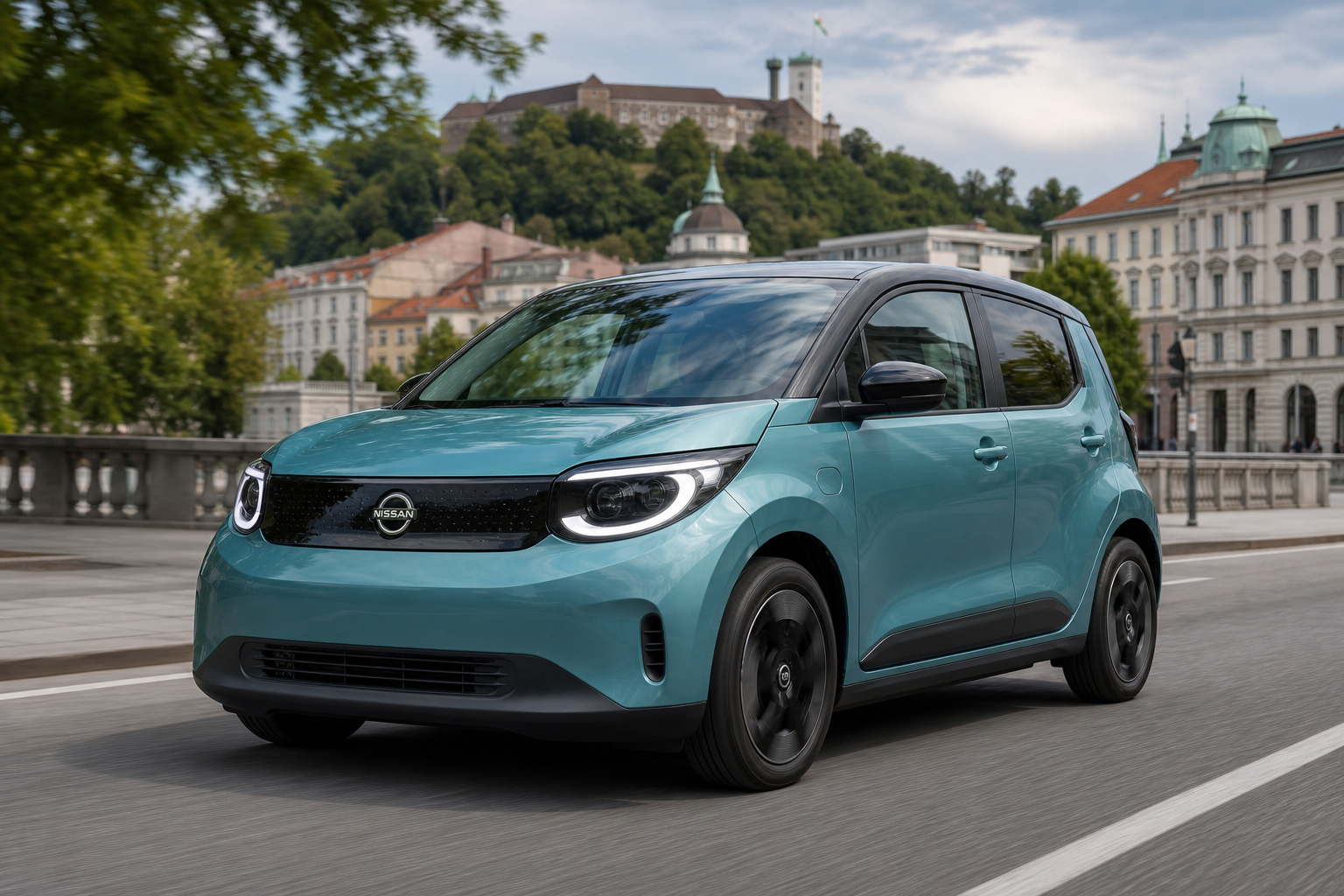

The Nissan Pixo is shaping up to be one of those wonderfully complicated little cars that makes a simple question—“Where is it from?”—surprisingly difficult to answer.
It wears a Japanese badge, shares its underpinnings with the new Renault Twingo and Dacia Spring, and will be built in Slovenia. That gives the electric city car a distinctly European mechanical identity beneath its Nissan branding. The passport situation is already more involved than the average crossover brochure.
A Nissan Badge on a Shared Foundation
The Pixo’s most important detail is not its name or exterior styling, but the architecture beneath it. Nissan says the car shares its underpinnings with the new Renault Twingo and Dacia Spring, placing it within a family of small electric vehicles developed around the realities of urban driving.
That matters because city cars are unusually sensitive to engineering costs. A compact vehicle has less room in which to hide expensive hardware, and an electric model adds a battery, motor, power electronics, charging equipment, and the necessary safety structure. Developing all of that for one badge would be a costly exercise. Sharing the basic architecture across several brands makes considerably more sense.
It also explains why the Pixo should not be viewed as an entirely separate Nissan project in the traditional sense. The badge, design treatment, equipment strategy, and brand positioning may be Nissan’s own, but the underlying engineering is part of a broader Renault-led family. That approach is hardly exotic in the modern car business, although electric city cars make the logic particularly obvious.
Why the Electric City-Car Formula Is So Difficult
Small electric cars sound like an easy proposition until somebody has to price one. A large electric SUV can absorb the cost of a substantial battery because buyers are already spending serious money on the vehicle. A tiny urban runabout cannot rely on that luxury. Its entire appeal depends on being compact, efficient, simple, and relatively attainable.
That is why shared underpinnings are so valuable here. The same basic engineering can support several vehicles while allowing each manufacturer to alter the styling, cabin presentation, software, and equipment. In theory, the customer gets a Nissan that feels like a Nissan, rather than a rebadged Twingo with a different grille stuck on as an afterthought.
Whether the Pixo achieves that distinction will depend on details that have not yet been disclosed, including its final powertrain specifications, battery capacity, charging performance, interior design, dimensions, and pricing. Those omissions are important. Without them, it is impossible to judge the car’s range, acceleration, practicality, or value against other small EVs.
Slovenia Adds Another Layer to the Story
The Pixo will be built in Slovenia, giving the project a manufacturing connection separate from both Nissan’s Japanese identity and the Renault and Dacia engineering relationship. That is not merely an interesting footnote. Where a car is assembled affects production capacity, logistics, supply-chain planning, and the economics of selling it in different markets.
Slovenia has long been part of Europe’s automotive manufacturing network, and local production can make sense for a small car intended primarily for European use. Keeping assembly close to the market reduces some transport demands and allows a manufacturer to use an established plant rather than creating an entirely new operation for a low-volume model.
There is also a strategic advantage in building related models in the same industrial ecosystem. Shared components and common manufacturing processes can lower complexity, although the final result still has to be managed carefully. A factory capable of producing several brands’ vehicles is efficient when the products are genuinely related; it becomes a source of confusion only when the differences between them are mostly cosmetic.
The Renault Twingo and Dacia Spring Connection
The two vehicles mentioned alongside the Pixo occupy slightly different positions. The Twingo name carries a long history of small-car cheekiness and clever urban packaging, while the Dacia Spring has established itself as a deliberately simple and affordable electric vehicle. The Nissan will therefore enter a family with different personalities already attached to the same basic engineering approach.
That gives Nissan room to choose its own angle. It could emphasize design, cabin technology, comfort, safety equipment, or a more polished ownership experience. The mechanical relationship may be shared, but the way the car is presented will determine whether customers see it as a proper Nissan or merely another member of a corporate parts bin.
There is nothing inherently wrong with shared engineering. The automotive industry has relied on it for decades, from engines and transmissions to entire platforms. The trouble begins when manufacturers spend too much time explaining brand individuality and not enough time delivering it. Buyers are generally quite good at noticing when a supposedly distinctive vehicle is wearing a different suit over the same skeleton.
What Has Not Been Confirmed Yet
The available information establishes the Pixo’s identity as an electric city car, its relationship with the Renault Twingo and Dacia Spring, and its Slovenian production location. It does not yet establish the figures that will determine whether the car is genuinely compelling.
- Battery capacity and estimated driving range
- Motor output and performance
- Charging speeds and connector specifications
- Passenger and cargo capacity
- Pricing and market availability
- Trim levels and standard equipment
Those details will matter more than a dramatic launch photograph. A city EV does not need sports-car acceleration or a battery large enough to cross a continent. It does need sensible range, straightforward charging, useful interior space, and a price that does not turn a small runabout into a luxury purchase. The whole point of the category is to make urban electric transportation less burdensome, not to provide another excuse for a five-year finance contract.
A Small Nissan With a Complicated Identity
The Pixo is interesting precisely because it sits at the intersection of several modern automotive realities. Nissan brings the badge and customer base. Renault and Dacia contribute the shared engineering relationship. Slovenia provides the production site. The finished car will have to turn those separate pieces into something coherent.
That is a tougher job than it sounds. A small electric car has nowhere to hide poor packaging, weak value, or needless complexity. If Nissan gets the fundamentals right, the Pixo could become a sensible, properly differentiated city car rather than another exercise in badge engineering. If it does not, the result will be an electrically powered reminder that changing the emblem is the easiest part of building a new car.
0 Comments