
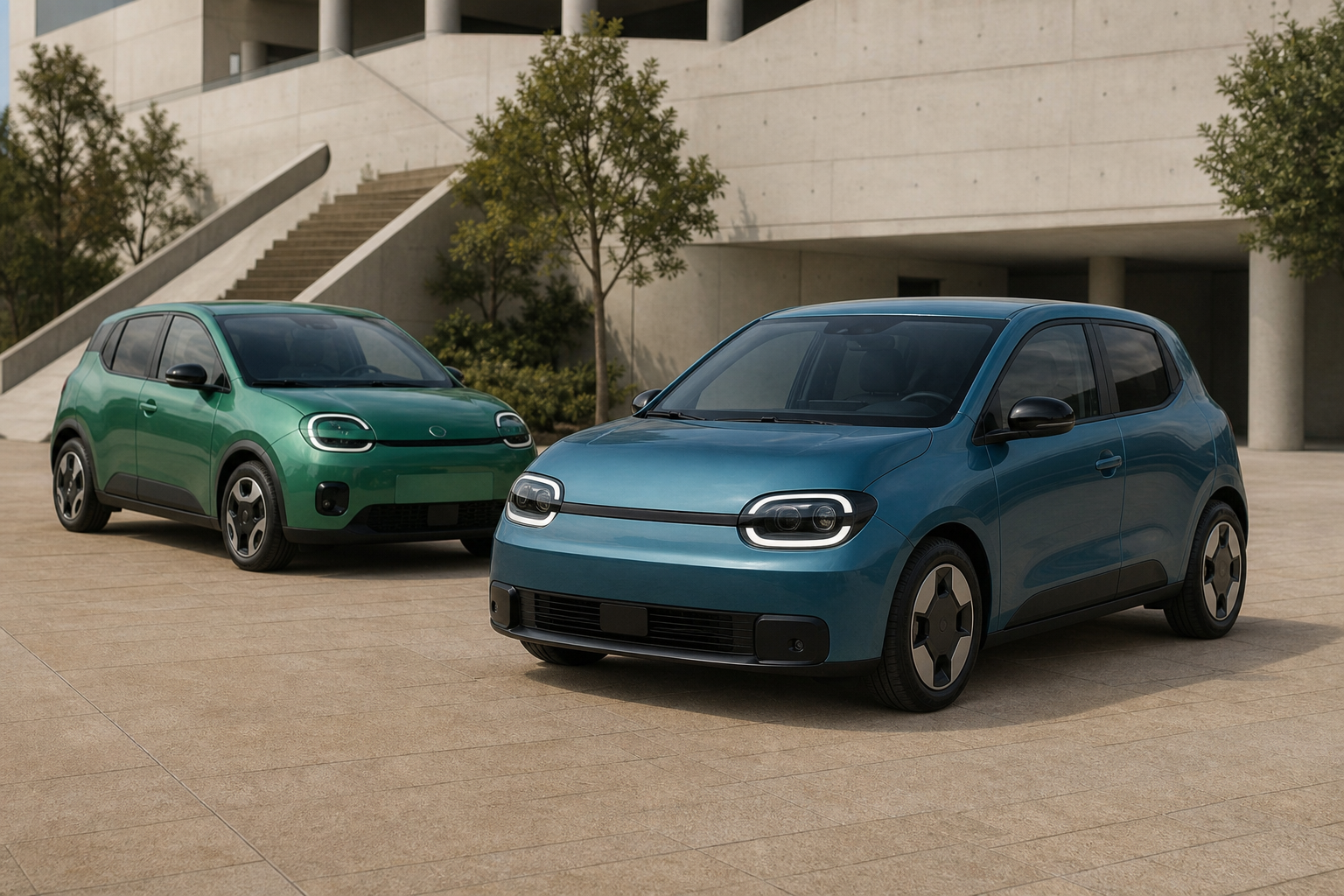

Nissan’s upcoming Pixo and the Renault Twingo E-Tech are closely related electric city cars, sharing their platform, battery, motor, and much of their cabin. A close look at the two models at the Athens Motor Show shows how Nissan has used redesigned body panels and trim to give its version a separate identity.
Different front-end designs
The biggest visual change is at the front. While the Twingo uses a rounded, frog-eyed appearance, the Pixo adopts a more upright nose with squared headlights and pixel-style LED graphics. Nissan also redesigned the bumper, hood, and front fenders to support the new look.
The Pixo’s front end includes a grille-less nose, rectangular cladding around the lower intake, and a simpler hood access cover. The displayed car was finished in Wonder Purple, one of the special colors Nissan has promised for the model.
The two cars retain a shared profile, although their alloy wheel designs differ. Higher-grade Pixo versions are expected to use wheels measuring up to 18 inches. Nissan’s revised bumpers also make the Pixo slightly longer, at 3,796 mm—7 mm more than the Twingo.
More shared details at the rear
Similarities are more apparent from behind. The Twingo’s distinctive rear glass remains recognizable on the Pixo, though Nissan adds its own textured surround and Pixo lettering. The tailgate and rear bumper are also specific to the Nissan.
Squared-off taillights echo the front-end treatment and include smile-shaped details within their clusters. Compared with the Renault, the Pixo’s bumper has simpler lower cladding, a sculpted license-plate recess, and no bumper guards.
Nearly identical cabins
Inside, the relationship between the two models is much closer. Both feature a 7-inch digital instrument display, a 10-inch infotainment screen with Google built-in, and the same physical controls, switches, stalks, and storage areas.
The main differences are decorative. The Twingo uses more colorful door and dashboard accents, while the Pixo places greater emphasis on trim surrounding the climate vents. Otherwise, the cabin layouts are largely shared.
Despite their small exterior dimensions, both cars benefit from a 2,492 mm wheelbase and the packaging of the AmpR Small electric vehicle architecture. Their rear seats slide through 170 mm, recline, and fold, helping provide additional flexibility. Renault lists up to 360 liters of cargo space, while the Nissan offers up to 356 liters. In-cabin storage is rated at 19 liters for the Twingo and 18 liters for the Pixo.
Shared electric powertrain
The Pixo and Twingo use an 81-horsepower front-mounted electric motor paired with a 27.5-kWh lithium-iron-phosphate battery. Both are listed with a 161-mile WLTP range and support 50-kW DC charging.
Nissan has not yet announced pricing for the Pixo. The Renault Twingo E-Tech currently starts at €19,490 in Greece, although local incentives can reduce the effective price to €14,990 when the stated subsidy and scrappage bonus are included.
Both models are built at Renault’s Novo Mesto plant in Slovenia alongside the Dacia Spring EV. They were developed for European and UK markets and will face budget-focused electric rivals including the Leapmotor T03 and BYD Dolphin Surf, as well as the upcoming Volkswagen ID. Up! and Kia EV1. A future Citroen 2CV revival is also expected to target a lower price point.

0 Comments