
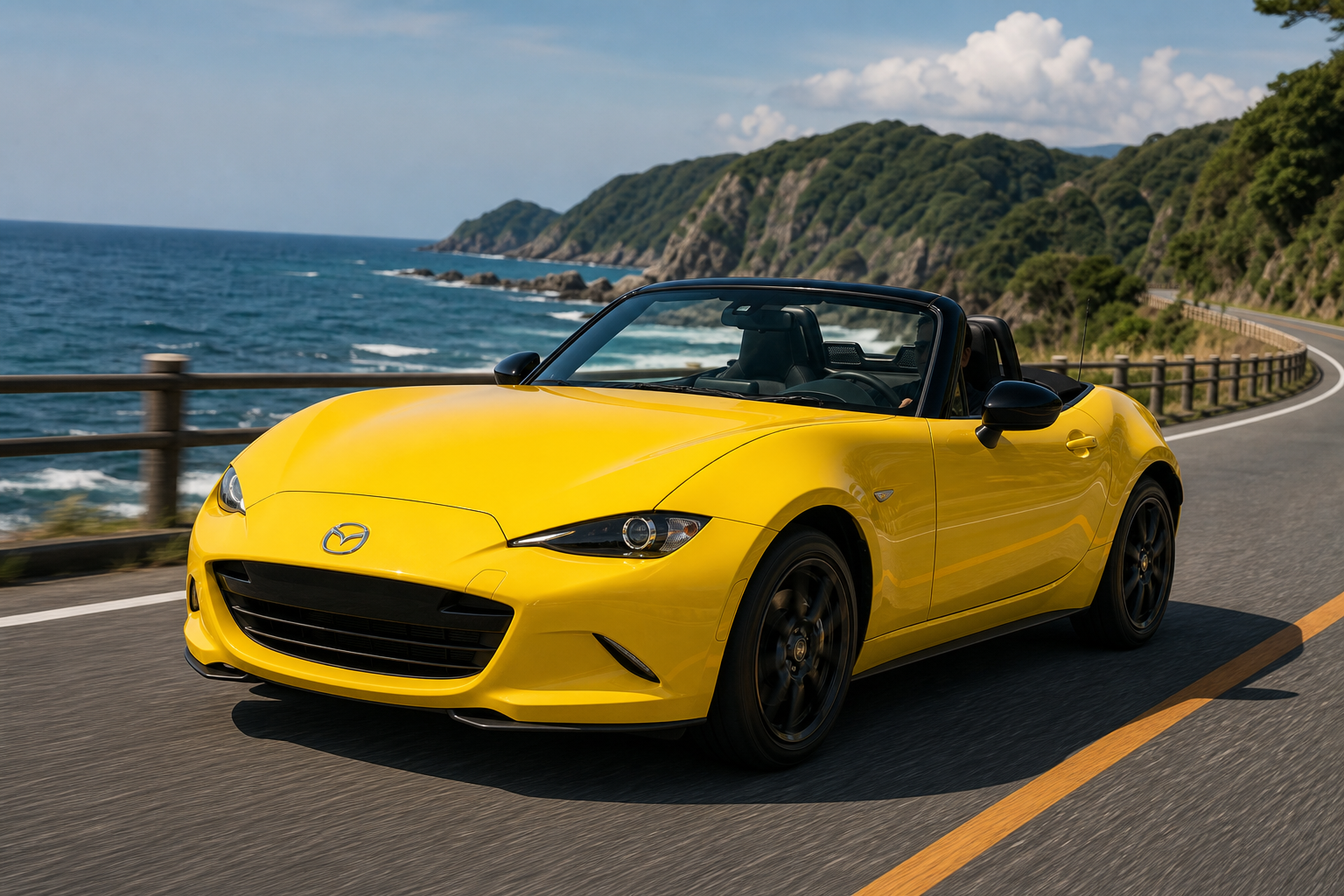

Mazda has finally given Japan’s MX-5 Miata something it has been missing for far too long: a proper splash of yellow. The bright-yellow roadster will be offered in limited quantities, adding a bit of visual mischief to a car whose appeal has always rested on light weight, simple engineering, and the pleasure of driving with the roof folded away.
It is a small change, but a welcome one. Modern sports cars have developed a curious habit of dressing like expensive kitchen appliances, with black, white, gray, and silver doing most of the work. A vivid yellow Miata cuts through that monotony immediately. It looks like a car that intends to be enjoyed rather than merely parked outside a luxury apartment building while its owner discusses cryptocurrency.
A Brighter Miata for Japan
The special roadster is aimed at Japanese Mazda fans and will be available only in limited numbers. The announcement is centered on the exterior color, rather than a new performance variant or major mechanical revision.
That distinction matters. The Miata’s appeal does not depend on extraordinary horsepower or an intimidating specification sheet. Its formula has remained unusually focused: a compact two-seat convertible, rear-wheel drive, a manual-transmission-friendly character, and a chassis intended to make ordinary roads entertaining. A bright color suits that mission rather better than another anonymous shade of graphite.
Mazda has not presented the yellow finish as a new engine, suspension package, or track-focused edition. There is no suggestion here of extra power, revised aerodynamics, or the sort of enormous rear wing that makes a small sports car look as though it has become involved in a disagreement with an airport. This is a color-led special offering, and that is perfectly reasonable.
Why Color Still Matters on a Small Sports Car
Paint is often treated as a minor detail in an era when manufacturers talk endlessly about software, driver-assistance systems, battery architecture, and screens large enough to host a cinema. Yet color can alter the entire personality of a car, particularly one as visually simple as the Miata.
The MX-5 has compact proportions and a relatively clean shape. There is no giant grille, no parade of fake vents, and no slab-sided attempt to suggest that a small roadster is secretly a luxury SUV. A strong color therefore has room to do the talking. Yellow emphasizes the Miata’s short overhangs, low seating position, and open-air character without requiring a body kit or a marketing department armed with a thesaurus.
It also fits the emotional side of convertible ownership. A roadster is already an unapologetically visible car. The driver is exposed to the weather, the occupants are easy to spot, and every trip feels slightly more deliberate than it would in a sealed sedan. Choosing bright yellow rather than quietly disappearing into traffic makes the point rather clearly: yes, this is a toy for grown-ups, and no, the owner is not especially interested in pretending otherwise.
The Miata’s Strength Is Its Restraint
The temptation with special editions is to pile on equipment until the original idea gets buried. Add larger wheels, stiffer springs, louder exhausts, complicated electronic modes, and enough trim badges to make the car look as though it has been promoted several times without changing jobs.
The Miata generally works best when Mazda resists that urge. Its charm comes from proportion and response rather than brute force. The car is small enough to place accurately on a narrow road, light enough to feel lively without absurd speeds, and mechanically familiar enough that the driver remains involved. A new color can celebrate those qualities without interfering with them.
That is particularly important for a convertible. The pleasure of a roadster does not come exclusively from acceleration figures. It comes from the combination of steering, seating position, visibility, engine response, and the simple act of removing the roof. The Miata has always understood that a sports car can be entertaining before it becomes terrifyingly fast. Yellow paint does not change that recipe; it merely makes the dish easier to spot.
Limited Availability Will Add to the Appeal
Because the yellow roadster is being offered in limited quantities, it will naturally attract buyers who want something less common than the standard palette. That rarity may become part of the car’s appeal, although the color itself is the real point. A limited-run Miata does not need to be a collector’s unicorn to be desirable. Sometimes it is enough to have the car everyone recognizes, in a shade most people will not see every day.
There is also a practical advantage to offering distinctive colors in small batches. Mazda can give its sports car a little extra personality without turning the entire model range into a carnival of questionable choices. Yellow will suit some customers brilliantly. Others will look at it, pause, and choose gray because apparently joy requires prior authorization. That is the useful thing about a color option: it lets the buyer reveal a little of themselves without changing the car’s fundamental character.
A Modest Update With Proper Miata Logic
The Japanese-market yellow Miata is not a reinvention, and it does not need to be. The roadster’s appeal has never depended on constant reinvention. In a car industry that often treats every new paint color as an excuse to claim a revolution, Mazda’s offering is refreshingly straightforward.
It is a familiar sports car in a more cheerful suit, available to a limited number of Japanese buyers. That may sound modest because it is modest. But a small, rear-wheel-drive convertible in bright yellow is exactly the sort of modest idea that can make a parking lot, a back road, or a dull Tuesday afternoon considerably less dreary.
The MX-5 Miata has always been at its best when it refuses to take itself too seriously. This one simply makes that attitude visible from a greater distance.
0 Comments