
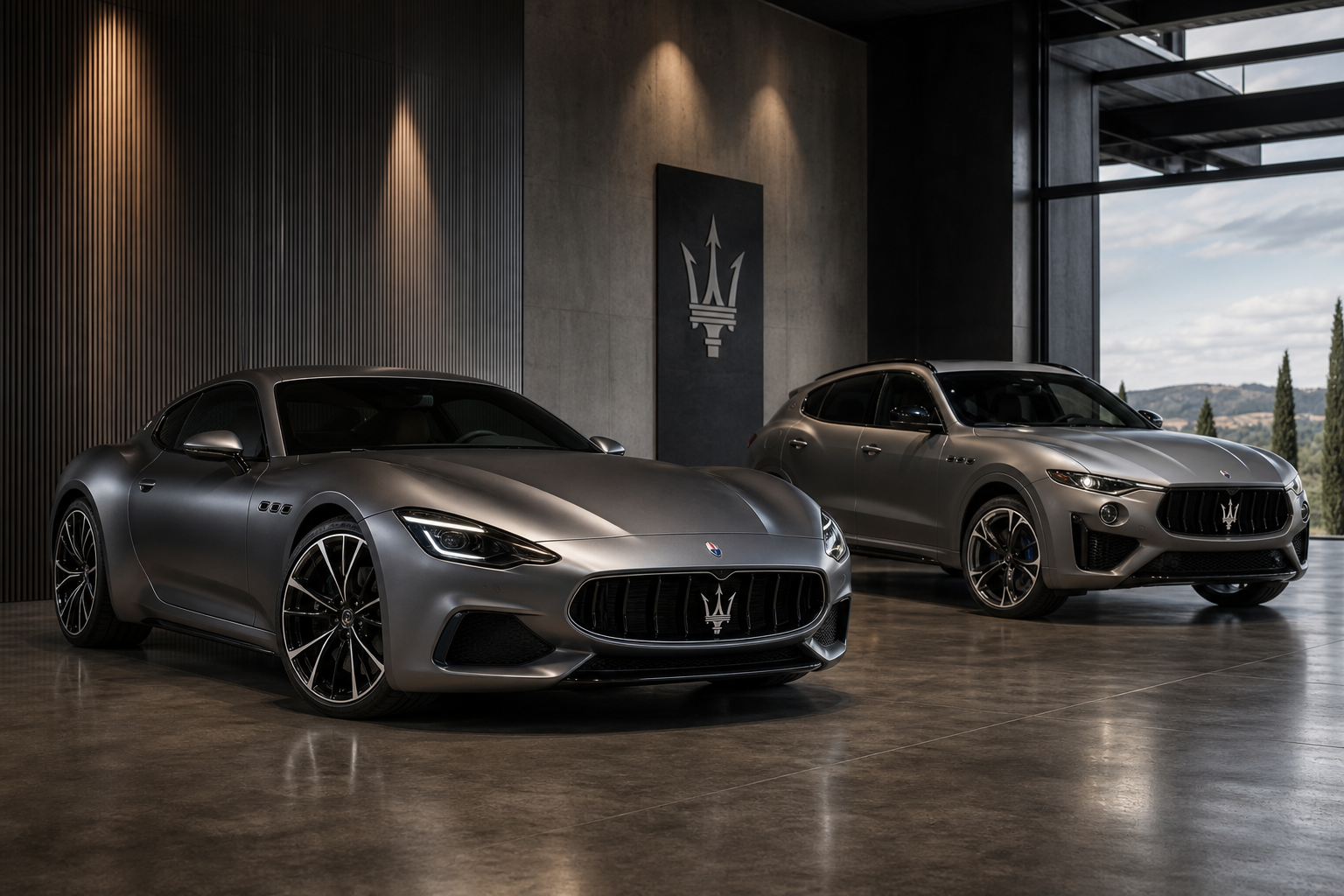

Maserati’s next battery-electric models may not be the usual Modena fairy tale of hand-shaped leather, Latin flair, and a great deal of self-confidence. According to the report at hand, the brand is lining up a rather more global arrangement: Huawei technology, JAC production, and Italian final assembly. That is a long way from the romantic notion of a trident-badged car being assembled by candlelight in Emilia-Romagna, but it could be a very practical way to get new EVs into showrooms without waiting for the universe to politely cooperate.
A Broader Electric Strategy Than Maserati’s Current Lineup
The headline here is not merely that Maserati wants more electric cars. The interesting part is the shape of those cars. The report suggests the company’s next EVs could be a large grand tourer and an SUV, which would make a fair amount of sense given where Maserati sits in the market. A large GT gives the brand room to lean into comfort, style, and long-distance pace. An SUV, meanwhile, is the sort of vehicle every premium brand seems obliged to build these days, because apparently even Italian exotica has to do school runs now.
That pairing would also broaden Maserati’s EV presence beyond its current approach. Instead of treating electrification as a single-model experiment or a neat badge exercise, the brand appears to be shaping a more conventional product ladder: one car for the road-trip crowd, another for buyers who want height, visibility, and the familiar prestige SUV recipe. It is less theatrical than a mid-engined science project, sure, but far more useful for actual sales.
Huawei Tech, JAC Production, Italian Assembly
The most unusual part of the report is the manufacturing and engineering setup. Maserati is said to be pairing Huawei technology with JAC production, while still retaining Italian final assembly. That suggests a split development model, where the core hardware and production backbone come from China, with the final brand-specific finishing done in Italy.
For a heritage manufacturer, this sort of arrangement is not exactly orthodox. It is, however, increasingly the sort of pragmatic compromise that keeps a premium brand from spending the next decade designing a perfect car for a market that has already moved on. The automotive industry has never been shy about international supply chains, but Maserati’s reported approach feels especially telling because it blends Chinese industrial scale and technology with an Italian badge that still trades heavily on design, character, and origin story.
Huawei’s role is particularly notable. The company has become a significant technology player in China’s EV ecosystem, especially in software, connectivity, and related vehicle systems. Maserati tapping into that kind of expertise would signal a willingness to borrow from the strongest available toolbox rather than insist on doing everything the old-fashioned way. Noble idea in theory, but old-fashioned pride does not help much if your rivals are shipping clever electric hardware faster than you are.
Why Maserati Would Go This Route
Maserati has never been a volume giant, and that matters. Smaller prestige brands face a brutal arithmetic problem when switching to electric powertrains. Battery development is expensive. Software is expensive. Compliance is expensive. And if you want to sell cars globally, everything becomes even more expensive, which is the automotive equivalent of a hangover getting a second wind.
Using outside technical and manufacturing resources can shorten development time and lower the cost of getting a new model to market. It can also help a brand fill in gaps more quickly. Maserati already has electric ambitions, but the pace of that transition matters just as much as the ambition itself. A larger GT and SUV would give the company two body styles with broad appeal, both of which fit neatly into the premium EV world where size, comfort, and presence tend to count for a great deal.
There is also a business reality here. Luxury EV buyers are not all searching for the same thing. Some want the long, low, expensive-looking machine that makes the driveway feel more dramatic. Others want the taller, more versatile vehicle that can handle daily life without giving up the badge. Maserati needs both if it wants a serious electric portfolio rather than a polite demonstration project.
Italian Character, Global Hardware
This sort of arrangement inevitably raises the question of identity. If the technology is Chinese, the production is Chinese, and only the final assembly is Italian, what exactly makes the car a Maserati beyond the badge and the styling? That is the sort of question manufacturers hope buyers will not ask too loudly in the showroom.
But the answer, at least in part, lies in execution. A premium brand can still impose its own character through chassis tuning, steering calibration, design language, interior finish, and the way the whole machine is presented to the customer. Those things are not trivial. They are the difference between a car that feels like a rebadged industrial appliance and one that feels like it belongs in a premium showroom, even if some of its genes were clearly borrowed from elsewhere.
Maserati has long lived in that delicate space between romance and reality. The romance says Italian style and emotion; the reality says global business, platform sharing, and the occasional unavoidable spreadsheet. If this report proves accurate, the next phase of Maserati EV development will lean heavily toward the latter while trying very hard to preserve the former. That is a difficult balancing act, but then Maserati has never exactly enjoyed taking the easy route.
What It Could Mean For Buyers
For shoppers, the most important part of this story is not the corporate choreography. It is the likely result: two new Maserati EVs with broader market reach, likely faster development, and a more clearly defined role in the lineup. A large electric GT could appeal to buyers who still want some theater in their grand touring, while the SUV would target the far larger pool of customers who want a premium EV with room, height, and a proper badge on the nose.
Whether that formula produces a genuinely distinctive Maserati or just another expensive electric crossover with an Italian accent is the real question. The answer will depend on how much of the brand’s old charisma survives the parts-bin diplomacy. If Maserati can make a globalized EV platform feel elegant, fast, and a little bit mischievous, there may be something worth watching. If not, well, the premium EV world already has plenty of cars that are competent, polished, and emotionally indistinguishable from a well-organized office filing cabinet.
Either way, Maserati seems determined to keep moving. And in a segment where hesitation can be fatal, that may be the most sensible thing of all.
0 Comments