
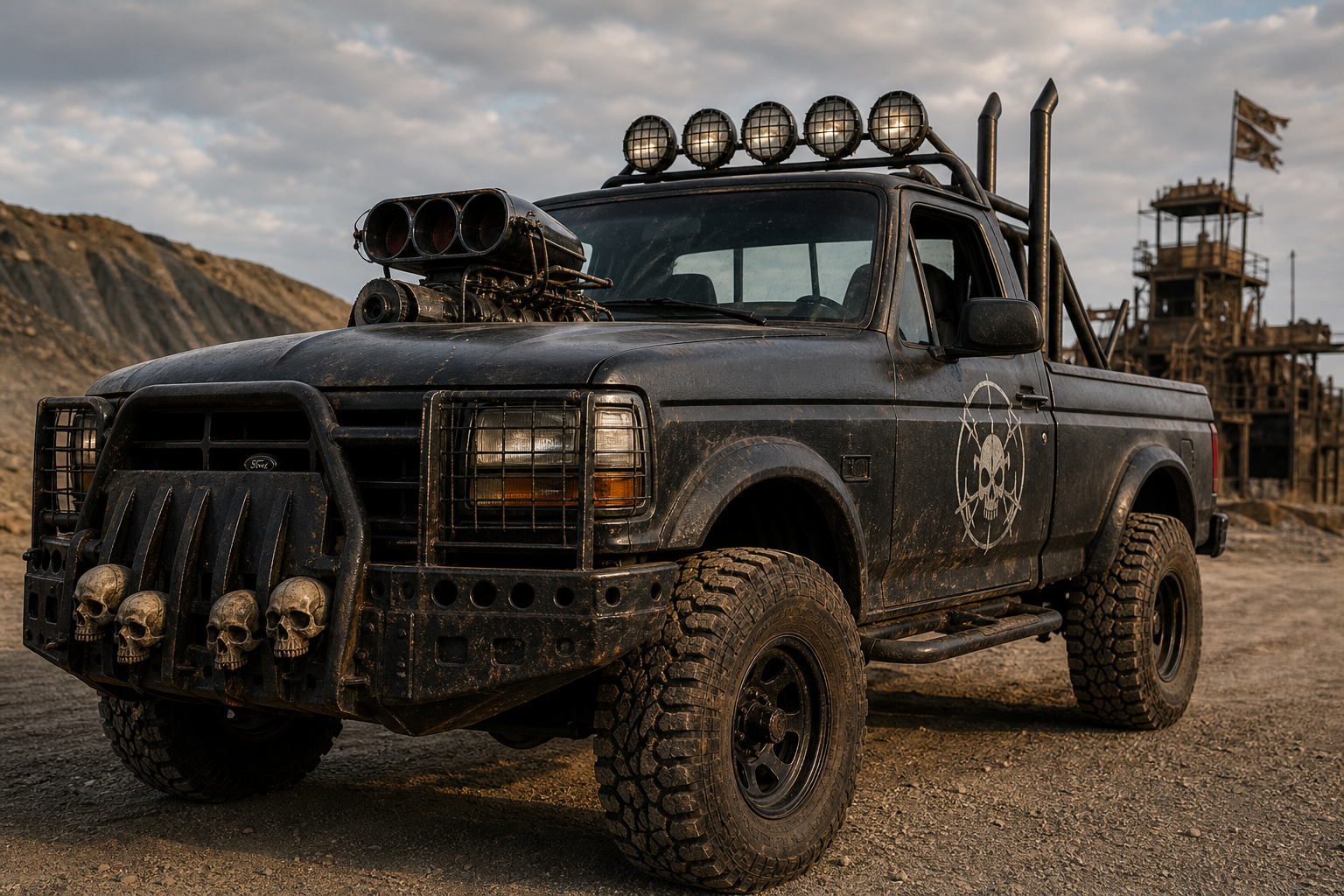

There’s no shortage of movie-inspired cars that mistake adding a few blacked-out parts for genuine menace. This Ford F-150, presented as a homage to the Mad Max “Humungus Machine,” at least starts with the right basic idea: take a familiar pickup and give it the sort of visual attitude normally reserved for vehicles that have escaped from a post-apocalyptic warlord’s garage.
The truck is now being offered through Bring a Trailer, giving one buyer the chance to acquire an F-150 built around one of cinema’s most recognizable automotive villains. The available information is deliberately brief: this is a Mad Max-inspired F-150, rather than an original film vehicle, and the appeal rests primarily on its interpretation of the Humungus Machine rather than on any claim that it appeared on camera.
A Pickup With Proper Wasteland Credentials
The Humungus Machine remains memorable because it looked less like a carefully styled movie prop and more like a working piece of automotive brutality. Its identity came from the combination of a pickup’s practical shape, aggressive modifications, and the general impression that it had spent several years being driven through places where civilized people would prefer not to park.
That makes a Ford F-150 a sensible starting point for a tribute. The F-150 already carries the visual language of a truck built to do a job. It has a separate bed, upright proportions, a broad stance, and enough physical presence to support a suitably theatrical transformation without becoming a fiberglass sculpture wearing a truck’s name badge.
There is also a pleasing bit of automotive logic in using an F-150. The original Mad Max films were built around recognizable production vehicles, modified until they looked as though society had collapsed but the local fabrication shop was still taking appointments. A modern homage based on a real pickup follows that tradition more convincingly than a sports car dressed up with a few movie references.
Homage, Not Hollywood Artifact
The distinction matters. This F-150 is not being presented as one of the actual vehicles used in a Mad Max production. It is a tribute, and the “Humungus Machine” description identifies the design inspiration rather than establishing a film connection.
That should not diminish the truck’s appeal. Replica and homage vehicles live or die by how well they capture the spirit of the original. A perfect historical recreation is not always the goal, particularly when the source material itself occupies a slightly hazy corner of movie-car history. What matters is whether the finished vehicle looks deliberate rather than as though someone visited a hardware store with an unclear plan and too much enthusiasm.
The Bring a Trailer setting is particularly appropriate for this sort of machine. The site has become a natural meeting point for unusual trucks, movie-inspired builds, modified classics, and vehicles that would struggle to explain themselves in a conventional dealership showroom. A standard F-150 has to justify itself with payload ratings and cabin practicality. A Humungus homage has rather different responsibilities. It must look capable of leading a convoy into the desert while remaining, at least theoretically, road legal.
Why the F-150 Works as a Foundation
Ford’s full-size pickup has long been a useful canvas for customization because its basic shape is so familiar. That familiarity gives modifications immediate context. Change the stance, exterior finish, lighting, bodywork, or hardware and the truck’s character can shift dramatically without losing its identity.
That is important with a movie tribute. The best builds retain enough of the donor vehicle to make the transformation interesting. If every original line disappears beneath armor, exaggerated accessories, and theatrical trim, the result becomes a prop rather than a convincing automotive interpretation. The viewer should still recognize the F-150 underneath the apocalypse.
There is an additional advantage: an F-150 does not need to pretend to be a serious off-road racing machine to look credible in this role. Its proportions already suggest durability and utility. The fictional Humungus Machine may belong to a world of improvised warfare and dwindling resources, but the real-world donor comes from one of the most established truck families in the United States. That contrast is part of the fun.
The Buyer’s Questions Are Less Cinematic
Movie-inspired vehicles encourage the eye to do most of the shopping. The silhouette, paint, and overall attitude make the initial impression. Auction bidders still need to apply the less glamorous questions before getting carried away by visions of desert highways and dramatic engine noises.
With a modified F-150, the important details will include the quality of the workmanship, the condition of the underlying truck, and whether the alterations were carried out in a way that remains practical to live with. Buyers should pay close attention to how the modifications affect visibility, lighting, access to the bed, ground clearance, tire fitment, and routine maintenance. A truck can look wonderfully hostile while making an oil change feel like a minor military operation.
Documentation is just as important. The auction listing should be examined for information about the truck’s history, title status, photographs of the build, and any available records for the modifications. Those details are not as visually exciting as the design itself, but they determine whether the new owner receives a usable F-150 or a very large conversation piece with unresolved paperwork.
That distinction is worth keeping in mind because tribute vehicles often attract buyers through emotion first and practicality second. There is nothing wrong with buying a vehicle because it makes you grin. That is one of the better reasons to own a car. But the grin becomes more durable when the truck starts, stops, steers, and passes whatever inspection requirements apply where it will be registered.
A Different Kind of Collectible
The appeal of this F-150 is unlikely to come from rarity in the traditional collector-car sense. It is not valuable because it represents a limited-production Ford performance model or a historically important factory specification. Its attraction is cultural and visual.
That gives the truck a broader audience than a conventional restored pickup. It may interest Mad Max fans, Ford truck enthusiasts, custom-build followers, and buyers who simply want something with more personality than the average modern pickup. Those groups overlap, but they do not always want the same thing. One buyer may care about faithful movie styling; another may care about the quality of the fabrication; a third may be perfectly happy if it causes children to point at the grocery store.
That last quality should not be dismissed. Modern pickups have become astonishingly large, expensive, and digitally elaborate, yet many of them still look remarkably similar in a parking lot. A carefully executed homage cuts through that uniformity. It is gloriously unnecessary, but at least it is honest about being gloriously unnecessary.
What the Auction Really Offers
Bring a Trailer is not offering the chance to own a piece of Mad Max production history. It is offering something more accessible: a Ford F-150 reinterpreted through the visual grammar of one of the most influential automotive films ever made.
That means the right buyer will value the build on its own terms. The truck does not need to be mistaken for the original Humungus Machine to succeed. It only needs to capture enough of that vehicle’s menace, improvisation, and theatrical excess to make the connection instantly understandable.
In a world full of pickups fitted with tasteful wheels and carefully selected accessories, there is something refreshing about one that appears to have been designed for a much less organized future. Whether it becomes a regular driver, a showpiece, or the centerpiece of a particularly entertaining collection, this F-150 has one advantage that no specification sheet can quantify: it refuses to be anonymous.
0 Comments